15世纪明代早期铜鎏金水月观音(纽约佳士得)
尺寸:高26 cm
年代:明代 15世纪
质地:铜鎏金
风格:中原
来源:拍卖会
成交:365,000美元(2014.09)
参阅:外部链接
鉴赏:
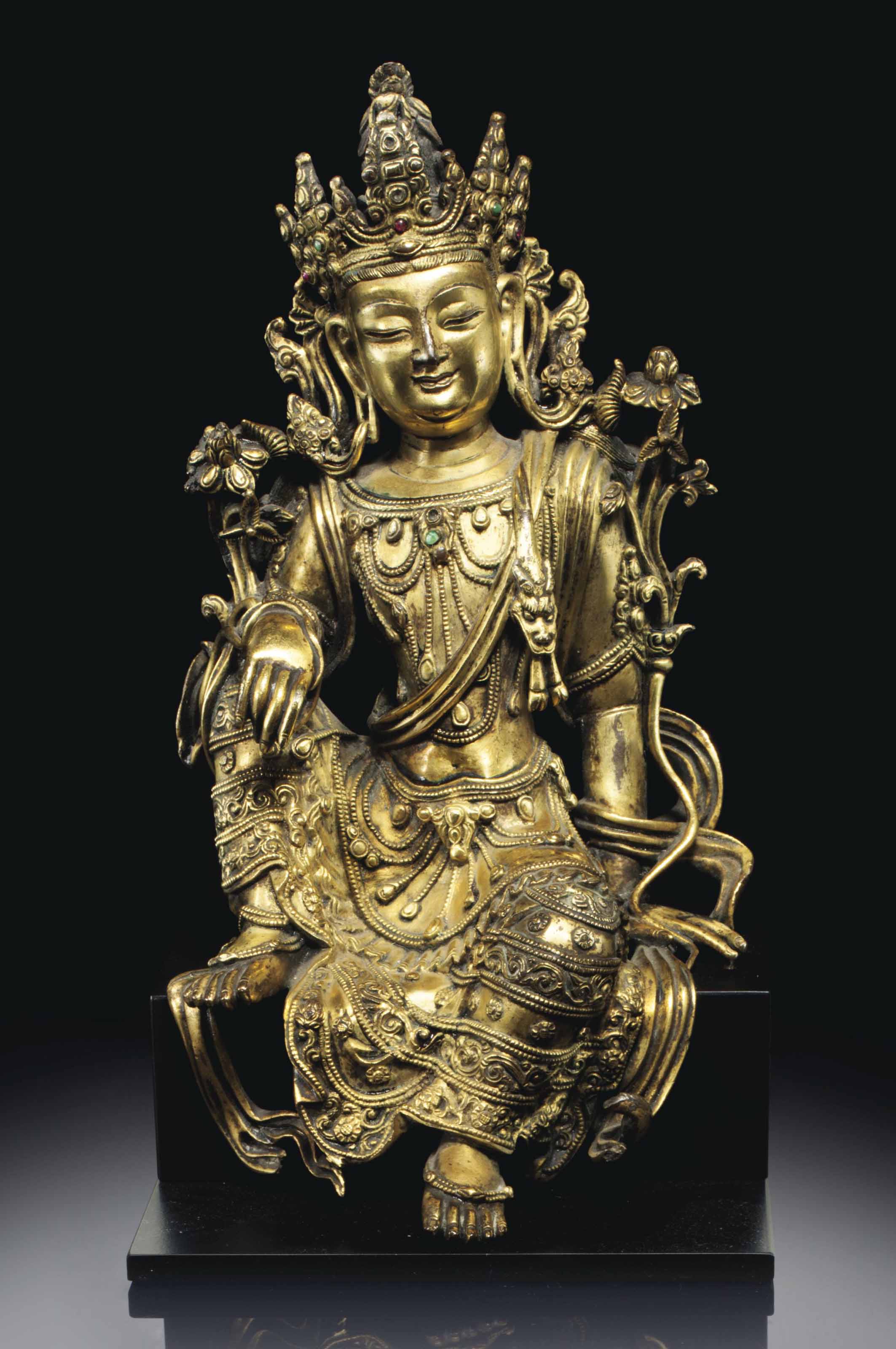 A FINELY CAST GILT-BRONZE FIGURE OF AVALOKITESHVARA
MING DYNASTY, 15TH CENTURY, PROBABLY ZHENGTONG PERIOD (1436-1449)
The bodhisattva Guanyin is shown seated in rajalilasana holding in each hand a slender stem of lotus that rises to the shoulders, and is richly dressed in an elaborately decorated dhoti, a goat pelt wrapped around the torso and the arms, beaded jewelry and a five-point crown inset with 'jewels' behind which is a seated figure of Amitabha Buddha.
精铸铜鎏金观音像
明代,十五世纪,约正统年间(1436-1449年)
此尊观音菩萨呈自在坐姿(rajalilasana),双手各持一纤细莲花茎,花枝沿臂而上开于肩侧。菩萨身着华美庄严之裙(dhoti),腰系珠链璎珞,肩披山羊皮,头戴五叶宝冠,冠中嵌饰“宝石”,冠后安立阿弥陀佛坐像。
来源:
Colonel Robert Coleman Hall Brock (1861-1909) and Alice Gibson (1861-1925), Philadelphia, Pennsylvania.
Henry Gibson Brock (1886-1940) and Margaret Cust Burgwin (1926-1961) Collection, Muncy, Pennsylvania, and thence by descent within the family.
元明时期,佛教造像中最受欢迎的,或许当属观音菩萨。此菩萨的常见化现之一即所谓的“水月观音”或“南海观音”,此形象呈“自在坐”于模仿岩石海岸的台座之上。
其他元末明初时期的铜鎏金观音像上亦可找到类似的繁复珠链璎珞装饰,例如现藏于大英博物馆的 Oppenheim 旧藏一尊(见W. Zwalf编《Buddhism: Art and Faith》,伦敦,1985年,编号298);旧金山亚洲艺术博物馆一尊(见《海外遗珍:中国艺术在海外收藏——佛教雕塑》,台北故宫博物院,1990年,第178页,编号164);以及牛津东方艺术博物馆一尊(见《T.O.C.S.》,1959-1960年,第32卷,图版102,编号236)。此三尊均呈自在坐姿,与本件作品共享诸多共同特征,如放射状珠链、纤细腰身及飘逸衣纹等。
Perhaps the most popular figure of the Buddhist pantheon during the Yuan-Ming period was the bodhisattva Guanyin (Avalokiteshvara). One of the common depictions of this bodhisattva is the so-called 'Water-Moon Guanyin,' or 'Avalokiteshvara of the Southern Seas,' which shows the figure seated in rajalilasana, or 'Royal Ease', on a base mimicking a rocky shore.
Similar depictions of elaborate festoons of jeweled chains can be found on other gilt-bronze images of Guanyin dated to the late Yuan-early Ming period, such as the figure from the Oppenheim Collection, now in the British Museum, illustrated by W. Zwalf (ed.) in Buddhism: Art and Faith, London, 1985, no. 298; a figure in The Asian Art Museum of San Francisco, illustrated in Hai-wa yi-zhen: Chinese Art in Overseas Collections - Buddhist Sculpture, National Palace Museum, Taipei, 1990, p. 178, no. 164; and a third figure in the Museum of Eastern Art, Oxford, illustrated in T.O.C.S., 1959-1960, vol. 32, pl. 102, no. 236. All three of these figures are shown seated in rajalilasana and share many common characteristics with the present figure, such as the radiating beaded chains, narrow waist and flowing style of drapery.