2-3世纪贵霜时期犍陀罗石雕释迦牟尼佛说法坐像(伦敦大英博物馆)
尺寸:高40.6 cm
年代:2-3世纪 贵霜时期
质地:片岩(schist)
风格:犍陀罗
来源:伦敦大英博物馆
参阅:外部链接
鉴赏:
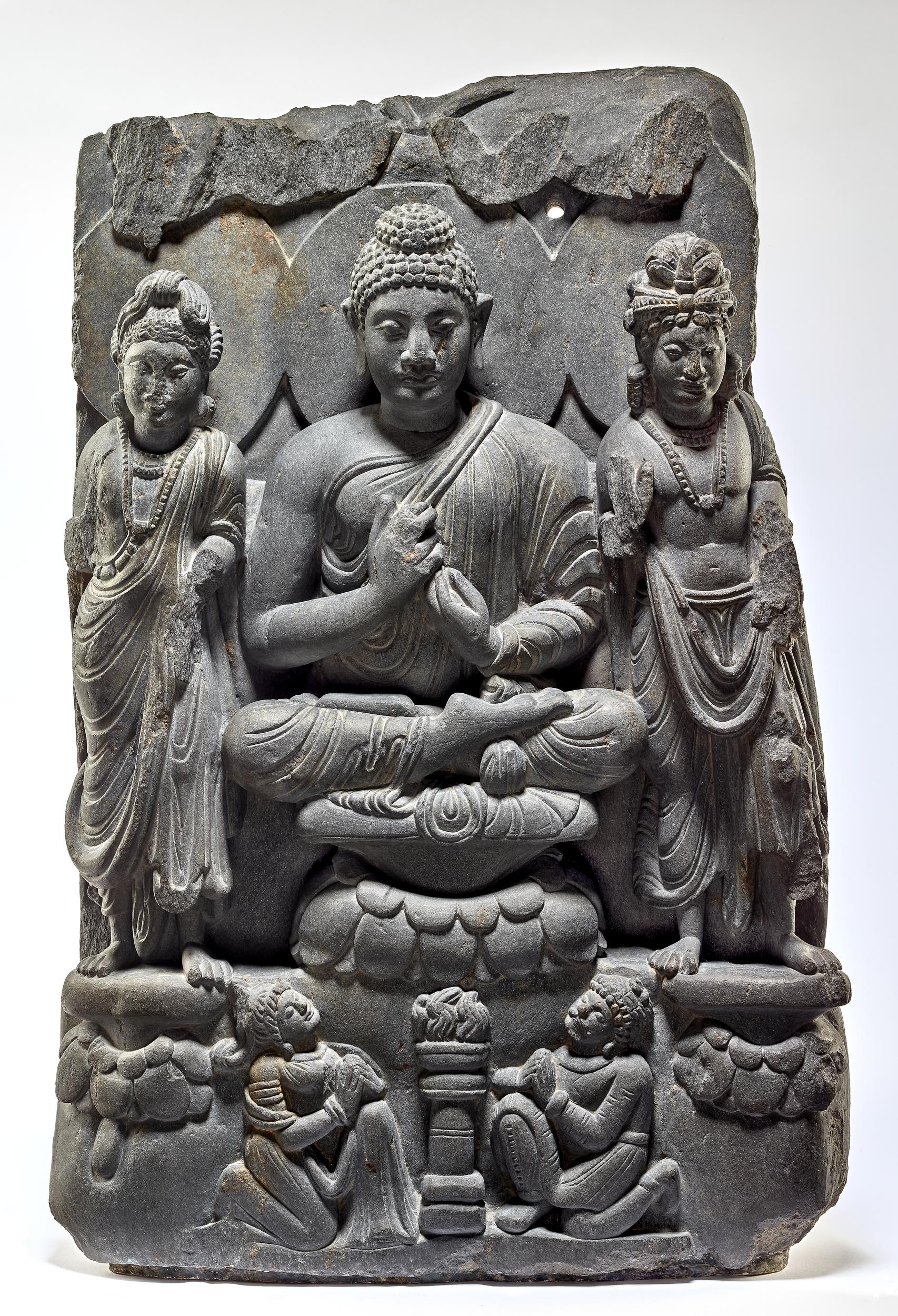
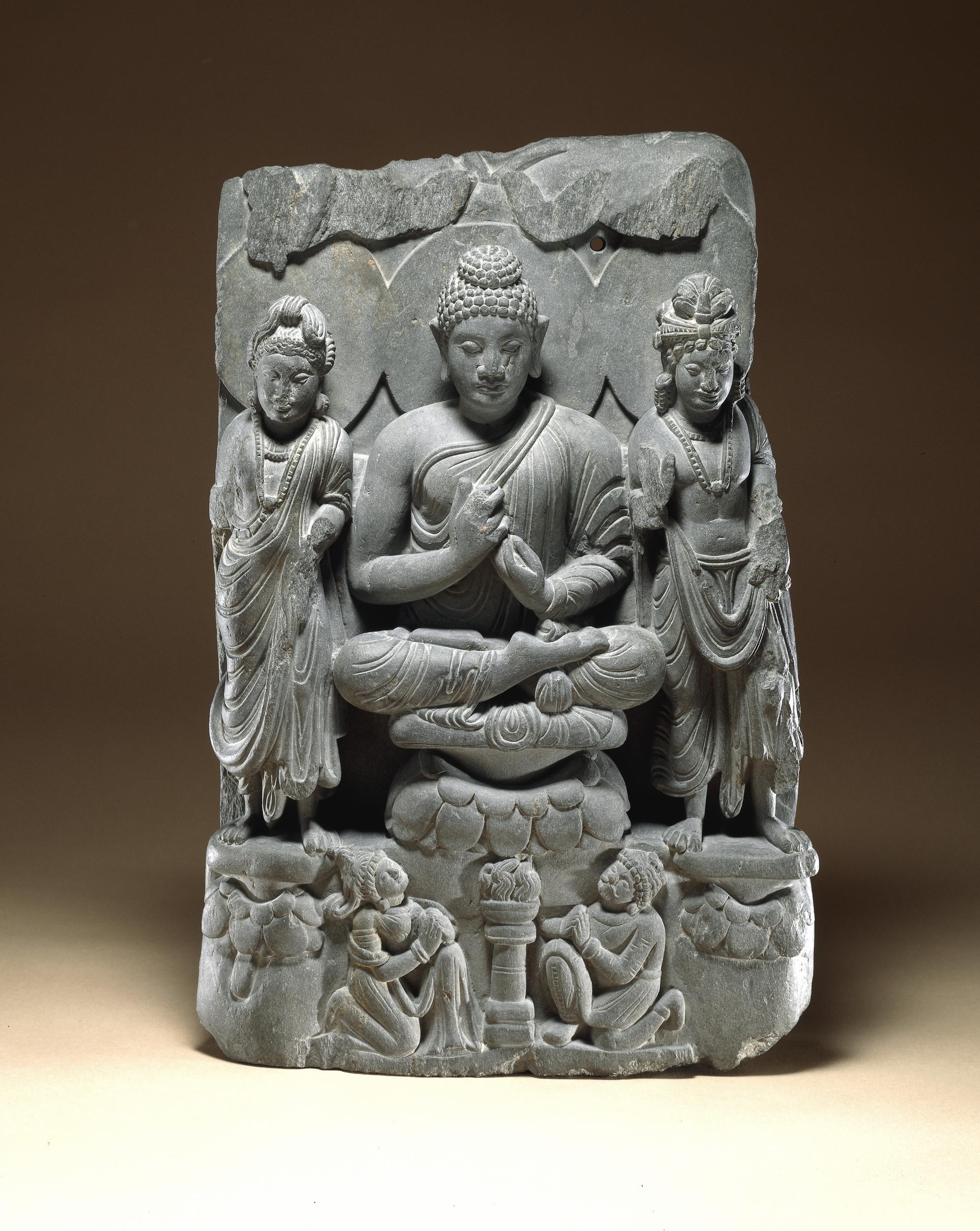 The Buddha preaching flanked by two bodhisattvas
Panel showing the Buddha preaching between two standing Bodhisattvas.
The haloed and seated Buddha wears the over-robe leaving his right shoulder and feet bare and an undergarment visible below his right shoulder; it lies on the seat beside a fall of gathered drapery from his left wrist which spreads out. The drapery folds are defined mainly by paired grooves separating broad flat strips. The head is a long and regular oval; the hair, representing the Indian snail-shell curl tradition, consists of a series of beaded rows running from side to side and concentric on the uṣṇīṣa. The eyes are rounded and open with prominent lids under gently rounded brows, and there is no ūrṇā. The nose is broad, the mouth shaped, the chin prominent and the concave ears stand out symmetrically. The hands have long fluid fingers, the left index and middle fingers touching the bottom of the right hand in the preaching gesture. The Buddha's seat is the top of an obconical gynoecium tapering into a lotus with two downturned rows of plain petals, the lower row showing another beneath.
The Bodhisattva on the Buddha's left wears a patterned collar and a necklace with a plain strand and one of beads, and the uttarīya loops in the narrow mode. His left hand holds a damaged garland and his right may have been in 'abhayamudra'. The turban has a large crest and tapering central ornament, and retaining bands radiate from below it. The face is oval and long with long, narrow, low-lidded eyes and a long, straight, rather prominent mouth. The earrings have pendent beads. The other Bodhisattva, presumably Maitreya, wears a similar collar and necklace, a cord with a crescentic amulet and three or four boxes, one cylindrical, paridhāna and uttarīya with paired grooves for folds and worn in the wide mode; a water pot was probably held in his lost left hand. Most of his right forearm is lost; the hand may have been in 'abhayamudra' or turned palm inwards. He wears a diadem, earrings with beaded hoop and a horizontal length of hair, knotted over a chignon and looped on one side. His face, similar to that of the other Bodhisattva, is more gently rounded. Both Bodhisattvas lack the ūrṇā, are haloed and stand on feet with long toes on a lotus pedestal like the Buddha's; one lotus also has a short stalk. The three haloes overlap.
Below the Buddha an incense-burner or lamp (showing flames rather than smoke) on a columnar stand is flanked by a worshipper with knee-length tunic, ornamented trousers, moustache, two horizontal rows of curls over the forehead, vertical bands of curls above and a chignon, kneeling with hands joined while a woman with a prominent band of hair in front and a loop of hair behind kneels opposite; she wears armlets, bracelets, earrings, collar, a tunic, a cloak gathered over her right leg and a scarf. Both have small, protruding, rounded eyes.
Above the haloes may be the remains of flying figures bearing a crown or garland.
佛说法图,两侧胁侍菩萨
画面表现佛陀坐在中间说法,两侧各立一尊菩萨。
佛陀有头光,结跏趺坐,身穿袈裟,右肩及双足裸露,右肩下可见内衣;衣袍搭在座上,左腕处垂下成簇的衣褶,向外铺展。衣纹主要由成对的凹槽划分出宽阔平坦的衣带。头部呈长而规整的椭圆形;头发表现的是印度式的螺发,由一排排珠状纹样左右相连而成,肉髻上则为同心圆纹。眼睛圆睁,眼睑突出,眉弓圆缓,无白毫。鼻宽,口有形状,下巴突出,双耳凹陷且对称。手指修长流畅,左手食指、中指触右手掌心,呈说法印。佛座为倒圆锥形的莲台,向下收束成莲花,有两排向下翻卷的素花瓣,下排花瓣下方另有一排花瓣。
佛左侧的菩萨佩戴花纹项圈和项链(其中一串为素珠,一串为珠串),上衣采用窄式搭法。左手持残损的花环,右手可能结施无畏印。头巾有大冠饰及向上收窄的中心饰物,下方有辐射状的束带。脸呈长椭圆形,眼睛长而窄,眼睑低垂,口唇长而直,较为突出。耳环垂有珠饰。另一侧菩萨(推测为弥勒)佩戴相似的项圈和项链,身上系有带新月形护符和三四只盒子(其中一盒为筒形)的绳带,下裙和上衣衣纹以成对凹槽表现,采用宽式搭法;左手遗失,原本可能持水瓶。右前臂大部分缺失,手可能结施无畏印或掌心向内。头戴宝冠,耳环有珠饰环,一绺头发横过,在发髻上打结,一侧有环。脸形与另一菩萨相似,但更为圆润。两菩萨均无白毫,有头光,赤足立于莲台上,脚趾修长,莲台与佛座相似;其中一朵莲花还有短茎。三者的头光相互重叠。
佛下方有一柱状台的香炉或灯(呈现火焰而非烟雾),两侧各有一位礼拜者。一侧为男性,身穿及膝短袍、饰纹裤,蓄须,额上有两排横卷发,上方有竖向卷发和发髻,跪姿合掌。对面为女性,额前有显著的刘海,脑后有一环发髻,跪姿相对;她佩戴臂钏、手镯、耳环、项圈、短袍、覆右腿的披风和一条围巾。两人均有小而凸出的圆眼。
头光上方残存有持宝冠或花环的飞天形象。
Zwalf 1996:
相对简单的三尊像(triad)——中央为佛陀说法坐像,两侧为较正面站立的菩萨——与更复杂、人物密集、有时建筑装饰极为华丽的说法图归为一类。后者中同样的菩萨(或立或坐)胁侍说法佛,但其形象不那么突出。持水瓶的菩萨普遍被认为是弥勒,但对面戴头巾的形象仍有争议。两尊菩萨可任一位立于佛的右侧,其图像学细节也有变化:两者都可能右手结施无畏印(abhayamudra),但弥勒也可能掌心向内,或手持莲花;而戴头巾者则可能在左手持莲花或花环。可惜这些手印(mudra)与持物多有残缺。佛通常坐于开放的莲花上,莲花花瓣可如本例这样向下翻卷或朝上,有时下方有莲茎自水中升起。其他细节差异众多。
这一组图像曾依据《天譬喻经》(Divyāvadāna)第十二章被解释为“舍卫城神通”(Miracle of Śrāvastī)中的分身变现场景,跪拜者为卢哈苏达多及其妻子,两侧立像为因陀罗和梵天。后来的解释包括:带有菩萨的“普通礼拜场景”;作为象征神性内在性与权能的一般性神变相(theophany);大乘佛经中对会众开演教法的示现;以及某些情况下以阿弥陀佛为中心佛的净土浮雕场景。在一项未发表的研究中,菲利金齐认为这些三尊像是更复杂神变相的简化版本,适合个人化的礼拜;她将那些复杂神变相解读为报身(saṃbhogakāya,佛向菩萨显现的神圣法则)的示现。她认为持水瓶的胁侍菩萨是弥勒,而戴头巾者为观世音菩萨,并提出在犍陀罗地区以日轮图像特征来辨识他的多种可能。另一项未发表的研究(大量参考日本学者的成果)中,日比·基·朱详细反驳了过往的诸多解释,但认为从图像学上判断,他所谓的“说法佛板”(preaching Buddha panels)可能是一种早期表现——将释迦牟尼与菩萨悉达多和弥勒组合在一起,没有特定经典依据,而是出于经济考虑在一块浮雕上呈现,而非在佛龛中分别布置雕像。至于更复杂的后期作品(其中观世音可能替代了悉达多),他认为反映的是释迦牟尼在建筑物与会众中说法,并体现出从节日庆典与巡行仪式中衍生出的仪轨繁复性。
品相:
灰色片岩,残损,有缺口。
顶部不平整;左侧面平整,基本光滑,浅刻有“R25”;右侧面未损处呈圆弧状;底部平整粗糙,有凿痕。
背面大体平整,有短凿痕,一角光滑的斜面上刻有“J”。
有一个从前至后的圆形针孔。
发现地:
Found/Acquired: Jamalgarhi, Buddhist monastery
Asia: South Asia: Pakistan: North West Frontier Province: Mardan District: Jamalgarhi
来源:
Donated by: Maj-Gen Sir Alexander Cunningham
著录:
Zwalf 1985 / Buddhism: Art and Faith (125)
Zwalf 1996 / A Catalogue of the Gandhara Sculpture in the British Museum (111)
Shimada and Willis 2016 / Amaravati: The Art of an Early Buddhist Monument in Context (p.63, fig.80)
Jansari and Muthukumaran 2025 / Ancient India: living traditions (p.268, fig. 6.45)
展览:
Buddhism: Art and Faith (BM 1985)
2025 22 May - 19 Oct, London, BM, G30, Ancient India: living traditions
馆藏号:
1887,0717.48