3-4世纪犍陀罗石雕释迦牟尼佛说法坐像(纽约邦瀚斯)
尺寸:高70 cm
年代:3-4世纪
质地:片岩石雕
风格:犍陀罗
来源:拍卖会
成交:1,080,000美元(2024.03)
参阅:外部链接
鉴赏:
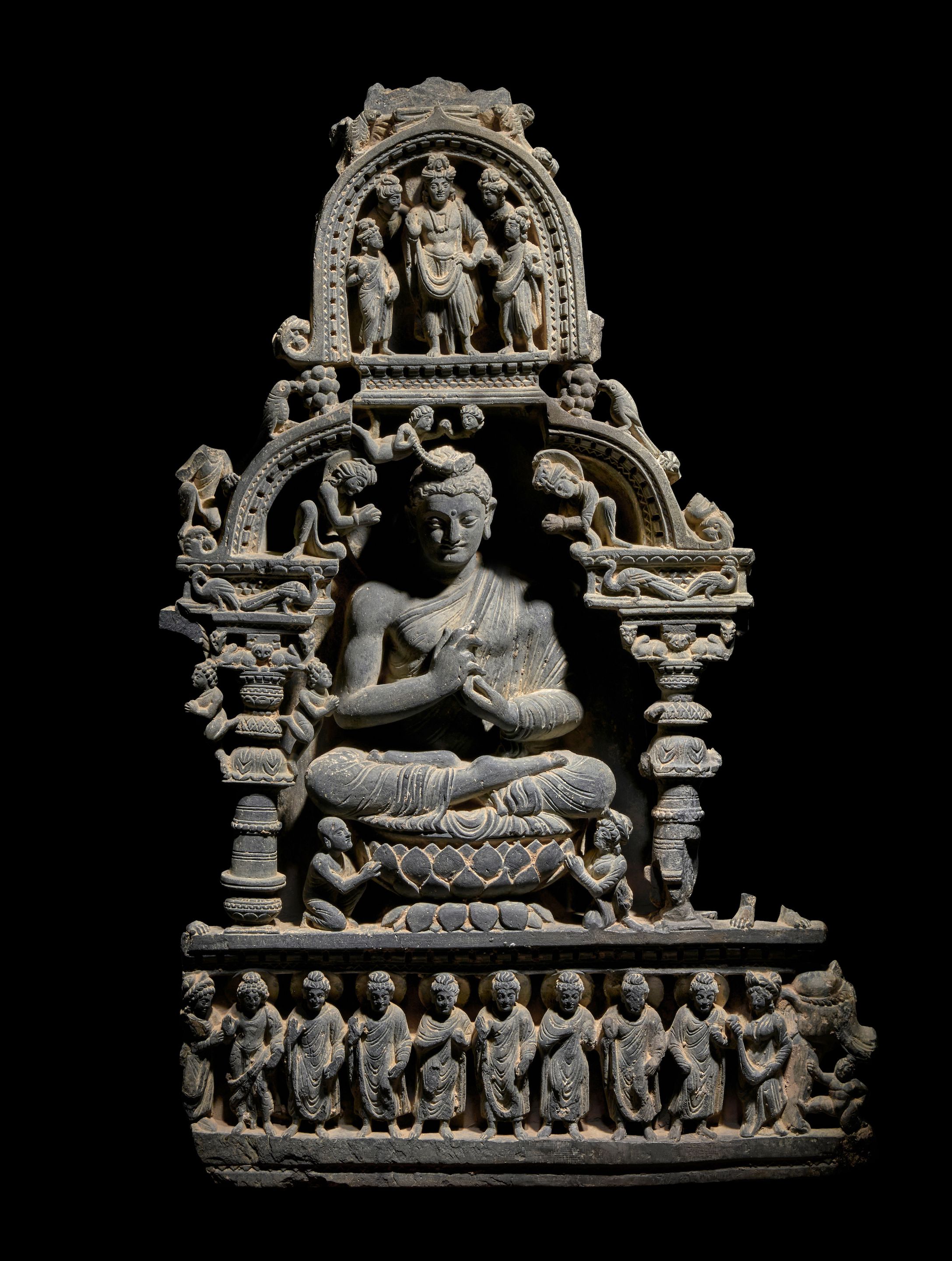
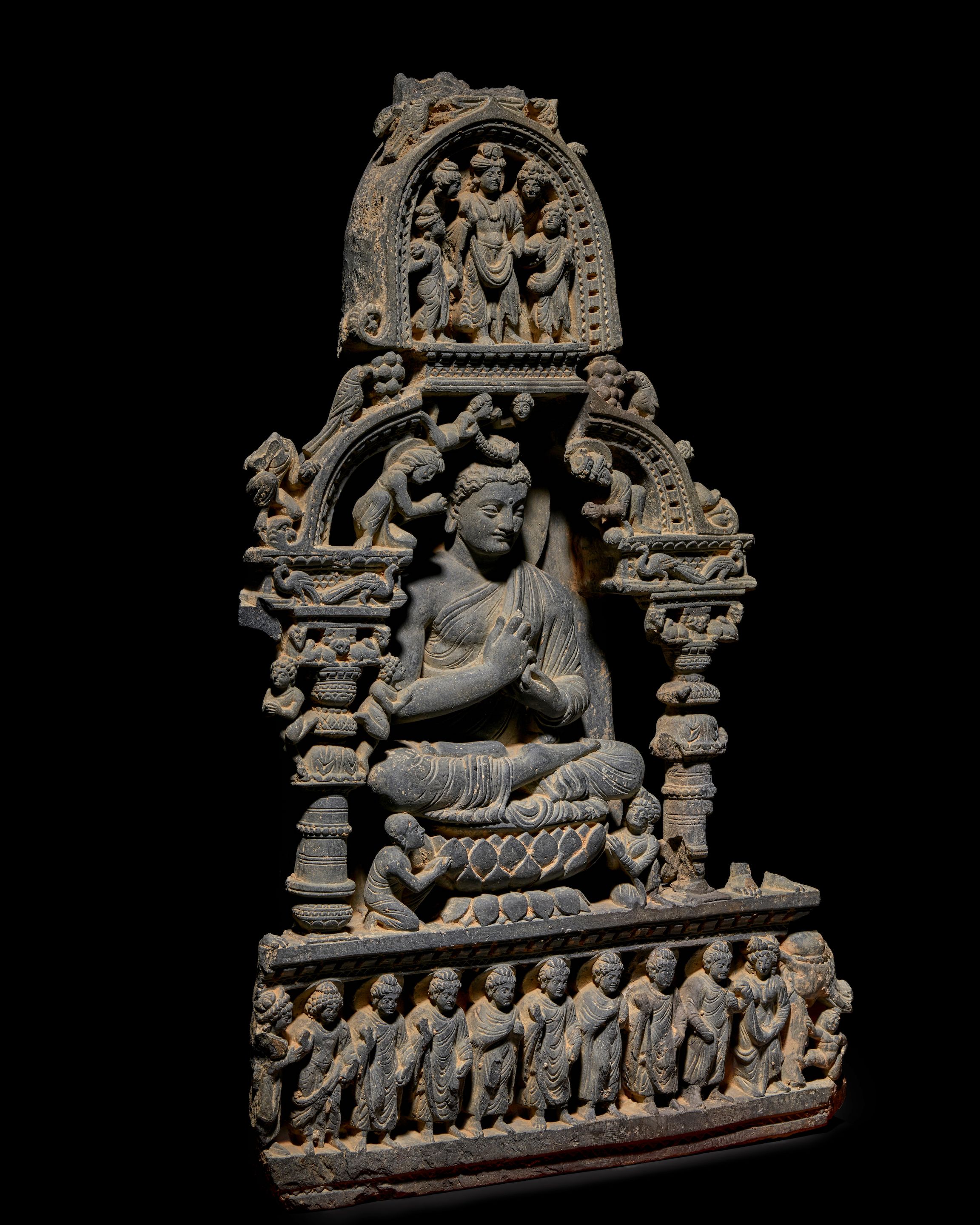
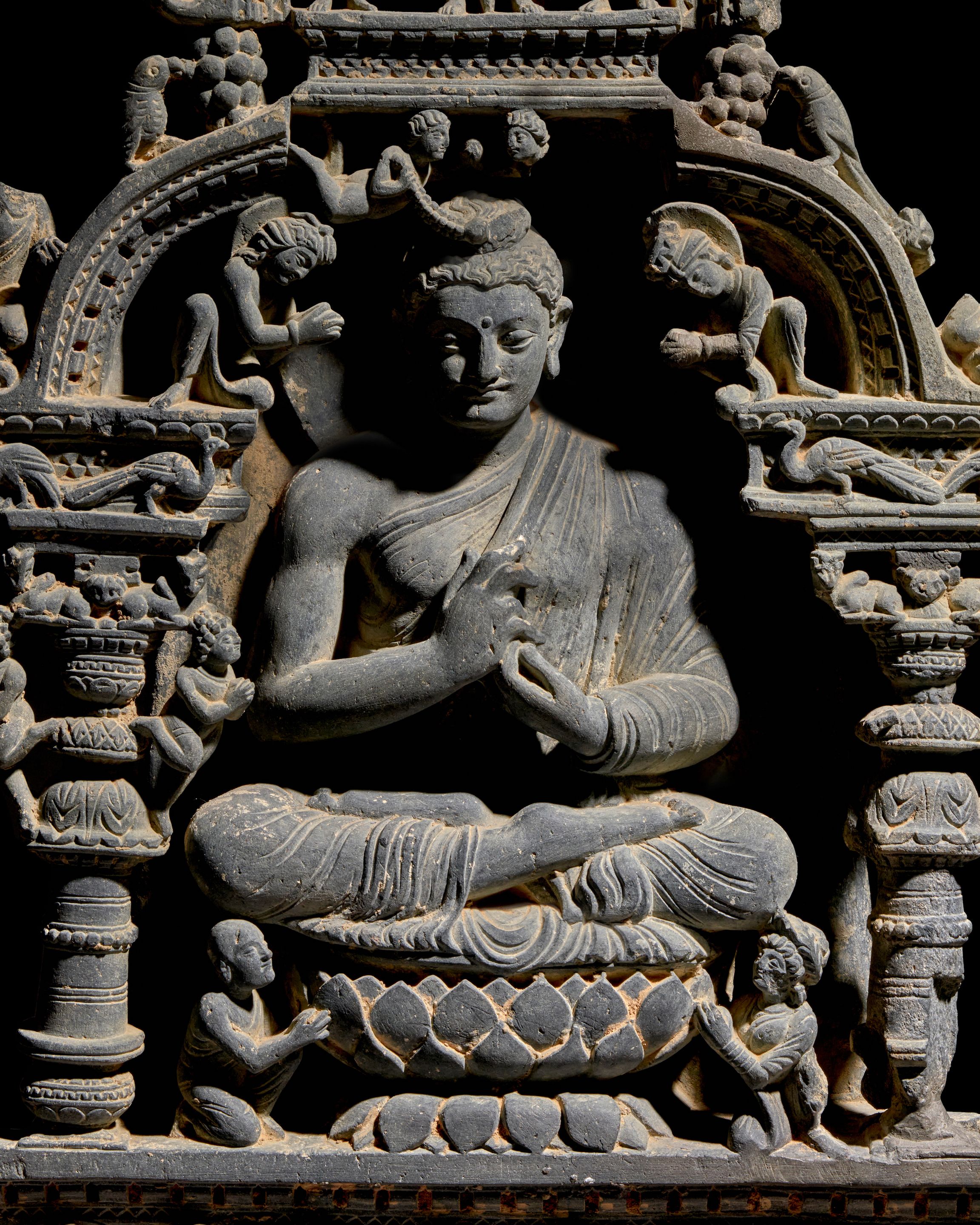 A SCHIST GABLE RELIEF WITH THE TEACHING BUDDHA
ANCIENT REGION OF GANDHARA, 3RD/4TH CENTURY
27 1/2 in. (70 cm) high
Footnotes
犍陀羅 三/四世紀 片岩說法佛石碑
Published
Nara National Museum, Special Exhibition of Arts of Buddha Shakyamuni, Nara, 1984, no. 50.
Nara National Museum, Special Exhibition, Bodhisattva, Nara, 1987, no. 4.
Isao Kurita, Gandharan Art: The World of the Buddha, Tokyo, Vol. II, 2003, p. 109, no. 294.
Osmund Bopearachchi, When West Met East: Gandharan Art Revised, Vol. I, 2020, p. 150.
Osmund Bopearachchi, Beyond Boundaries: Buddhist Art of Gandhara, Berkeley Art Museum & Pacific Film Archive, University of California, 2021, p. 30.
Exhibited
Special Exhibition of Arts of Buddha Shakyamuni, Nara National Museum, 29 April – 3 June 1984.
Special Exhibition, Bodhisattva, Nara National Museum, 29 April – 31 May 1987.
Beyond Boundaries: Buddhist Art of Gandhara, Berkeley Art Museum & Pacific Film Archive, University of California, 30 April 2021 – 13 March 2022.
Provenance
Sotheby's, London, 4 July 1978, lot 446
Japanese Private Collection, 1978-2003
Christie's, New York, 21 March 2007, lot 226
Private Collection, New York
Architectural reliefs of this design once featured prominently along the front of a stupa in the ancient region of Gandhara. Stupas served as the earliest Buddhist monuments dedicated to housing relics of the Buddha. Under the Kushans in the 2nd century CE, many new Buddhist monuments were constructed to commemorate the Buddha - his life, his attainment of nirvana, and the Mahayana path towards Buddhahood. The building programs focused on the construction of these cenotaphs were initially modelled on the round masonry Indian prototype. Like those earlier Indic models, relief panels were affixed to decorate the exterior. Over time, the circular shape in the 1st and 2nd century developed, and a more regional architectural style emerged which elongated the ritual mound and set it on a square base. As the style became more sophisticated, so too did the reliefs which were viewed as a practitioner circumambulated the monument.
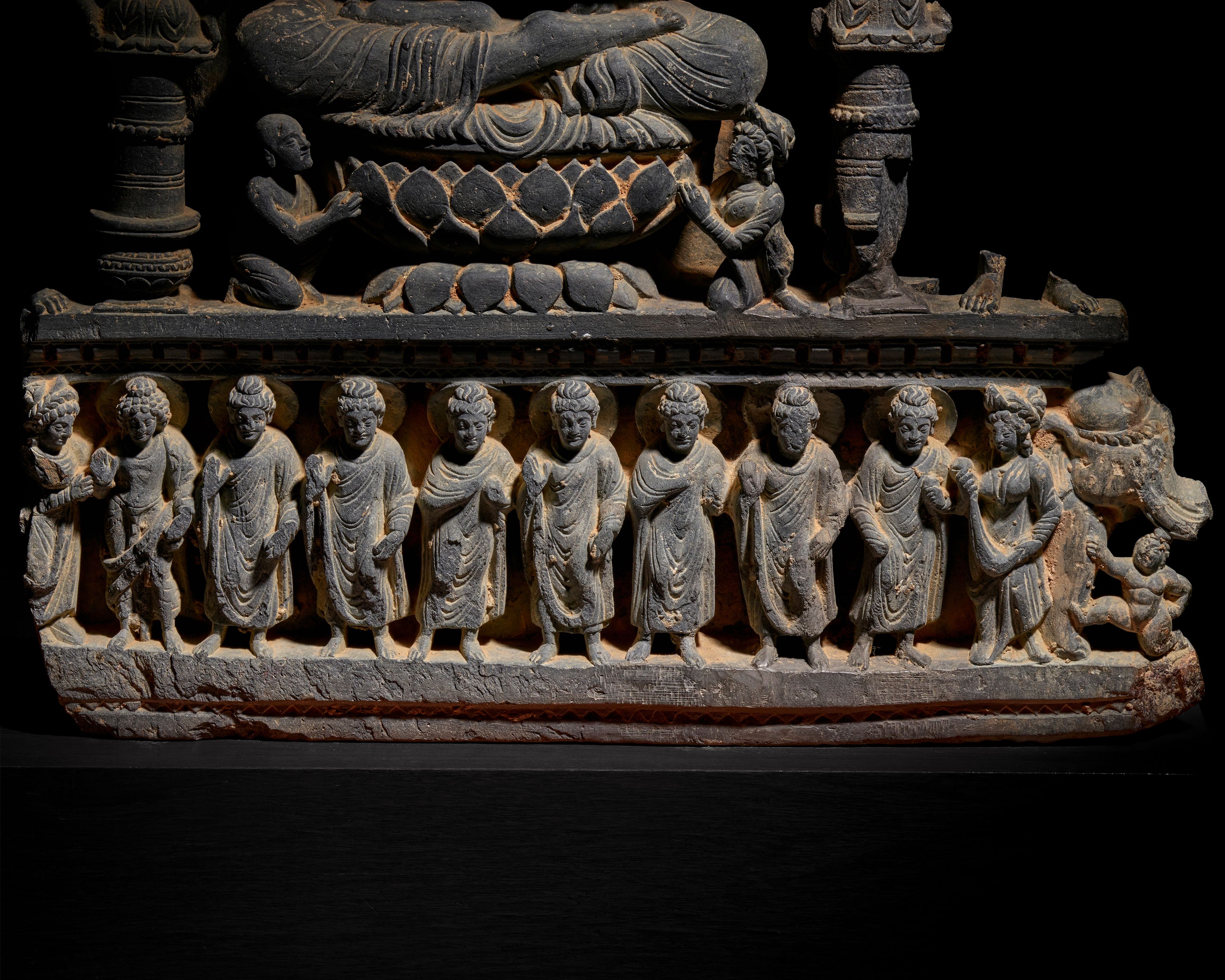
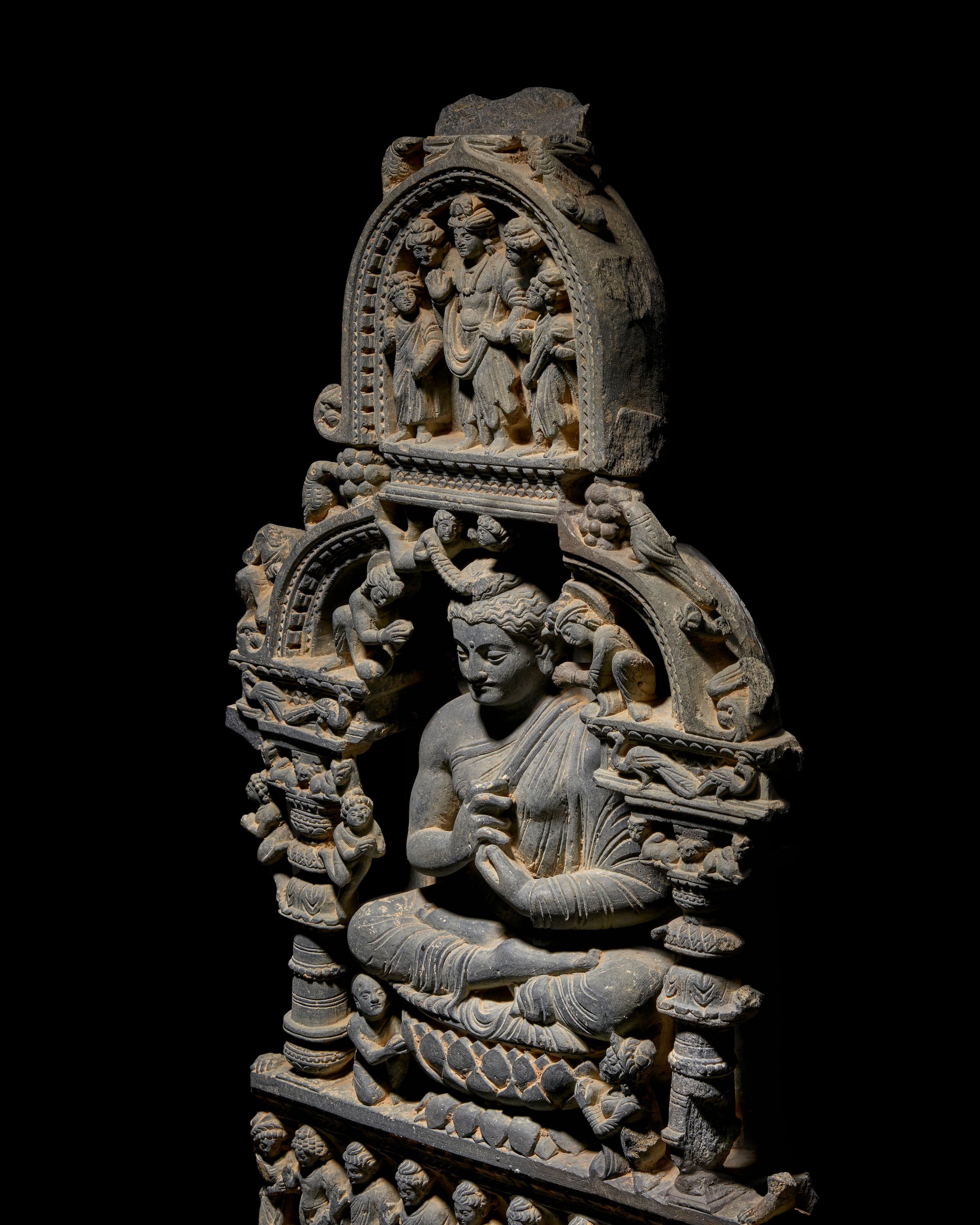
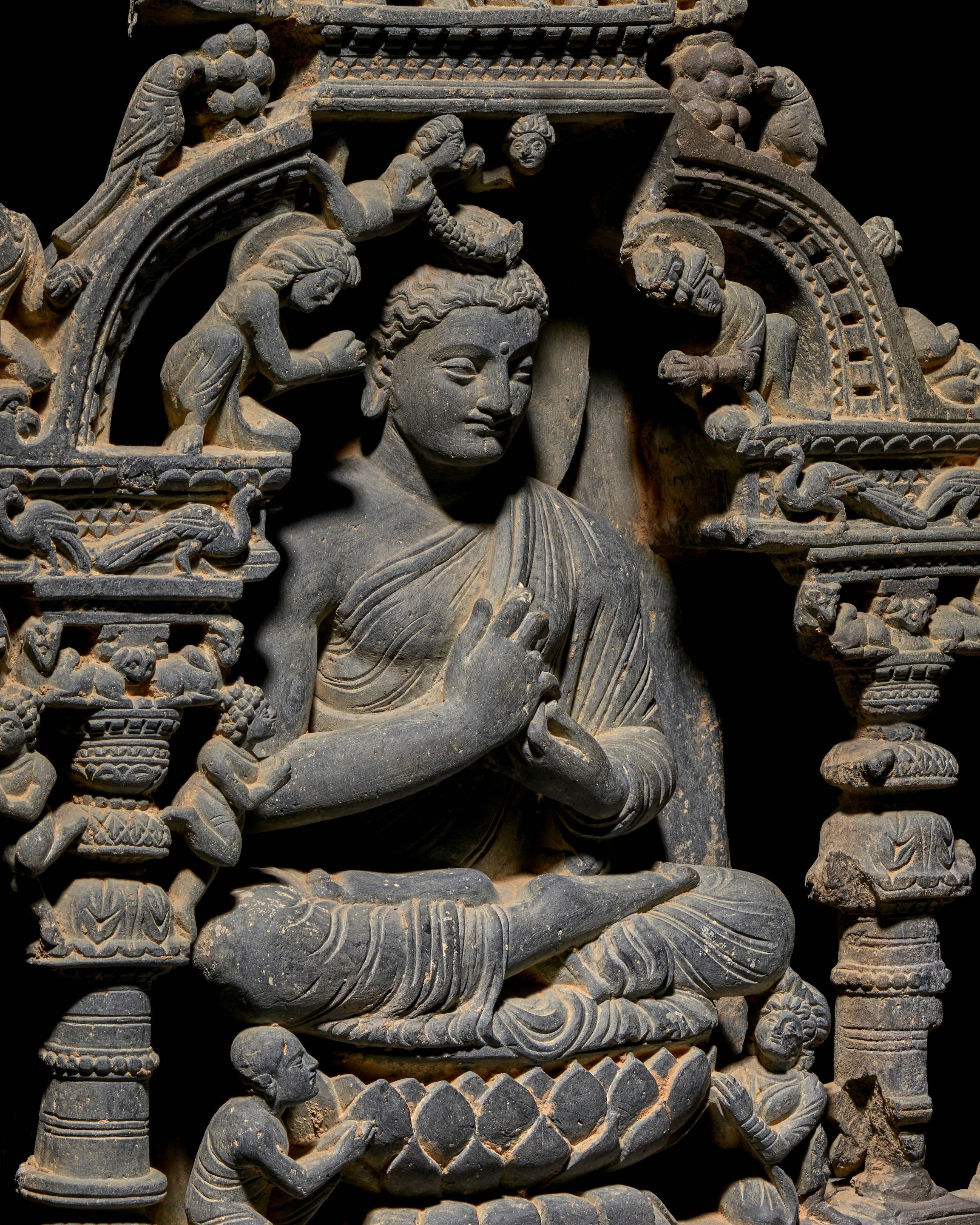
The front of the stupas, as illustrated in a model (Kurita, Gandharan Art, Vol. I: The Buddha's Life Story, 2003, p. 28, fig. 24), show false front gables shaped in stacked arched lobes, in a manner resembling the one depicted here. In the present example, curved pediments with dental cornices frame the three-part gable, corresponding to another in the British Museum (1880.219). Two drum columns flank the Buddha decorated with cherubic attendants and surmounted by an architrave of peacocks. In each of the three compartments, scenes depict from top to bottom the former life of the Buddha, the Buddha teaching, and the seven past Buddhas with the Future Buddha, Maitreya.
In the 3rd century, narrative reliefs gave way to more devotional statuary of the Buddha and the popular veneration of bodhisattvas. “This direct connection of Buddha Śākyamuni with his far-away predecessor…puts the previous lives of the Buddha into a series and postulates a systematic spiritual development of the Bodhisattva towards Buddhahood, through which the Bodhisattva concept gains in importance (Luczanits, In Gandhara – The Buddhist Heritage of Pakistan. Legends, Monasteries and Paradise, 2008, p. 75).” Scenes in each of the upper and lower registers echo this trend. The tympanum depicts a previous life of the Buddha as the Bodhisattva. Dressed in paradigmatic royal garb, the historical Shakyamuni is shown in his penultimate incarnation prior to his final emanation as Gautama Buddha.
In the lower register, a single row illustrates the Seven Buddhas of the Past alongside the future Buddha Maitreya. Depictions of these seven historical Tatagathas can be traced back to Sanchi in the 3rd century BCE (ibid, 2008, pp. 73-5, fig. 5). They might have also gained popularity in Gandhara's cosmopolitan society through a conflation with the Famed Seven Sages of ancient Greece, who were said to have presented Apollo with the Delphic Precepts. These precepts were prominently transcribed onto a funerary monument dedicated to Kineas, one of the founders of Ai-Khanoum, which was in the most scared part of the ancient Hellenistic city in modern-day Afghanistan (Hiebert & Cambon (eds.), Afghanistan: Hidden Treasures from the National Museum, Kabul, 2008, p. 124, figs., 28-9). The inclusion of Maitreya, also exemplified in another 'Seven Buddhas of the Past' frieze (Victoria & Albert Museum, IM.71-1939), points to a broadening religious context within Gandhara. With the Buddha connected to his predecessors of the past as well as to those of the future, the continued commitment among all the Buddhas becomes an eternal and “endless chain of oath and prophecy (ibid, 2008, p. 75).”
These changes, rooted in Mahayanist philosophy and cosmology, positioning the concept of 'Buddhahood' within a limitless expanse of time and space, informs the subject at the center of this frieze. Initially identified as the 'Miracle of Sravasti', this iconographic program remains one of the most debated and inconclusive within Gandharan art since the preeminent scholar, Alfred Foucher's (1865–1952) attribution, though undebatable is the exaltation or deification of the Buddha at the center. An enlarged 'Teaching' (or 'Preaching') Buddha sits on a lotus holding his hands in dharmachakra mudra, accompanied by attending figures. In some steles, like this and another in the Peshawar Museum (Kurita, Gandharan Art, Vol. I: The Buddha's Life Story, 2003, p. 197, fig. 396), elaborate architectural settings frame the Buddha along with accompanying figures. Juhyung Rhi points out that depictions of the Buddha in this format arose in the middle of the 3rd century as his image became more deified, paralleling Mahayana texts which describe him seated on a 'thousand-petalled lotus' throne (Rhi Gandharan Images of the Sravasti Miracle: An Iconographic Reassessment, Berkeley, 1984, p. 141).
Elaborate depictions of the Teaching Buddha surrounded by smaller buddhas and bodhisattvas, which were presumably represented in the flanking figures whose feet remain along the columns, resemble the complex scenes described in these Mahayana texts. Concepts of 'purifying' and 'adorning' the Buddha and his buddhafield have been linked to the imagery of such paradisical scenes of the Teaching Buddha (ibid, 1984, p. 150). Visible here and in the famous 'Muhammad Nari Stele' (Lahore Museum G-155), these celestial realms inhabited by multitudes paying homage to the Buddha's splendor appeal to these two Mahayana principles. The Buddha's purity is reflected as he arises from the transcendent lotus while devotion is portrayed by the entourage who bow in reverence and offer to adorn him with garlands. Mahayana veneration of the Buddha and bodhisattvas found their origins tied to stupa worship, concretely exhibited here. It was a practice linked to purification of the practitioner, who through devotional acts, would eventually gain entry into these celestial Buddha domains.
The present lot compares favorably to the only other Gandharan false gable relief of the Teaching Buddha auctioned in the past decade, sold at Christie's, New York, 12 September 2012, lot 522.