
侧边栏

3-4世纪犍陀罗石雕菩萨头像(纽约邦瀚斯)
尺寸:高31.8 cm
年代:3-4世纪
质地:片岩石雕
风格:犍陀罗
来源:拍卖会
成交:149,000美元(2015.09)
参阅:外部链接
鉴赏:
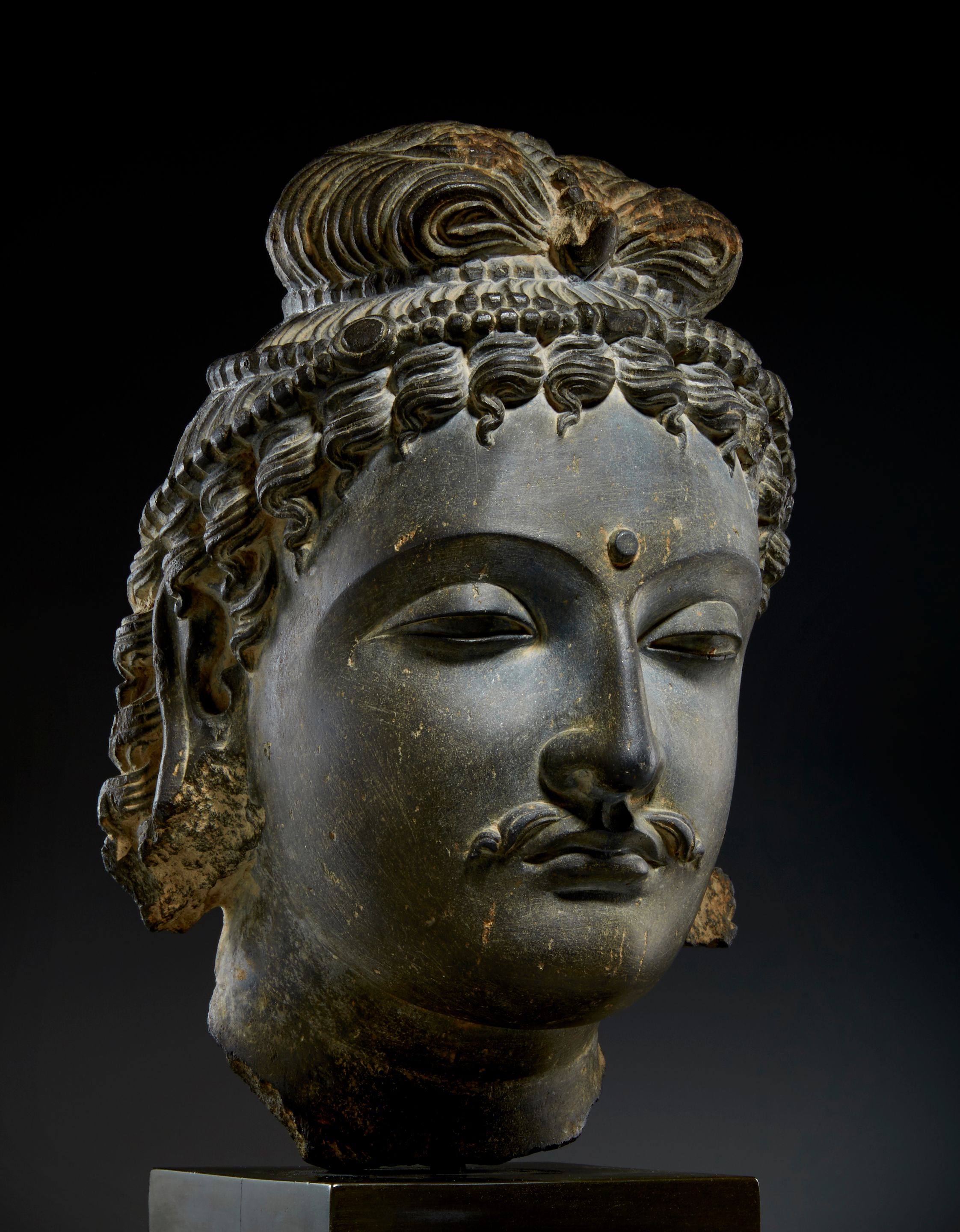
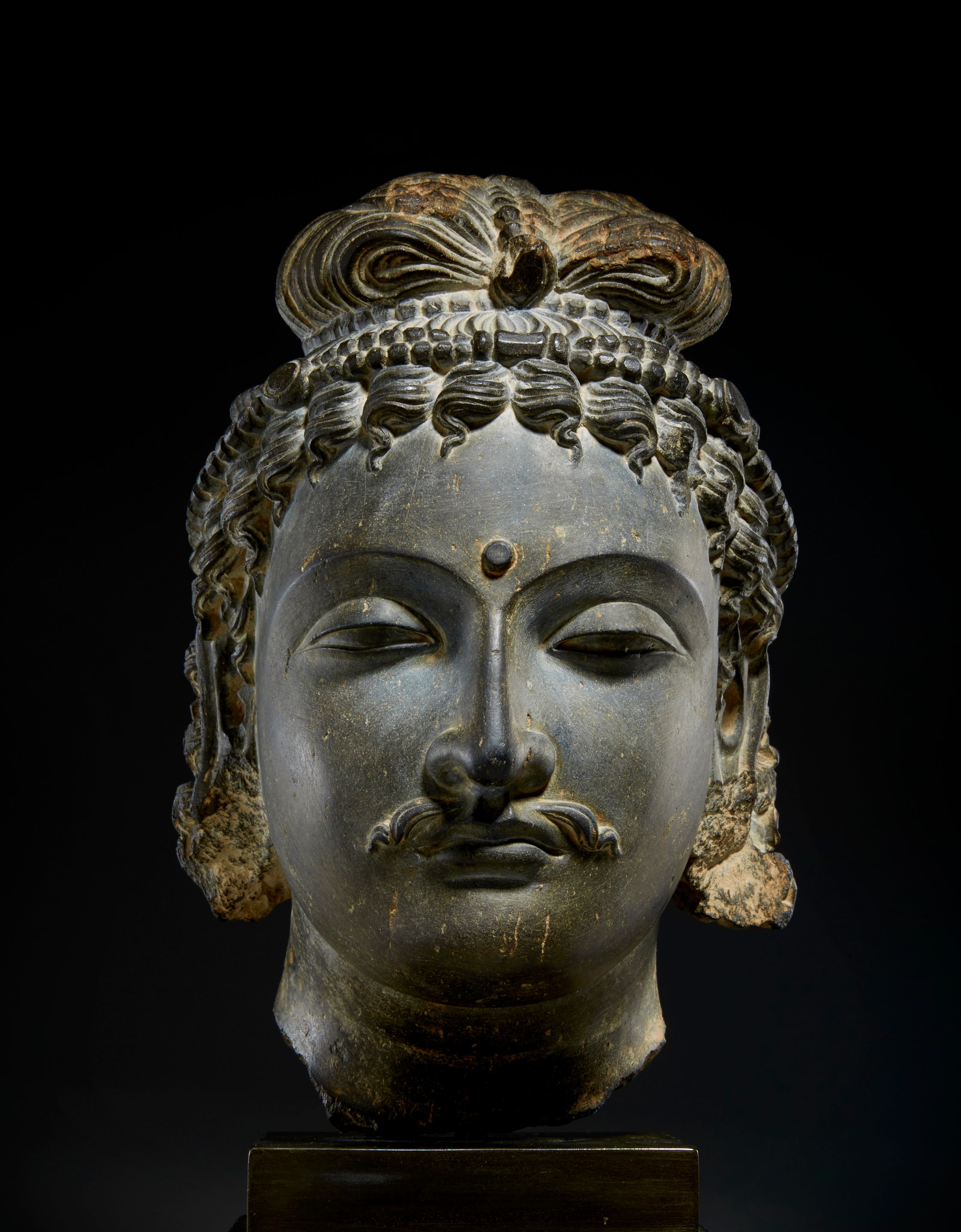
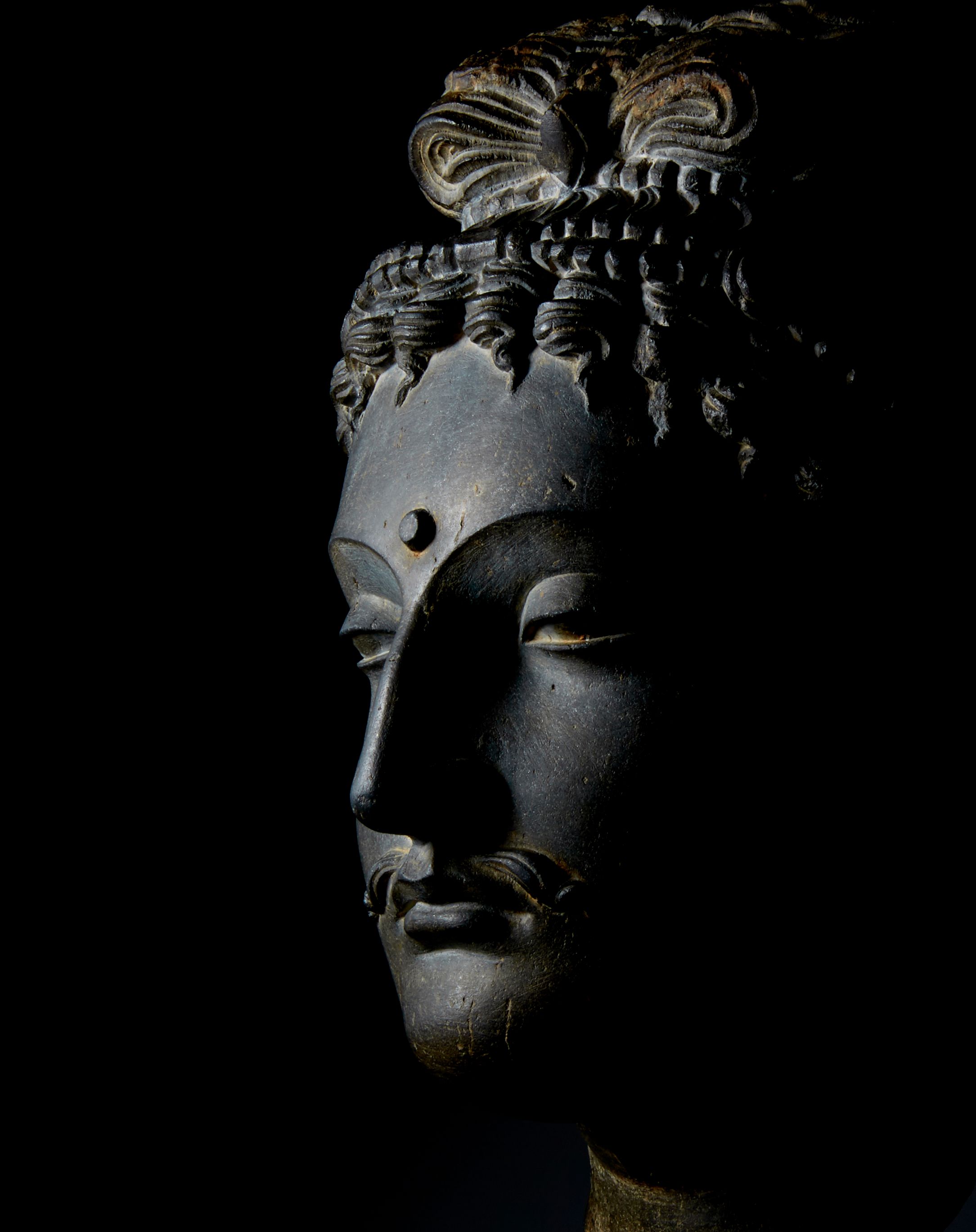 A schist head of a bodhisattva
Ancient region of Gandhara, 3rd/4th century
His coiffure immaculately arranged in a butterfly topknot and ringlets falling across his forehead in high relief.
12 1/2 in. (31.8 cm) high
Footnotes
健陀羅 三/四世紀 片巖菩薩頭像
The luxurious treatment of the voluminous curls across his broad forehead and the tops of his ears presents the lingering influence of Greco-Roman sculpture on early Buddhist art. Each terminates with exquisite tail-like twists. This style of topknot is generally assigned to Maitreya, as in an example from the Avery Brundage Collection ((B60S597), see The Asian Art Museum of San Francisco: Selected Works, 1994, p. 23).
Gandharan sculptors transformed the Greco-Roman ideal of perfect divine bodies to evoke the perfection of the divine mind. Compare the head with another superb example in the Norton Simon Museum of Art (Pal, Asian Art at the Norton Simon Museum, Vol. 1: Art from the Indian Subcontinent, Pasadena, 2003, p. 63, no. 30). The rare level of quality is also comparable to one sold at Bonhams, New York, 16 March 2015, lot 57, and another at Christie's, New York, 19 March 2013, lot 201.
The eyebrow's sharp ridges also nod to Gandharan sculpture's evolution towards an abstracted ideal. In discussion of a 4th-5th century example in The Metropolitan Museum of Art, Behrendt explains that with later works, 'The face, which is not naturalistic and registers no emotion, reflects the northern Indian conception of an enlightened being, with abstract intersecting planes combining to define the forehead…' (Behrendt, The Art of Gandhara, New York, 2013, p. 68). He refers to a later example exhibiting a vastly more abstracted nose with sloped sidewalls (p. 70, no. 53). Also, the topknot does not rest with the same sense of gravity as the present lot.
Our example also compares favorably to another in The Metropolitan Museum of Art (Lener & Kossak, The Lotus Transcendent, New York, 1991, p. 83, no. 49). There, the proportions are narrower, and the hair curls are more tightly bunched and not as crisply defined. Also contrast with a head in the British Museum (Zwalf, Gandhara Sculpture, Vol. II, 1996, pp. 39-41, nos. 53-8).
Its 1968 exhibition catalogue entry attributed the present lot to Takhi-i-Bahi. Compare to a similarly superior standing figure from Takhi-i-Bahi with painstaking curls published in Luczanits (ed.), Gandhara – Das Buddhistische Erbe Pakistans, Mainz - Bonn, 2008, p. 224, abb. 3.
Published:
LeRoy Davidson, Art from the Indian Subcontinent from Los Angeles Collections, UCLA, Los Angeles, 1968, p. 18, no. 15.
Exhibited:
Art from the Indian Subcontinent from Los Angeles Collections, University of California, Los Angeles Art Galleries, March 1968.
Provenance:
Estate of Patrick Doheny (1923-2014), acquired before 1968

