
侧边栏

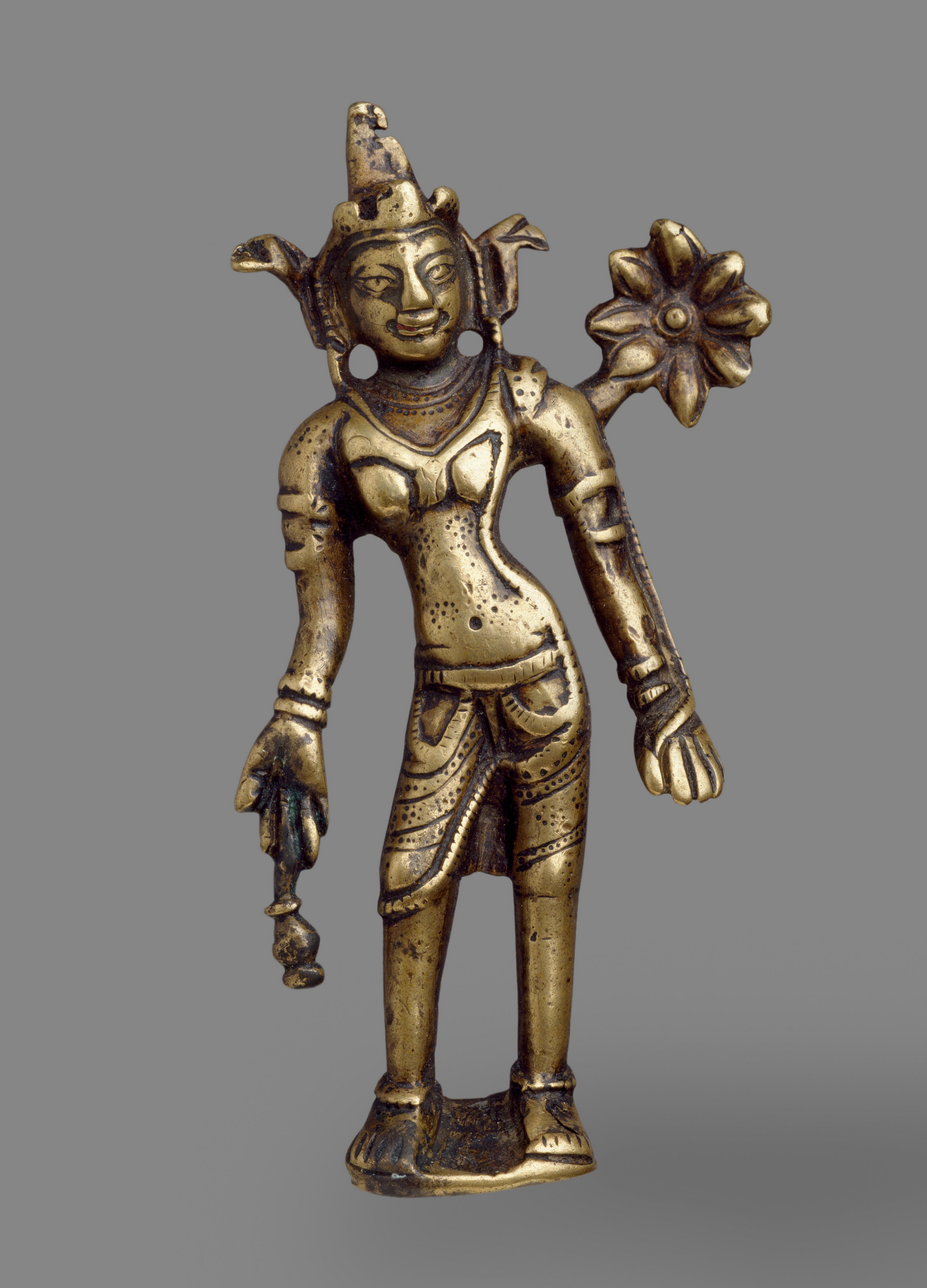
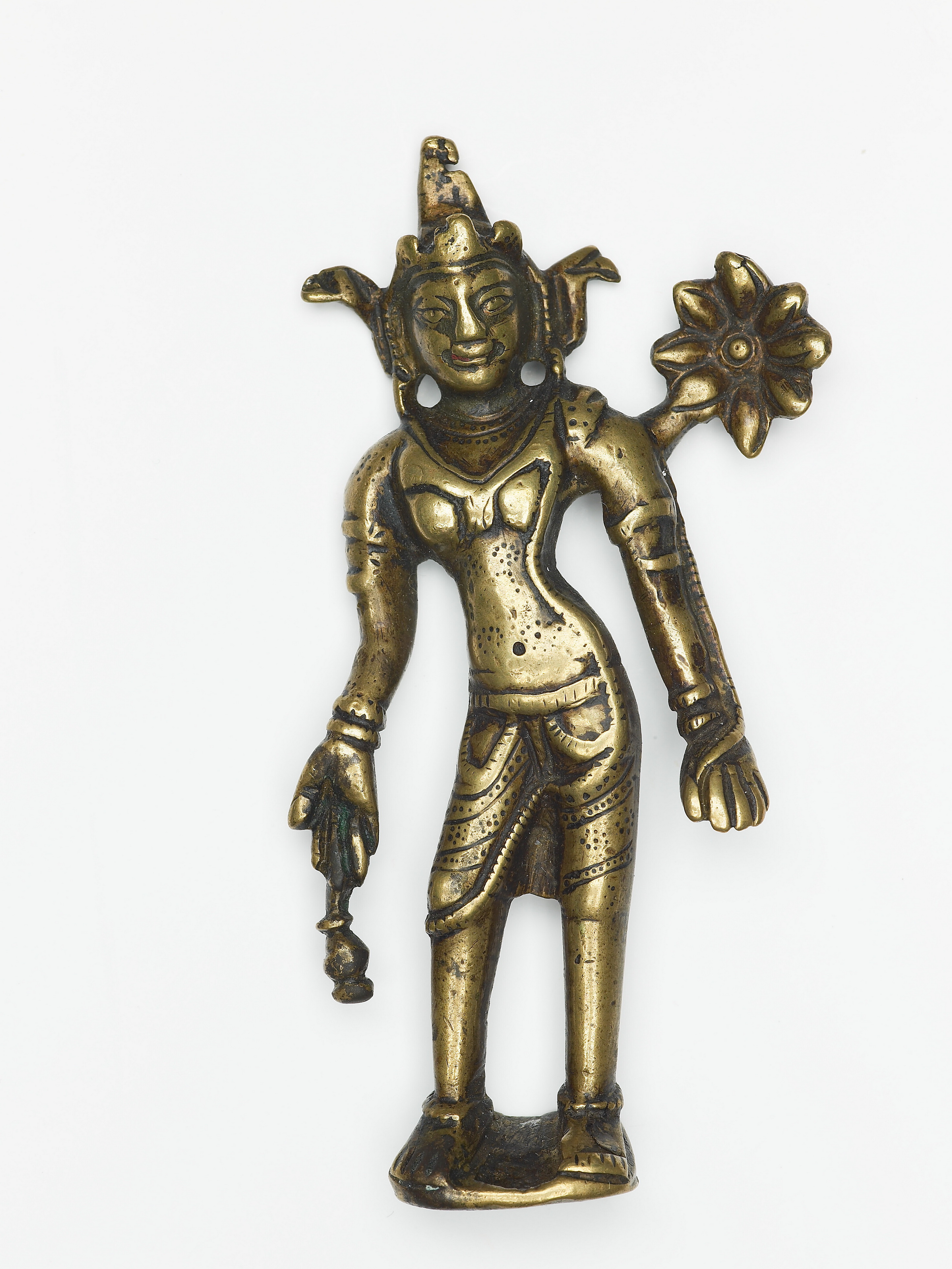
11-12世纪西藏西部黄铜莲花手观音立像(牛津大学阿什莫林博物馆)
尺寸:8.7 x 4.5 x 1cm
年代:11-12世纪
质地:黄铜
风格:西藏西部
来源:牛津大学阿什莫林博物馆
参阅:外部链接
鉴赏:
 brass, with traces of red pigment
黄铜,带有红色颜料的痕迹
This slender standing Bodhisattva holds a large eight petal lotus flower and a small vase, representing the container of amrita, the nectar of immortality. This iconography was popular in Nepal, where it is known as Amoghapasa, but in this case he also holds a rosary, which apparently was not the intention of the sculptor here. In Tibetan or western Himalayan painting and sculpture, Avalokitesvara frequently serves as one of two standing attendant Bodhisattvas flanking the Buddha Sakyamuni [1]. The identification of this figure as an aspect of Avalokitesvara is indicated by the triangular object visible on the left shoulder, which must be understood as the head of an antelope, whose paws are decoratively tied over Avalokitesvara's heart.
Although the three-pointed crown is now broken, the tall chignon is visually balanced by the strong curves of the lateral ribbons of the crown. The face with its broad smile and wide eyes has much charm. A similar chignon and facial features, as well as the over-large fingers and toes, are found in a Manjusri now in the British Museum. Snellgrove identified this as a circa tenth-century sculpture originating in northwest India, while Klimburg-Salter has attributed it to the western Himalayas, eleventh to twelfth century [2]. Similar features are seen in a Manjusri in the Ford collection, attributed by Woodward to Western Tibet or the western Himalayas, 1000-1200 [3].
A small, light sculpture such as this might have formed part of a triad, or possibly have been placed among the consecration contents of a larger image of the Buddha Sakyamuni or a lama, since several similar images, including the British Museum Manjusri, were found inside a sculpture of a lama. These images share certain distinctive characteristics with this Avalokitesvara: very straight legs, a somewhat exaggerated bend at the hips, and a slight disproportion, as in the very large hands of this figure [4].
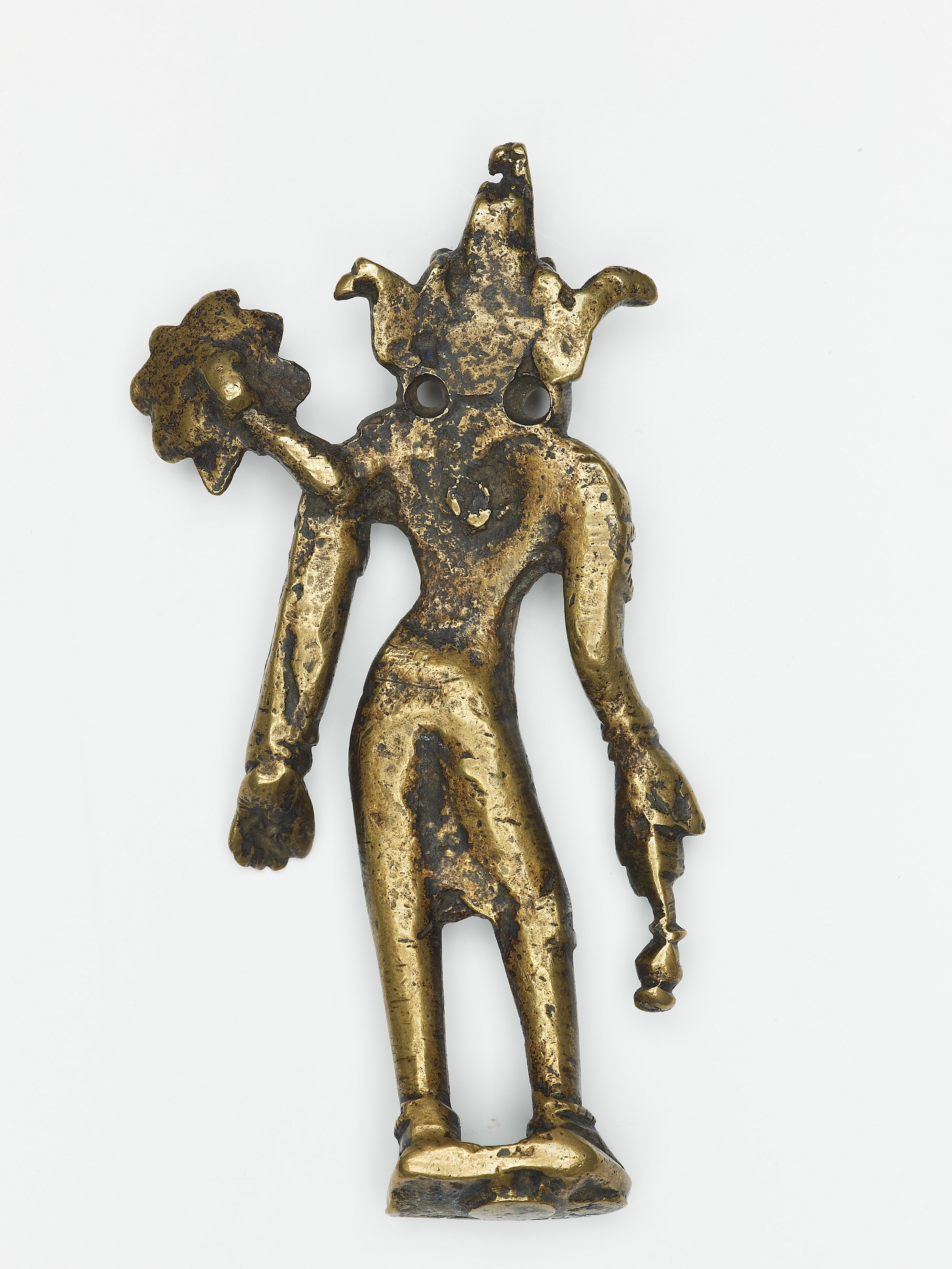
The beaded meditation belt appears to be an inlay in a different alloy, possibly with an admixture of silver due to the contrast in colour. Beside the lips there are traces of red pigment. The dhoti has diagonal stripes, alternating beading and a geometric pattern, but is only decorated at the front of the image. The back is unfinished from head to toes, except for a lug behind the lotus, indicating that it formerly had a prabha as well as a pedestal. Von Schroeder has identified several similar triads as Western Tibetan, eleventh to twelfth century, while Reedy has analysed the metal of similar sculptures found in triads as conforming with western Tibetan alloys [5]. Although these factors do indicate a western Tibetan provenance of the eleventh to twelfth century, comparison with the extant remains in the monasteries of the region, whether of clay sculptures or large cast standing Bodhisattvas, tends to suggest that these small cast images are the products of provincial ateliers in the western Himalayas or western Tibet which cannot yet be precisely identified.
[Footnotes:]
1 See von Schroeder, Indo-Tibetan Bronzes, pl. 32 etc., for several small triads of these Bodhisattvas.
2 Snellgrove, Indo-Tibetan Buddhism, pl. 17a, and Klimburg-Salter, The Silk Road and the Diamond Path, pl. 90: British Museum acc. no. 1905.5.19.15.
3 H. Woodward, 'Artistic production, religious practice' in Pal, Desire and Devotion, pl. 167, h. 14.9 cm.
4 See also Pal, Art of Tibet, pl. S8, who suggested a provenance from a remote provincial atelier.
5 Reedy, Himalayan Sculpture, pl. W119, for the Buddhist triad in the Pal collection, and W145, for the Los Angeles County Museum sculpture discussed by Pal (Art of Tibet, pl. S8).
这尊修长的立姿菩萨手持一朵大型八瓣莲花和一个小瓶,小瓶代表盛放甘露(不朽琼浆)的容器。此图像在尼泊尔颇为流行,在那里被视为不空羂索观音的形象;但在此例中,他还持有一串念珠,这显然并非雕塑者的本意。在西藏或西喜马拉雅的绘画与雕塑中,观音常常作为胁侍菩萨之一,立于释迦牟尼佛的两侧[1]。此尊造像可被辨识为观音的一种化身,其左肩可见的三角形物件应被理解为羚羊的头部,而羚羊的前足则装饰性地系于观音的心口处。
尽管三叶冠现已残损,但高耸的发髻在视觉上与头冠两侧飘带的强烈曲线形成了平衡。菩萨面庞宽阔的笑容与睁大的双眼极具魅力。大英博物馆收藏的一尊文殊菩萨像上,可见相似的发髻与面容特征,以及比例过大的手指和脚趾。Snellgrove将其鉴定为约10世纪、源自西北印度的雕塑,而Klimburg-Salter则将其归属于11至12世纪的西喜马拉雅地区[2]。Ford收藏的一尊文殊菩萨像也展现了相似特征,Woodward将其归属于10至12世纪的西藏西部或西喜马拉雅地区[3]。
如此件作品一般的小型轻巧雕塑,可能曾构成一组三尊像的一部分,或者可能被安置于一尊更大的释迦牟尼佛或喇嘛像的内部装藏之中,因为包括大英博物馆那尊文殊菩萨在内的几件类似造像,正是发现于一尊喇嘛像的内部。这些造像与此尊观音像共享某些显著特征:非常笔直的双腿、臀部略显夸张的弯曲,以及某种程度上的比例失衡,例如本尊造像过大的双手[4]。
其上的念珠状禅修带看似由不同合金镶嵌而成,由于颜色对比,可能掺有银。唇部附近残留有红色颜料的痕迹。下衣(dhoti)饰有斜向条纹,交替呈现串珠纹与几何图案,但仅装饰于造像正面。造像背面从头至脚均未加修饰,唯莲花后方有一小耳,表明它原本应配有背光(prabha)和台座。von Schroeder已将几件类似的三尊像鉴定为11至12世纪的西藏西部作品,而Reedy则通过对三尊像中同类造像的金属成分分析,确认其符合西藏西部的合金特征[5]。尽管这些因素确实指向了11至12世纪的西藏西部产地,但与该地区寺院中现存的遗物——无论是泥塑造像还是大型的立姿菩萨铜像——相比较,又倾向于表明这些小型的铜像是西喜马拉雅或西藏西部地方工坊的产品,其确切地点尚无法精确认定。
[注脚]
1 参见von Schroeder,《Indo-Tibetan Bronzes》,图版32等,其中收录了数尊此类菩萨的小型三尊像。
2 Snellgrove,《Indo-Tibetan Buddhism》,图版17a;以及Klimburg-Salter,《The Silk Road and the Diamond Path》,图版90:大英博物馆馆藏编号1905.5.19.15。
3 H. Woodward,《Artistic production, religious practice》,载于Pal编,《Desire and Devotion》,图版167,高14.9厘米。
4 另见Pal,《Art of Tibet》,图版S8,其认为可能出自偏远的地区性工坊。
5 Reedy,《Himalayan Sculpture》,图版W119(关于Pal收藏的佛教三尊像),以及图版W145(关于Pal在《Art of Tibet》图版S8中讨论的洛杉矶郡艺术博物馆藏品)。
购买于1995年
著录:
Heller, Amy, Early Himalayan Art (Oxford: Ashmolean Museum, 2008), page mentioned: p. 126, page illustrated: p. 119, Cat. No.: no. 38 on p. 118

