
侧边栏

明代木雕骑犼观音(西冷印社)(伦敦佳士得)
尺寸:高125cm
年代:明代
质地:木雕
风格:中原
来源:拍卖会
成交:2,990,000元(2023.08); 99,650英镑(2008.11)
参阅:西冷印社 伦敦佳士得
鉴赏:
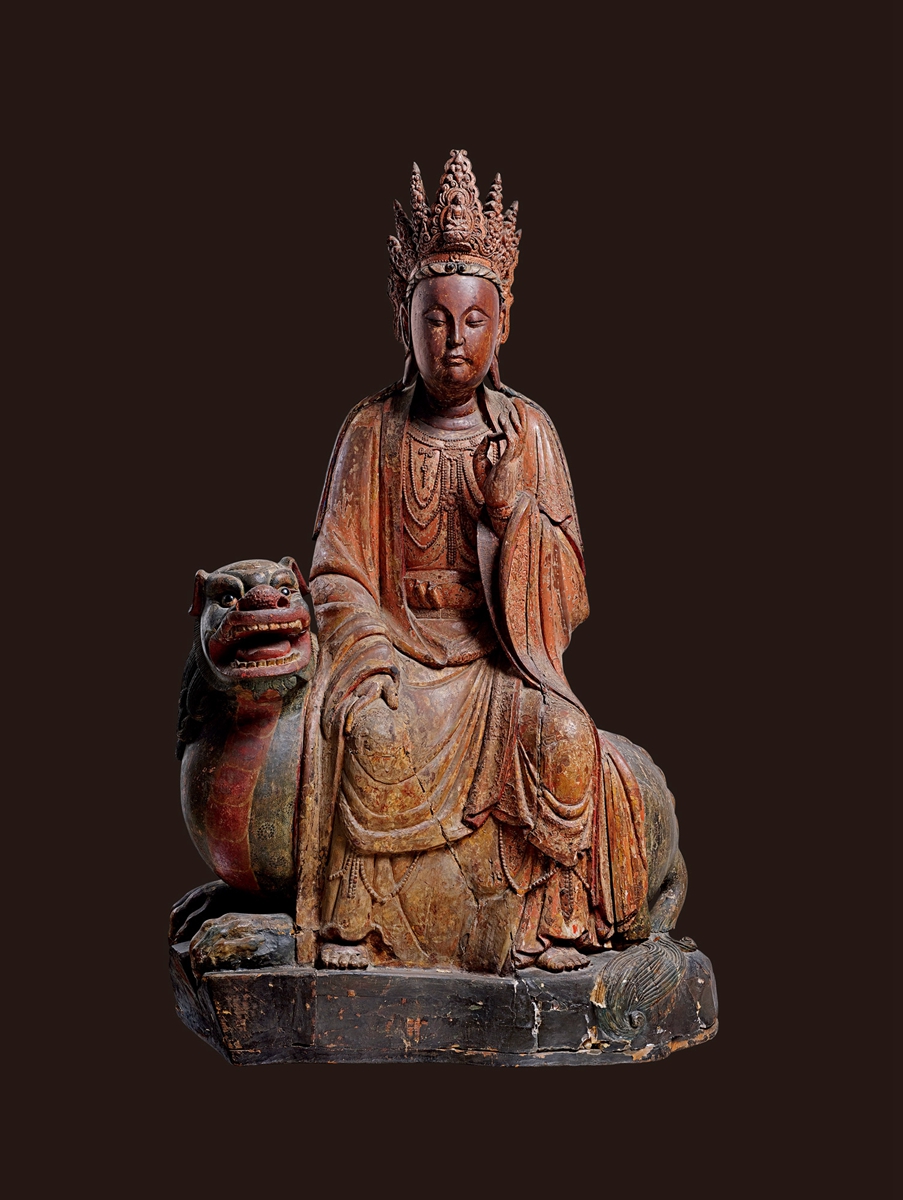
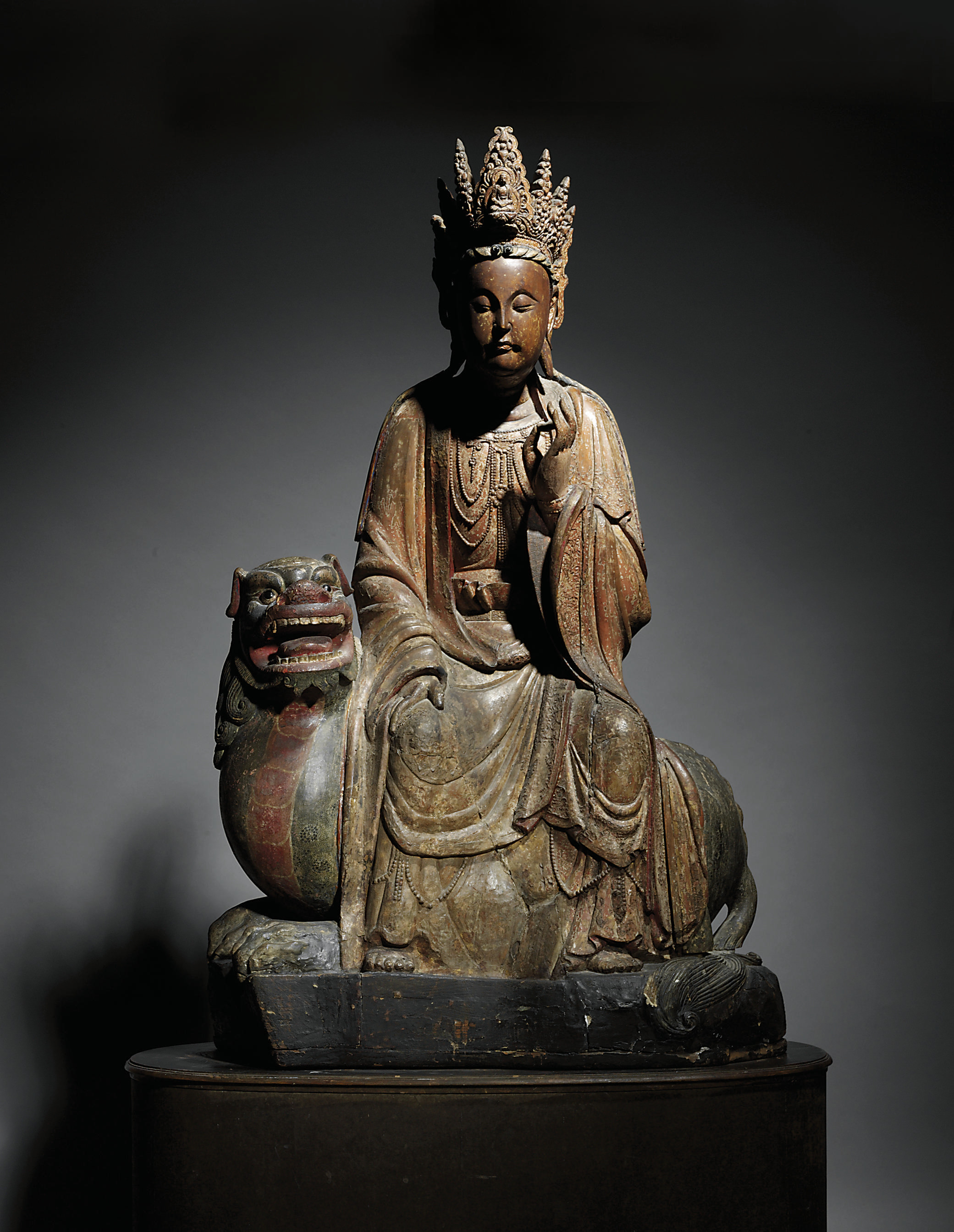 注:纽约大都会博物馆相似的一尊定为清代:清代木雕彩绘骑犼观音像(纽约大都会博物馆)
明·木胎狮吼观音坐像
出版:
1.一西平措编《佛韵-造像艺术集粹》,文物出版社
2.浙江省博物馆编《虔生出净世:中国古代汉传佛教造像精萃》,文物出版社
来源:
1.原欧洲著名收藏家旧藏;
2.伦敦佳士得。
3.北京翰海2010年秋季拍卖会
4.五觉斋旧藏
展览:
1.首都博物馆《佛韵——造像艺术集粹展》,2013年;
2.浙江省博物馆《虔生出净世——中国古代汉传佛教造像选萃展》,2017年。
A RARE AND LARGE LACQUERED WOOD FIGURE OF SIMHANADA AVALOKITESVARA EARLY MING DYNASTY, 15TH CENTURY
Modelled seated on the back of a recumbent lion on a platform, his left hand raised in vitarka mudra, his right hand resting on the right knee, wearing loosely draped robes falling in crisp graceful folds, the borders finely detailed with scrolling and cloud patterns, opening at the chest to reveal an elaborate beaded necklace, the head with a seven-leaf foliate crown containing the Buddha Amitabha in the central leaf, the elegantly carved face with full cheeks and small, pursed mouth in a contemplative expression, the beast with head inclining to its left, its eyes inlaid in black glass, and the curly mane and bushy tail detailed with incisions, traces of gilding and lacquer remaining
珍罕大型漆木狮吼观音像
明初,十五世纪
此像坐于莲台之上卧狮背部,左手抬起结说法印,右手抚右膝。身着宽袍,衣褶自然垂落,线条明快流畅,衣缘精细刻划卷草纹与云纹。胸前敞开,露出精致珠串项链。头部佩戴七叶宝冠,中央冠叶中安立阿弥陀佛。面容雕刻优雅,面颊丰腴,双唇小巧微抿,呈凝思之态。坐骑狮子头微左倾,双目镶嵌黑色玻璃,鬃毛卷曲,尾毛蓬松,均以阴刻线表现细节。残留鎏金与漆痕。
Simhanada Avalokitesvara is a non-Tantra form of Avalokitesvara invoked to cure leprosy. The epithet 'Simhanada' means 'with the voice of a lion,' and is also applied to both Sakyamuni and Manjusri. It has been suggested that it may have a reference to an ancient legend in which the roaring of a lion was believed to awaken still-born babies to life. The appearance of the lion can sometimes lead to the identification of Manjusri, but the Buddha Amitabha in the crown indicates that the figure is in fact a manifestation of Avalokitesvara. Also, Manjusri is commonly depicted wearing a five-leaf crown, a reference to Wutaishan (Five-Peak Mountain), not seven-leaf as is the case with the present figure.
A related figure of Simhanada, seated on a recumbent qilin and also dated to the Ming period, was included in the exhibition, Sculpture and Ornament in Early Chinese Art, Eskenazi, London, June 11 - July 13, 1996, Catalogue, no. 33. Another bodhisattva, dated Yuan/early Ming period, also on a qilin, with hair arranged in tresses, was exhibited in Chinese Buddhist Sculpture, Eskenazi, London, June 10 - July 12, 1997, Catalogue, no. 15, and was later sold in our New York Rooms, 24th March 2004, lot 116. Compare also a figure illustrated by O. Sirn, 'Studien zur Chinesischen Plastik de Post-T'angzeit', Ostasiatische Zeitschrift, (New series, 4th year) vol. 1/2, Berlin, 1927, pl. 8, fig. 18. See, also, the figure of the bodhisattva Samantabhadra seated on an elephant illustrated by d'Argenc, ed., Chinese, Korean and Japanese Sculpture in the Avery Brundage Collection, Tokyo, 1974, pl. 149, which is dated to the Yuan dynasty. Another comparable figure, also a figure of Samantabhadra, was included in the exhibition, Ancient Chinese Sculptural Treasures: Carvings in Wood, Kaohsiung Museum of Fine Art, 1998, no. 8, dated Yuan. A figure of Manjusri from the Leventritt Collection and dated to the Yuan period is illustrated by R. d'Argenc in Asian Art in the San Francisco Bay Area, Leipzig, 1978, fig. 202.
The present figure is in remarkably fine condition, and has been in the present owner's family since the 1920s. The illustrated photograph was taken in the 1950s with the figure in situ in the family residence. It is part of a larger collection of mainly Chinese works of art which were assembled mainly in the 1920s and 1930s.
狮吼观音是一种非密宗的观音化身,用于祈求治愈麻风病。“狮吼”这一称号意为“具有狮子般的声音”,同样也用于称呼释迦牟尼佛与文殊菩萨。有学者提出,这可能与一则古老的传说有关——据说狮子的吼叫能使死产婴儿复苏。狮子的出现有时会使人将其误认为文殊菩萨,但宝冠中的阿弥陀佛表明这尊像实际上为观音菩萨的化现。此外,文殊菩萨通常佩戴五叶宝冠,以象征五台山,而非本像所示的七叶宝冠。
一尊相关的狮吼观音像,坐于卧姿麒麟之上,亦断代为明代,曾参展于伦敦Eskenazi画廊1996年6月11日至7月13日举办的“中国古代雕塑与装饰艺术”展览,见图录第33号。另一尊元末明初时期的菩萨像,亦坐于麒麟之上,发辫盘绕,曾参展于伦敦Eskenazi画廊1997年6月10日至7月12日举办的“中国佛教雕塑”展览,见图录第15号,后于2004年3月24日在纽约佳士得拍卖,拍品116号。另可比较一尊刊载于O. Sirn所著《后唐时期中国雕塑研究》(《东亚杂志》,新系列第4年,第1/2卷,柏林,1927年,图版8,图18)的造像。又见d'Argenc编《Avery Brundage收藏中国、韩国及日本雕塑》中骑象普贤菩萨像(东京,1974年,图版149),断代为元代。另一尊可比较的普贤菩萨像,曾参展于高雄市立美术馆1998年举办的“中国古代雕塑瑰宝:木雕展”,编号8,断代为元代。Leventritt收藏的一尊文殊菩萨像,断代为元代,见R. d'Argenc著《旧金山湾区的亚洲艺术》(莱比锡,1978年,图202)。
此尊造像品相极为完好,自1920年代以来一直保存于现藏家家族中。所附照片摄于1950年代,当时此像仍陈设于家族宅邸之中。此像为一个大宗收藏的一部分,该收藏以中国艺术品为主,主要汇集于1920至1930年代。

