
侧边栏

12世纪大理国铜鎏金易长观音(纽约佳士得)
尺寸:高57.1 cm
年代:11-12世纪 大理国时期
质地:铜鎏金
风格:大理
来源:拍卖会
成交:2,580,000美元(2022.03)
参阅:外部链接
鉴赏:
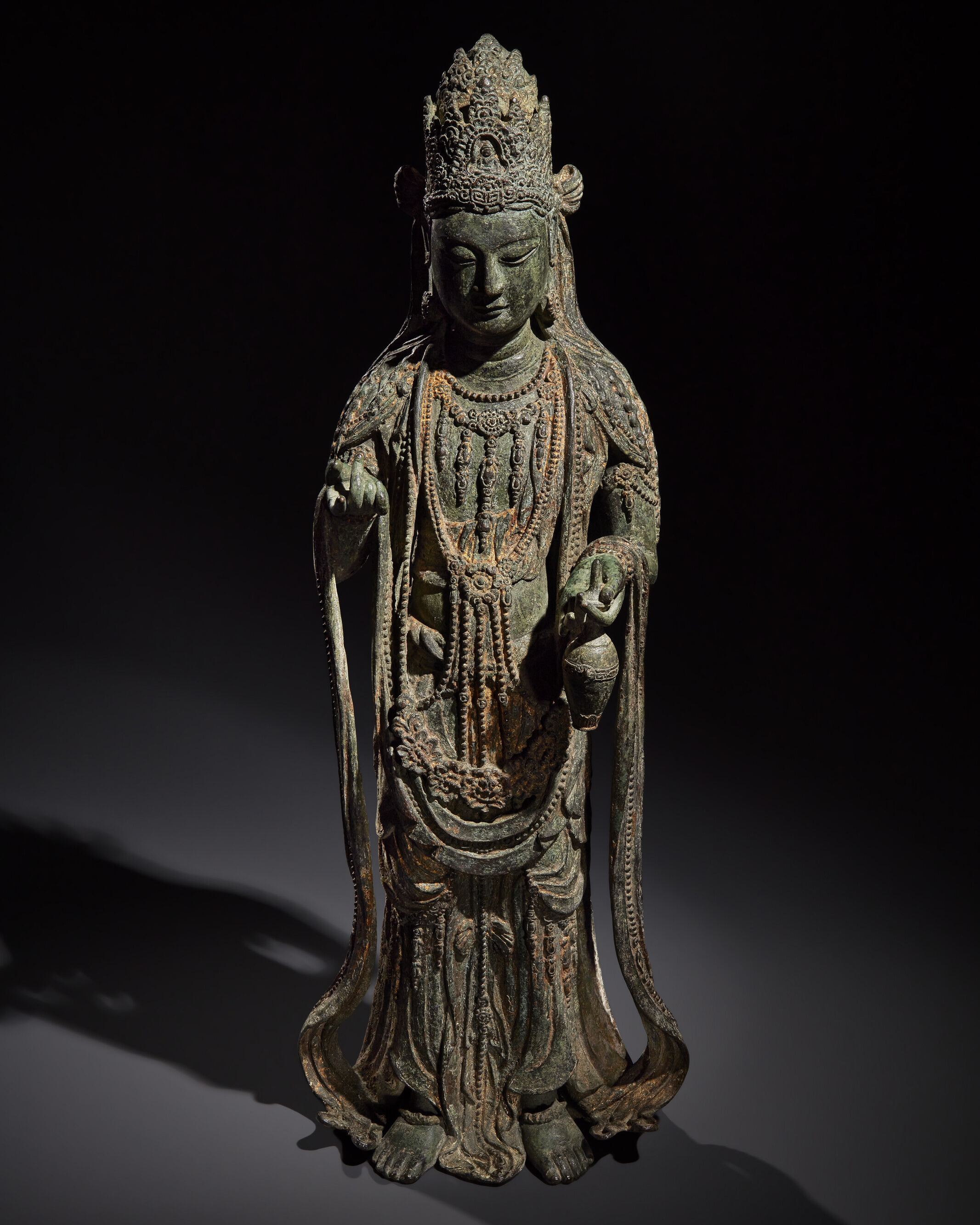
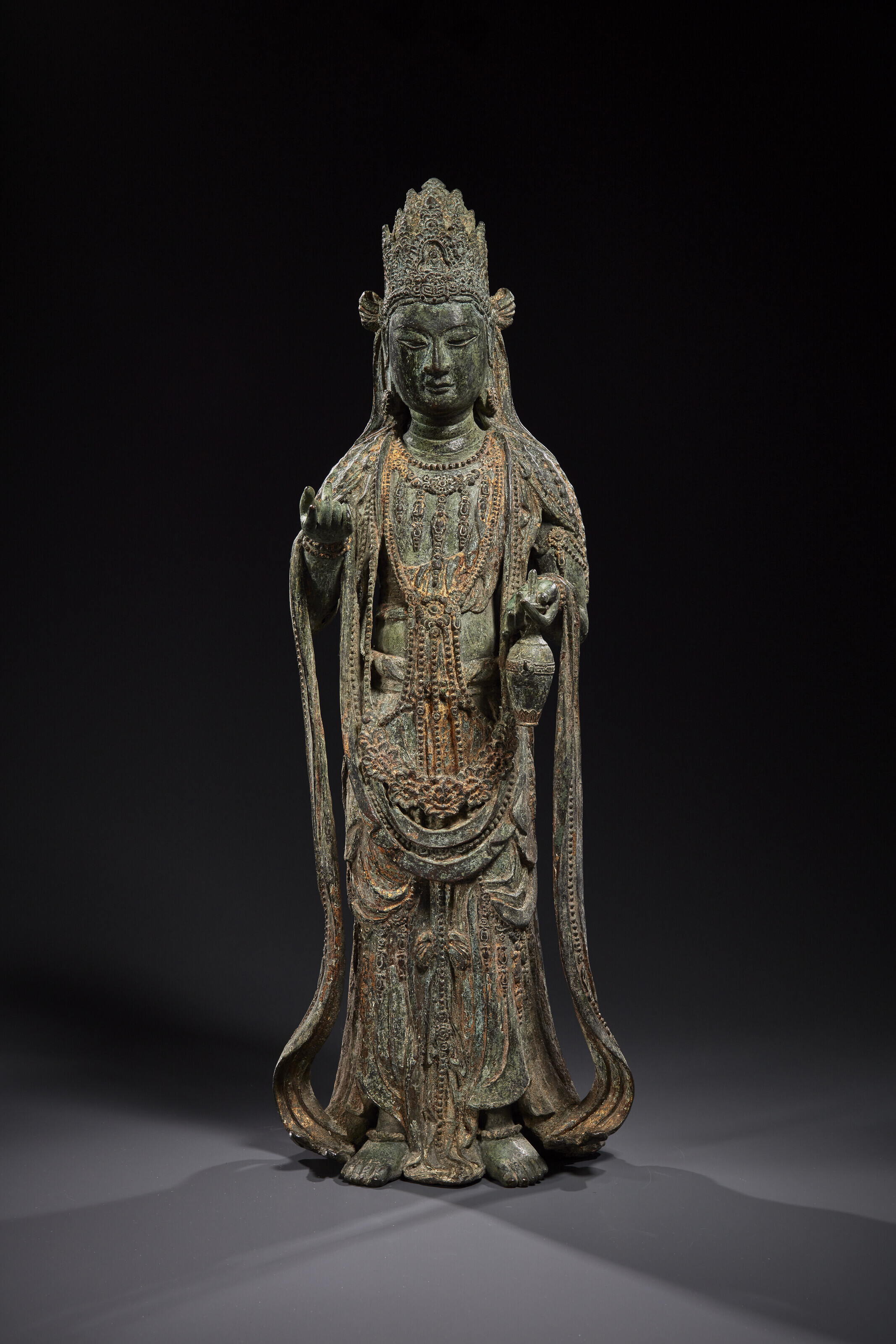
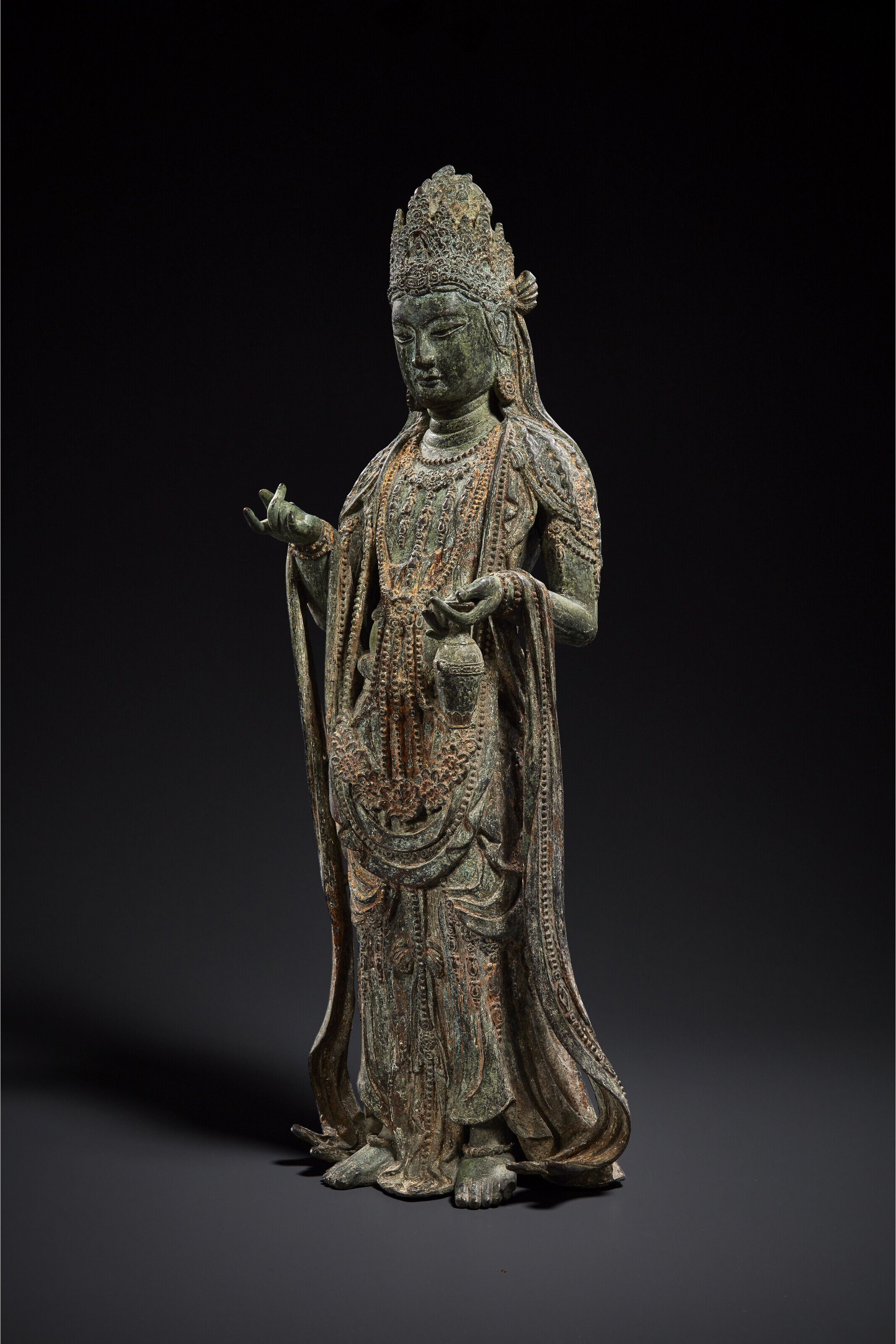
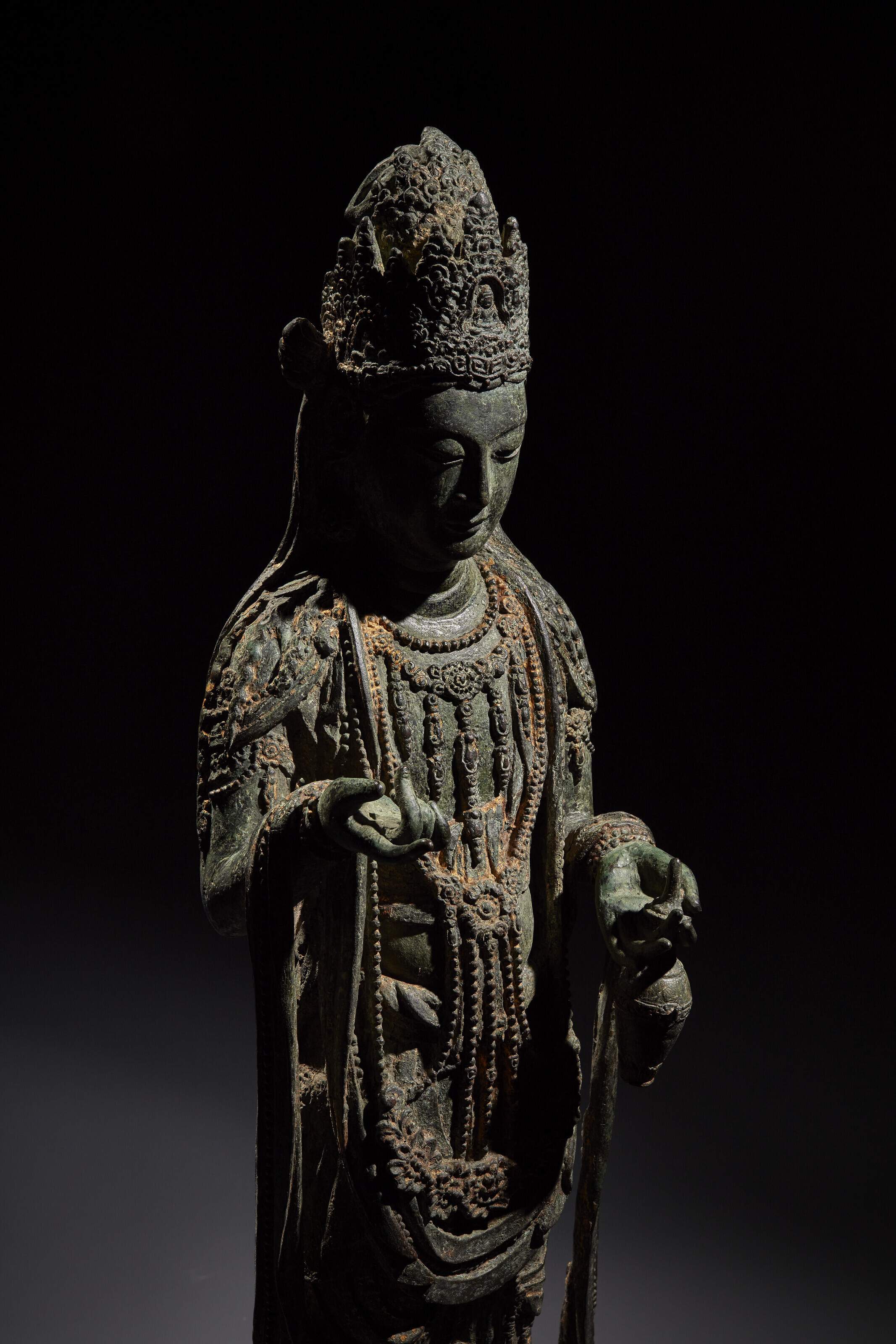
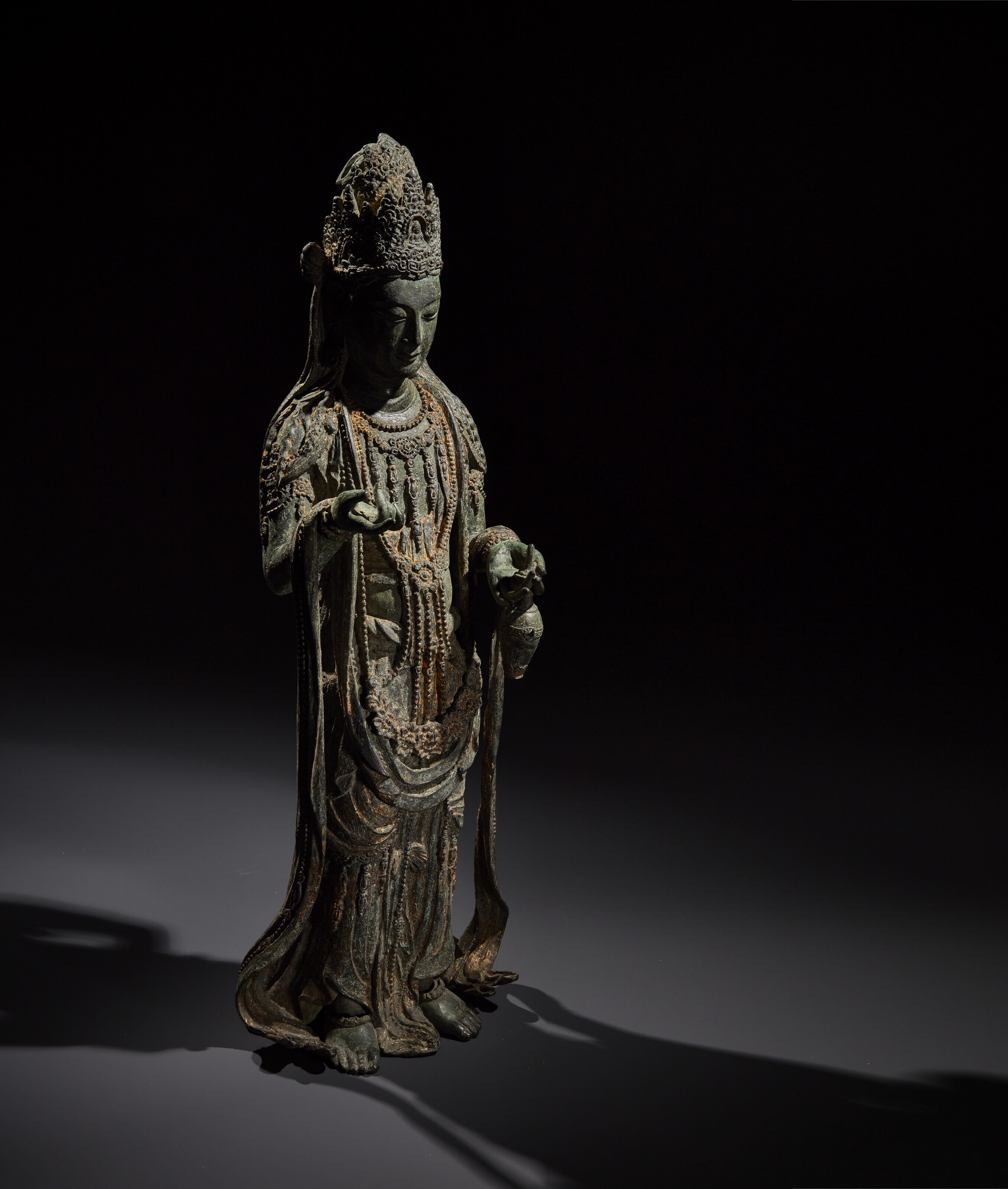
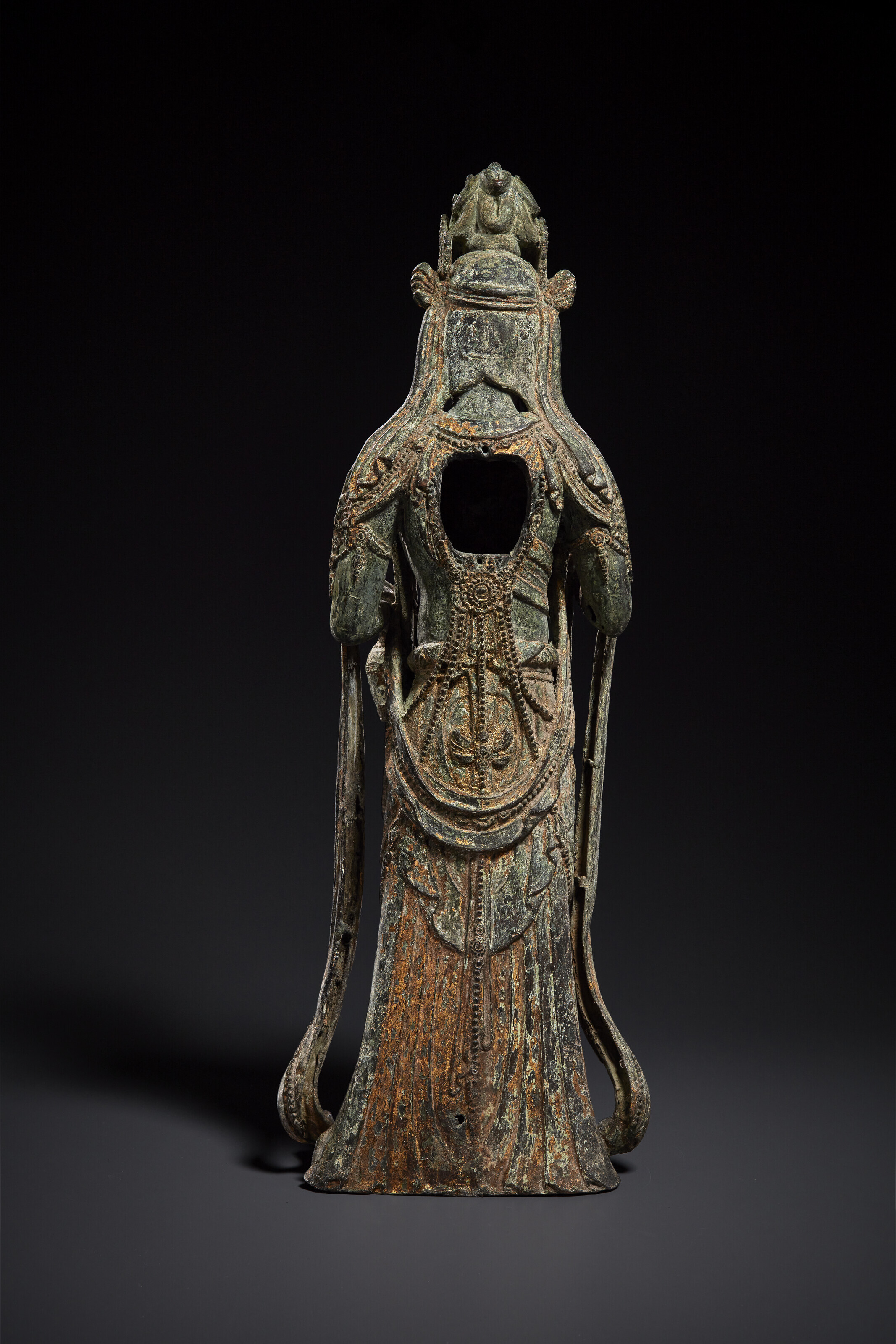 A MAGNIFICENT AND HIGHLY IMPORTANT GILT-BRONZE FIGURE OF GUANYIN
DALI KINGDOM, LATE 11TH-EARLY 12TH CENTURY
The bodhisattva is shown standing with both hands slightly raised with palms up, and holding in the proper left hand an ambrosia bottle (kundika). He wears a dhoti gathered by a sash around the waist and an abundance of jewelry, including armlets, bracelets, anklets, earrings, and an elaborate multi-strand necklace, as well as a shawl draped over the shoulders and a long scarf laid across the raised arms and falling on either side of the exposed bare feet. The face is cast with fine features below the tall foliate crown centered by a figure of Amitabha Buddha seated amidst vaporous clouds, while the hair is arranged in a tall coiffure atop the head and with long tresses cascading over the shoulders.
22 1⁄2 in. (57.1 cm.) high, oak stand
菩萨呈站立姿态,双手微微抬起,掌心向上,左手持一瓶净瓶(kundika)。下身穿裙衣(dhoti),腰间以帛带束系,佩戴璎珞、臂钏、腕钏、足钏、耳珰等众多饰物,双肩披覆帔帛,一条长帛搭于抬起的双臂之上,垂落在赤裸双足两侧。面容刻划精细,头顶高耸的花叶状宝冠中央,阿弥陀佛坐像端坐于祥云之间,头发梳成高髻于头顶,长发垂落肩头。
高 22 1⁄2 英寸(57.1 厘米),配橡木底座
来源:
C. T. Loo & Co., New York, circa 1924.
Grace Rainey Rogers (1867-1943) Collection, Greenwich, Connecticut.
Collection of the Late Grace Rainey Rogers; Parke-Bernet Galleries, Inc., 18-19 November 1943, lot 285.
C.T. Loo & Co., New York or Frank Caro, New York.
Arthur M. Sackler Collections.
Acquired from the above in 1982.
著录:
Tch'ou To-yi, Bronze Antiques de la Chine apparentant a C.T. Loo et Cie, Paris and Brussels, 1924, pl. 39-4.
Chinese Art Treasures, Vol. IV, Series A, Institute of Chinese Culture, Taiwan, 1961, pl. 20.
展览:
Los Angeles, Los Angeles County Museum of Art, Chinese Art Galleries: Stone Age Through Modern Times, 3 June 1978-2009.
On loan: Ithaca, NY, Herbert F. Johnson Museum of Art, Cornell University, 2011-2014.
重要珍稀大理国鎏金铜观音像
作者:Robert D. Mowry
哈佛艺术博物馆(Harvard Art Museums)Alan J. Dworsky中国艺术荣誉策展人
佳士得高级顾问
此尊庄严的观音菩萨(梵文Avalokiteshvara,中文称“观音菩萨”)像出自大理国(937–1253年),年代约为11世纪末至12世纪初,不仅瑰丽动人,更属稀有且极为重要之作。此像属于一小批手持净瓶与杨柳枝的鎏金铜观音造像群,该组造像在风格与整体面貌上均密切相关。本像高57.2厘米(22.5英寸),为该组造像中高度最高者之一。此像 provenance 显赫,曾为著名藏家Grace Rainey Rogers(1867–1943)旧藏,这一 provenance 记录表明,本像早在20世纪上半叶已流入美国。此像还经著名古董商C.T. Loo(1880–1957)之手,并早在1924年即已出版著录。
本像表现的是观音菩萨——更正式的名称为“观世音菩萨”——即大慈大悲的菩萨。观音被视为阿弥陀佛的化现,其宝冠正前方的小型阿弥陀佛像是其身份标识。菩萨左手所持之瓶,内可能装有“甘露”(梵文amrita,中文亦音译为“阿密哩多”或意译为“甘露”);此瓶亦可能为净瓶(kundika),即用于洒净的礼器。净瓶与甘露瓶均为观音的图像学标志之一。微微抬起的右手中,本像原持有杨柳枝;今已大部残失,仅存枝端。杨柳枝用于洒净,在中国古代象征身心的疗愈。与净瓶和甘露瓶一样,杨柳枝亦属观音的标准图像特征。杨柳枝作为观音的图像学标志,最早出现于6世纪末的中国,8世纪以后成为定式——这一传统多见于东亚艺术,而非印度或东南亚艺术。1
持杨柳枝与宝瓶的观音像属于中国而非印度的图像传统,通常被称为“杨柳枝观音”(Yangliu Guanyin,即Willow-Branch Guanyin)。大理国的杨柳枝观音像有时也被称为Bhaisajyaraja Avalokiteshvara,此梵文名称汉译为“药王”,意指杨柳枝的疗愈之力。此类造像最早出现于6世纪末的隋代(581–618年),以鎏金铜材质为主,纽约大都会艺术博物馆所藏一例(12.161a–c)可资佐证。2 这些早期造像确立了一种在后世(尤其在大理国)被沿用的类型范式。
观世音(Guanshiyin)是梵文Avalokiteshvara的意译,意为“观察世间音声者”,指观音能听闻苦难者的哀号和祈愿者的祈求。作为阿弥陀佛的世间化身,观音在释迦牟尼佛(历史佛陀)入灭之后、弥勒佛(未来佛)出世之前的时期守护世间。《法华经》第二十五品《观世音菩萨普门品》——这部最为著名的佛经——将观音描述为一位听闻众生呼号、不倦地帮助所有称其名号者的大慈大悲的菩萨。
观音属于佛教神祇中品位较高的“菩萨”(bodhisattva)。菩萨是已证得觉悟但仍无私地推迟进入涅槃,以帮助其他众生获得觉悟的慈悲存在。“菩萨”意为“觉悟者”,是利他者,致力于帮助其他众生通过证悟而从生死轮回中解脱。
菩萨以印度王子之姿呈现,身着华丽庄严的装束,这指向了悉达多·乔达摩(Siddhartha Gautama)在成佛(成为释迦牟尼佛)之前的世俗身份。这意味着,正如生为太子的悉达多(传统上约公元前563–前483年)最终成佛,菩萨在一切众生证得觉悟之后,也终将成佛。
菩萨身着华服,长发通常梳成高髻于头顶,长发垂落肩部。如本像所示,高髻有时周围戴有宝冠。菩萨身披庄严的帛带、华丽的锦缎裙衣(dhoti),并佩戴璎珞、臂钏、腕钏、足钏等众多饰物。与佛陀一样,菩萨亦有垂长的耳垂,但与佛陀不同的是,菩萨通常佩戴耳珰。
本像原立于莲花底座之上,供奉于佛坛。由于大理国此类铜像的原装底座鲜有存世,本像原配莲花底座的具体形制已不得而知。尽管如此,本像的底座或许与纽约大都会艺术博物馆所藏一件12世纪大理国阿嵯耶观音像的双层莲座相似(42.25.28)。3 本像底座亦可能与台北故宫博物院所藏一件相关杨柳枝观音像的底座有相似之处,4 不过台北那件像的底座很可能是后配之物,因其风格更接近明代(1368–1644年)和清代(1644–1911年)造像的底座样式(图1)。
本像在寺庙受供奉时,背后应配有头光或背光(mandorla)——即莲花瓣形的光轮,象征从圣体放射出的光芒,从而彰显其神圣地位。本像及该组相关造像的头部后方或肩胛之间均无用于固定背光的榫头,这表明:要么背光是以雕塑形式附着于现已失落的底座之上并由其支撑,要么背光是绘制于造像后方的墙壁上。1978年于云南省大理崇圣寺千寻塔内发现的8至9世纪金质阿嵯耶观音像所配的镂空银背光,可为我们推测本像原配背光的可能样式提供参考。
造像背部高处有一方形开口,边缘略带弧度,通往中空的内部。此开口原应覆盖一块鎏金铜板,其纹饰与周围底面相协调。这块盖板既遮挡了造像内部空腔,也固定了在开光加持仪式中放置于其内的供奉物品。佛教造像的开光加持包括一套依照经文详述的复杂仪轨。该仪轨最重要部分是在造像内部空腔中置入供奉物,通常包括小型纸本经咒、纸卷、玻璃珠、织物残片、小型铜印、金属或木制小像、谷物种子以及各种其他特殊物品。人们相信这些供奉物能为造像注入灵性,赋予其宗教效力。
此尊庄严造像及其同类作品出自大理国(937–1253年),年代约为11世纪末至12世纪初。大理国是中国西南部一个独立、虔信佛教的王国,与中国的宋朝(907–1279年)同时代,其疆域大致相当于今天的云南省。902年南诏(中国南方的一个独立王国)灭亡,此后该地区三个政权相继迅速兴衰,最终段思平(893–944年)于937年夺取政权,建立大理国。与南诏和唐朝(618–907年)关系紧张不同,大理与宋朝关系和睦,这促进了艺术与文化的交流。段思平及其继承者和大理国人民自称汉族,这有利于与宋朝的关系,也是“大理是中国的一个王国”这一看法的依据。
大理与辽代的风格均源自唐代,而宋、辽、大理三者之间的风格互动共同构成了一个复杂的艺术环境。因此,大理、宋、辽的造像在视觉和风格上表现出诸多相似性。这种相似性导致本组密切相关的观音像在年代和地域归属上存在广泛分歧——事实上,不同收藏、不同博物馆对这些造像的归属判定各异,有定为五代(907–960年)的,有定为大理国的,也有定为宋代或辽代的。
支持本像及其同类作品归属大理国的风格特征颇多,包括:方阔的面庞配以小巧的下巴;细长的杏仁眼,平视前方;大量装饰云纹(或其他实例中的花卉或宝珠纹)的精美宝冠;双耳上方头部两侧出现的蝴蝶结或宝冠构件,其飘带或珠串垂落于肩部;繁复的饰物,尤以垂落胸前、独具特色且极其华美的多层璎珞以及腰间的宝花纹饰牌为著;多条帛带与飘带;以及对每一尊造像正面与背面的精美处理,帛带、饰物和衣褶的细节在正背面均被细致刻画。这些元素在大理国造像中皆有对应,如日本新田集藏(Nitta Collection,1912–2006)旧藏、现属台北故宫博物院的鎏金铜杨柳枝观音像(Bhaisajyaraja Avalokiteshvara),5 以及大都会艺术博物馆藏鎏金铜千手千眼观音像(56.223)。6 尤其值得注意的是,肩部的披肩式帔帛、低腰式裙衣(dhoti)、垂落胸前的多层璎珞以及腰间带有宝花纹饰牌的珠串,亦可与昆明云南省博物馆所藏一件12世纪大理国菩萨坐像中的相应元素相参照。7
构成这一风格统一群体的其余为数不多的大理国鎏金铜像包括:日本鸟取县西伯郡大山寺所藏一尊观音立像(高37厘米);8 柏林亚洲艺术博物馆(Museum für Asiatische Kunst, Staatliche Museen zu Berlin)藏一尊(图2);上海博物馆藏一尊(高23厘米,图3);9 里士满弗吉尼亚美术馆(Virginia Museum of Fine Arts, Richmond)藏一尊(高48厘米);10 日本旧新田集藏(Nitta Collection)一尊(高46.2厘米);11 台北故宫博物院藏一尊(高53厘米);12 以及香港慈山寺佛教艺术博物馆藏一尊(高34厘米,编号2018.07)。
本尊杨柳枝观音像拥有辉煌的展览与出版记录,以及悠久显赫的 provenance,是一件稀有且极为重要的大理国雕塑——实为中国雕塑史上的一件杰作。作为该组相关造像中高度最高者之一,它出色地代表了11世纪末至12世纪初对隋代确立的、延续不断的图像类型的一次精彩诠释。
An Important Rare Dali Kingdom Gilt-bronze Sculpture of Guanyin
By Robert D. Mowry
Alan J. Dworsky Curator of Chinese Art Emeritus,
Harvard Art Museums, and
Senior Consultant, Christie’s
From the Dali Kingdom (937–1253) and dating to the late eleventh or early twelfth century, this majestic sculpture of the Bodhisattva Avalokiteshvara, who is known in Chinese as Guanyin Pusa, is not only beautiful and compelling but rare and exceptionally important. This sculpture belongs to a small group of gilt bronzes that depict Guanyin holding a vase and a willow branch, the several sculptures in the group all closely related in style and general appearance; standing 57.2 cm in height (221/2 in), the present image ranks among the tallest sculptures in this group. This sculpture claims a distinguished provenance, having formerly belonged to the prominent collector Grace Rainey Rogers (1867–1943), this provenance documenting that the sculpture was already in the United States during the first half of the twentieth century. The sculpture also passed through the hands of renowned art dealer C.T. Loo (1880–1957), and was published as early as 1924.
The sculpture portrays Guanyin Pusa —more formally known as Guanshiyin Pusa—the Bodhisattva of Infinite Compassion. Guanyin is regarded as a spiritual emanation of Amitabha and is identified by the small representation of Amitabha that appears at the front of the bodhisattva’s crown. The vase that the bodhisattva holds in the left hand likely contains ambrosia, or the nectar of immortality, known in Sanskrit as amrita and in Chinese as both yamilida and ganlu; it’s also possible that the vase is a kundika, or sprinkler for dispensing holy water in purification rituals; both the kundika and the ambrosia bottle are iconographic symbols associated with Guanyin. In the slightly elevated right hand, the figure originally held a willow branch; now mostly broken away, only the branch’s lower end remains. Used to sprinkle holy water, the willow branch was an ancient Chinese symbol of healing, both physical and spiritual. Like the kundika and the ambrosia vase, the willow branch figures among Guanyin’s standard iconographic attributes. The willow branch first appeared in association with Guanyin as an iconographic attribute in the late sixth-century China and became standard after the eighth century, especially in East Asian, as opposed to Indian or Southeast Asian, art.1
A Chinese rather than an Indian iconographic convention, images of Guanyin holding a willow branch and a vase are often termed Yangliu Guanyin, or Willow-Branch Guanyin; images of the Willow-Branch Guanyin from the Dali Kingdom are sometimes also called Bhaisajyaraja Avalokiteshvara, a Sanskrit name that translates into Chinese as Yaowang, or Medicine King, a reference to the healing powers of the willow branch. Such images first appeared in the late sixth century, during the Sui dynasty (581–618), typically in gilt bronze, as witnessed by the example in the Metropolitan Museum of Art, New York (12.161a–c).2 Such early images established a typology that would be followed in later periods, particularly in the Dali Kingdom.
A translation of the Sanskrit name Avalokiteshvara, Guanshiyin means “[The One Who] Perceives the Sounds of the World”, a reference to Guanyin’s ability to hear both the cries of the afflicted and the prayers of supplicants. An earthly manifestation of the Buddha Amitabha, Guanyin guards the world during the interval between the departure of the Historical Buddha Shakyamuni and the appearance of Maitreya, the Buddha of the Future. Chapter 25, Guanshiyin Pusa Pumenpin, of the Lotus Sutra, the best-known of all Buddhist scriptures, describes Guanyin as a compassionate bodhisattva who hears the cries of sentient beings and who works tirelessly to help all those who call upon his name.
Guanyin belongs to an elevated category of Buddhist deities known as bodhisattvas, benevolent beings who have attained enlightenment but who have selflessly postponed entry into nirvana in order to assist other sentient beings in gaining enlightenment. Meaning “enlightened being”, a bodhisattva is an altruistic being who is dedicated to assisting other sentient beings in achieving release from the samsara cycle of birth and rebirth through the attainment of enlightenment.
Elegantly outfitted in sumptuous trappings, bodhisattvas are presented in the guise of an early Indian prince, a reference to Siddhartha Gautama’s worldly status before he became the Historical Buddha Shakyamuni, implying that as Siddhartha (traditionally, c. 563–c. 483 BC), who was born a crown prince, became a Buddha, so will bodhisattvas eventually become Buddhas, once all sentient beings have attained enlightenment.
Richly attired, bodhisattvas are represented with long hair often arranged in a tall coiffure, or bun, atop the head and with long tresses of hair cascading over the shoulders. A crown sometimes surrounds the high coiffure as revealed by this sculpture. Bodhisattvas wear ornamental scarves, dhotis of rich silk brocade, and a wealth of jewelry that includes necklaces, armlets, bracelets, and anklets. Like Buddhas, bodhisattvas have distended earlobes, but, unlike the Buddhas, they typically wear earrings.
This sculpture originally stood on a lotus base and was presented on an altar. As few original bases of comparable Dali bronze sculptures have survived, the exact appearance of this sculpture’s original lotus base remains unknown. Even so, it is possible that this sculpture’s base might have resembled the double-lotus pedestal of the twelfth-century, Dali Kingdom Acuoye Guanyin in New York’s Metropolitan Museum of Art (42.25.28).3 The base might also have shown some similarity to that associated with the related Willow-Branch Guanyin sculpture in the National Palace Museum, Taipei,4 though the Taipei stand might well be a later replacement for a lost original, as its style corresponds more closely to pedestals of Ming (1368–1644) and Qing (1644–1911) sculptures. (Fig. 1)
When under worship in a temple, the present sculpture would have been backed by either a halo or a mandorla, the lotus-petal-shaped aureole suggesting light radiating from the deity’s body and thus signaling its divine status. That this sculpture and the related ones in this group lack a tenon at the back of the head or between the shoulder blades to secure a mandorla suggests either that a sculpted mandorla was affixed to and supported by the now-lost base or that the mandorla was painted on the wall behind the figure. The openwork silver mandorla associated with the eighth- or ninth-century gold Acuoye Guanyin discovered in 1978 inside the Qianxun Pagoda at the Chongsheng Temple, Dali, Yunnan province suggests the possible appearance of the present sculpture’s original mandorla.
A square opening with gently curved sides high on the figure’s back gives access to the sculpture’s hollow interior; the opening presumably was covered with a gilt-bronze plate whose decoration comported with that of the surrounding matrix. The plate concealed the sculpture’s interior cavity from view and secured in place the dedicatory objects deposited within during the consecration ceremony. The consecration of Buddhist sculptures included an elaborate ritual executed in accordance with canonical texts that describe the process in detail. The most important part of the ritual was the placement of consecratory objects within the sculpture’s interior cavity, those objects typically including small paper sutras and prayer scrolls, glass beads, textile fragments, small bronze seals, small sculptures of metal or wood, seeds, and assorted other special goods. Such dedicatory items were believed to enliven the image and accord it religious efficacy.
Created in the Dali Kingdom (937–1253), this majestic sculpture and its congeners date to the late eleventh or early twelfth century. An independent, devoutly Buddhist kingdom in southwestern China, Dali was coeval with China’s Song dynasty (907–1279) and more or less congruent with present-day Yunnan province. After the 902 fall of Nanzhao, an independent kingdom in southern China, and following the rapid rise and collapse of three successive states in the area, Duan Siping (893–944), seized power in 937 and established the dynastic Dali Kingdom. Unlike Nanzhao, which had had a contentious relationship with the Tang dynasty (618–907), Dali enjoyed cordial relations with the Song, which facilitated artistic and cultural exchange. Duan Siping, his heirs, and the people of Dali claimed to be ethnically Han Chinese, which facilitated relations with Song and which underlies the belief that Dali is a Chinese kingdom.
The derivation of Dali and Liao styles from Tang and the interplay amongst the styles of Song, Liao, and Dali created a complex artistic milieu, the sculptures from Dali, Song, and Liao thus exhibiting many visual and stylistic similarities. Those similarities have resulted in the widely varying attributions of the closely related Guanyin sculptures in this group; in fact, attributions of these sculptures vary from collection to collection, from museum to museum, and range from Five Dynasties (907–960) and Dali Kingdom to Song and Liao.
The stylistic characteristics that favor attribution of this sculpture and its congeners to the Dali Kingdom are numerous and include the squarish face with diminutive chin; the small, almond-shaped eyes that look directly forward; the elaborate crown extensively embellished with cloud motifs (or, in other instances with flowers or jewels); the bows or crown elements that appear on either side of the head immediately above the ears and from which ribbons or strands of pearls descend onto the shoulders; the wealth of jewelry, including the distinctive and very elaborate necklace with multiple strands that descend onto the chest and with a medallion at the waist; the numerous scarves and sashes; and the exquisite finishing of both the front and the back of each sculpture, with details of scarves, jewelry, and drapery folds meticulously articulated on both front and back. These elements find counterparts in such Dali sculptures as the gilt-bronze Willow-Branch Guanyin (Bhaisajyaraja Avalokiteshvara) formerly in the Nitta Collection, Japan (1912–2006) and now in the National Palace Museum, Taipei,5 as well as in the gilt-bronze Thousand-Arm, Thousand-Eye Avalokiteshvara in the Metropolitan Museum of Art (56.223).6 In particular, the cape-like shawl over the shoulders, the low-waisted dhoti, the necklace with strands dangling onto the chest, and the long strand of beads with a medallion at the waist also find parallels in those of a twelfth-century, Dali Kingdom seated bodhisattva in the Yunnan Provincial Museum, Kunming.7
The few other remaining Dali, gilt bronzes that form this cohesive group include the standing Guanyin sculptures at Daisen-ji Temple in Saihuku District, Tottori Prefecture, Japan (H. 37 cm);8 in the Museum für Asiatische Kunst, Staatliche Museen zu Berlin (Fig. 2); in the Shanghai Museum, (H. 23 cm) (Fig. 3);9 in the Virginia Museum of Fine Arts, Richmond (H. 48 cm);10 in the former Nitta Collection, Japan (H. 46.2 cm);11 in the National Palace Museum, Taipei (H. 53 cm);12 and in the Tsz Shan Monastery Buddhist Art Museum, Hong Kong (H. 34 cm) (2018.07).
With an impressive record of exhibition and publication and with a long and distinguished provenance, this Willow-Branch Guanyin is a rare and exceptionally important Dali-Kingdom sculpture; indeed, it is a masterwork of Chinese sculpture. Among the tallest in the small group of related sculptures, it well represents the late eleventh- to early twelfth-century interpretation of a continuing iconographic type established during the Sui dynasty.
1 Denise Patry Leidy, Donna Strahan, et al., Wisdom Embodied: Chinese Buddhist and Daoist Sculpture in the Metropolitan Museum of Art (New York: Metropolitan Museum of Art; and New Haven, CT, and London: Yale University Press), 2010, p. 86, no. 12.
2 See: Leidy, Strahan, et al., Wisdom Embodied, 2010, pp. 86-88, no. 12.
3 See: Leidy, Strahan, et al., Wisdom Embodied, 2010, . 137, no. 32.
4 Illustrated in the online Encyclopedia of Buddhist Arts (Taipei); see: https://arts.fgs.org.tw/fgs_arts/tw/keyword_search_detail.php?arg=QkVMCO9ZkwlsKb1rN1nS8ERdqx%2F8bxQc3iGehhUo4BbzWXeLVF%2B%2FLkaeDwo
5 See: Christie’s, Hong Kong, ed., Glories of Buddhist Art, 29 May 2019 (Hong Kong: Christie’s), 2019, pp. 47-49, lot 2710.
6 See: Leidy, Strahan, et al., Wisdom Embodied, 2010, pp. 138-140, no. 33.
7 See: Leidy, Strahan, et al., Wisdom Embodied, 2010, p. 140, fig. 100.
8 See: Matsubara Saburō, Chūgoku Bukkyō Chōkoku Shiron [The Path of Chinese Buddhist Sculpture], vol. 3 Tō · Godai · Sō [Tang, Five Dynasties, Song] (Tokyo: Yoshikawa Kobunkan), 1995, pl. 817
9 See: Matsubara, Chūgoku Bukkyō Chōkoku Shiron, vol. 3, 1995, pl. 818
10 See: Hugo Munsterberg, Chinese Buddhist Bronzes (Rutland, VT), 1967, figs. 56a and 56b; also see: National Palace Museum, ed., Chinese Art in Overseas Collections: Buddhist Sculpture (Taipei: National Palace Museum), 1986, no. 145 also see: Lidai Guanyin baoxiang [Treasured Images of Guanyin through the Ages], (Beijing: Zhongguo Shudian), 1998, p. 138
11 See: National Palace Museum, ed., The Crucible of Compassion and Wisdom: Special Exhibition Catalog of the Buddhist Bronzes from the Nitta Group Collection at the National Palace Museum (Taipei: National Palace Museum), 1987, p. 186, pl. 90 also see: Christie’s, Hong Kong, ed., Arts for the Emperors, Visions of the Buddhist Paradise, and Fine Chinese Works of Art, 26 April 1998 (Hong Kong: Christie’s), 1998, lot 603.
12 Illustrated in the online Encyclopedia of Buddhist Arts (Taipei) see: https://arts.fgs.org.tw/fgs_arts/tw/keyword_search_detail.php?arg=QkVMCO9ZkwlsKb1rN1nS8ERdqx%2F8bxQc3iGehhUo4BbzWXeLVF%2B%2FLkaeDwo

