
侧边栏

10世纪藏西克什米尔铜鎏金莲花手观音立像(纽约佳士得)
尺寸:高68.5 cm
年代:9-10世纪
质地:铜鎏金
风格:藏西克什米尔
来源:拍卖会
成交:1,538,500美元(2008.09)
参阅:外部链接
鉴赏:
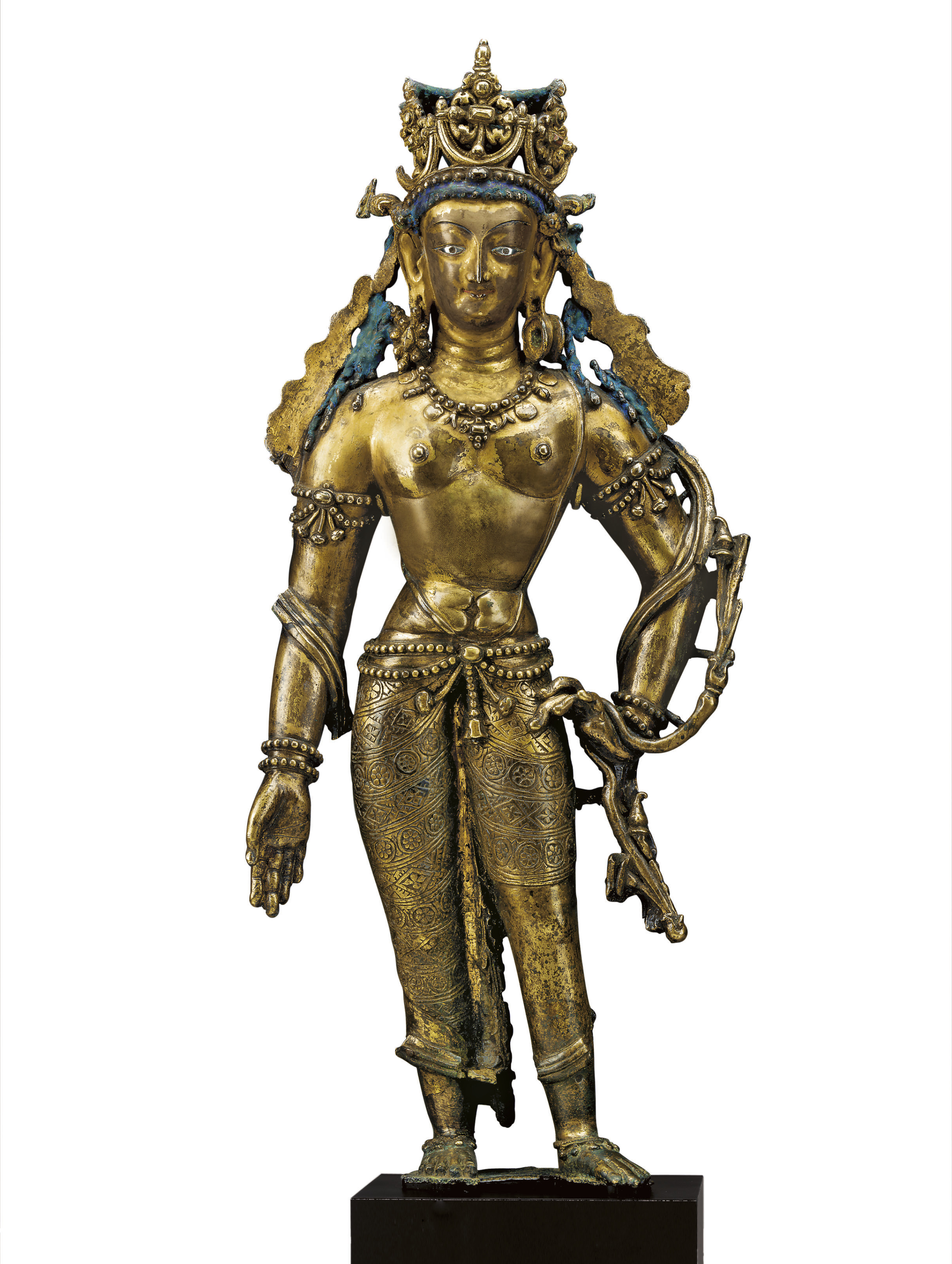 An important and large gilt bronze figure of Avalokiteshvara
Kashmir school in Western Tibet, 9th/10th century
Expressively cast standing with his right hand lowered in the open-handed gesture of compassion varada mudra and his left hand resting against his hips, wearing a long dhoti finely incised with alternating bands patterned with diamonds and florets, an eloborate beaded necklace, armlets and a sash, all with pendent jewels, the ears with a diamond pendant and large earrings, the chest well-defined and powerfully modeled, his face with a benign expression with large almond-shaped eyes inlaid in silver, surmounted by a headdress of crescent moons enclosing jewels, with undulating sashes flaring down to the shoulders
这尊造像姿态生动,呈站立姿。其右手低垂,结施与印(varada mudrā),即象征慈悲的开掌手势;左手则倚靠于臀部。下身系着一条长裙(dhoti),裙上精刻有菱形与小花图案交替排布的带饰。佩戴着精致的串珠项链、臂钏和一条饰有垂坠珠宝的圣带(sash),双耳饰有钻石耳坠及大耳环。胸膛线条分明,肌肉塑造健硕有力。面容神情慈悲和善,杏仁状的大眼睛以银镶嵌。头上戴着新月簇拥珠宝的头冠,起伏飘动的缯带飘拂至肩部两侧。
This is a most remarkable bronze marking a milestone at the very emergence of a flourishing tradition of casting bronze images in Tibet, of large size for its period and one of very few existing examples that were gilt. It displays classic Kashmiri stylistic elements, for example in the pronounced modeling of the muscles around the navel and strong upper torso, the accentuated roundness of the beaded jewelry following Indian Pala period prototypes, and silver inlaid eyes. The crown type is first noted in Bamiyan, while the triple crescent crown with side rosettes as in the present example, is characteristic of Kashmiri style of the 8th/9th century, as is the dhoti worn with one short leg secured with a sash hanging down between the flexed legs, see D. Klimburg-Salter, The Silk Route and the Diamond Path, 1982, pp. 104, 163 and pl. 30. The two different types of earrings point to an Indian tradition along with the beaded jewelry and is a highly unusual feature in the Kashmiri context.
These elements of style and fashion were introduced to Western Tibet most notably during the second propagation of Buddhism from the mid 10th century onward. This figure represents an extremely important early example for Kashmiri craftsmen – and to a lesser degree the influence of artisans from Himachal Pradesh – likely working in the Guge Kingdom of Western Tibet during the earliest phase, illustrative of the transfer of an iconographic type from Kashmir to Tibetan artists. The epitome of this exchange was reached at the very end of the 10th century, when Rinchen Zangpo, the 'Great Translator', commissioned an image of Avalokiteshvara in homage to his father from the image maker Bidhaka in Kashmir in 998. It was installed at Kha-tse, Western Tibet, where it still remains and where it was first identified by Thomas and David Pritzker based on biographical accounts of Rinchen Zangpo, see D. Pritzker, 'The Treasures of Par and Kha-tse,' Orientations, September 2000, pp. 131-33, ill. p. 133. Zangpo's biography further states that he returned from Kashmir with 32 artists and craftsmen to work for Tibetan patrons, see U. von Schroeder, Buddhist Sculptures in Tibet, vol. 1, 2001, p. 74.
For other examples of this iconographic type, compare with a large figure of Avalokiteshvara in the Pritzker Collection, with a similarly modeled torso, see A. Heller, Tibetan Art, 1999, cat. no. 34; a figure of Vajrasattva at the Potala Palace, dated circa 10th century, in U. von Schroeder, Buddhist Sculpture in Tibet, vol. 1, 2001, cat. no. 31B-C; a figure in the same stance, identified as Manjushri, at the Jokang, see U. von Schroeder, Buddhist Sculpture in Tibet, 2001, vol. 1, pl. 41B-E, p. 155; and a closely related example of Padmapani, from the collection of Mr. and Mrs. John D. Rockefeller 3rd, in U. von Schroeder, Indo-Tibetan Bronzes, 1981, fig. 22A, with similarly modeled details, specifically regarding the jewelry and textile designs. The above mentioned examples all display ornate floral garlands and greater ornamentation, while the present example, with its powerful modeling of the torso and clarity in the overall design with plain garland, is likely of earlier date.
这尊铜像极为卓绝,标志着西藏繁荣铜像铸造传统兴起过程中的一座里程碑。其体量在同期作品中堪称宏大,且是少数留存至今且施以鎏金的实例之一。它展现出典型的克什米尔风格元素,例如脐周肌肉的显著塑造与强劲的上身躯干、遵循印度波罗时期范式的饱满圆润的串珠饰,以及银嵌眼睛。此种冠式最早见于巴米扬,而本品所示的三新月冠带侧边花饰,正是8至9世纪克什米尔风格的特征;同样具有风格特征的还有所着的短摆一侧固定的围裙式腰布,其圣带垂于两腿之间(参见D. Klimburg-Salter,《The Silk Route and the Diamond Path》,1982年,第104、163页及图版30)。两种不同类型的耳饰及串珠饰品指向了印度传统,这在克什米尔语境中极为罕见。
这些风格与时尚元素主要自10世纪中叶起,随着佛教后弘期传入西藏西部。此像代表了极为重要的早期范例——由克什米尔工匠(以及较小程度上来自喜马偕尔邦的工匠影响)很可能在西藏西部古格王国的最早阶段制作,体现了克什米尔向西藏艺术家传递造像样式的过程。这种交流的顶峰出现在10世纪末:998年,“大译师”仁钦桑布(Rinchen Zangpo)在克什米尔委托造像师比达卡(Bidhaka)制作了一尊观音像,以敬奉其父。该像供奉于西藏西部的喀孜寺(Kha-tse),至今仍存,并由托马斯·普利兹克(Thomas Pritzker)与大卫·普利兹克(David Pritzker)根据仁钦桑布的传记记载首次加以确认(参见D. Pritzker,《The Treasures of Par and Kha-tse》,《Orientations》杂志,2000年9月,第131–133页,图见第133页)。仁钦桑布的传记还记载,他从克什米尔带回32位艺术家与工匠为西藏施主们服务(参见U. von Schroeder,《Buddhist Sculptures in Tibet》,第一卷,2001年,第74页)。
与此尊造像类型相关的其他实例包括:普利兹克收藏(Pritzker Collection)中一尊大型观音像,其躯干塑造与本件相似(参见A. Heller,《Tibetan Art》,1999年,图录第34号);布达拉宫(Potala Palace)一件约10世纪的金刚萨埵像(参见U. von Schroeder,《Buddhist Sculpture in Tibet》,第一卷,2001年,图录第31B–C号);大昭寺(Jokang)一尊同一姿态、被认定为文殊菩萨的造像(参见U. von Schroeder,《Buddhist Sculpture in Tibet》,2001年,第一卷,图版41B–E,第155页);以及约翰·D·洛克菲勒三世夫妇(Mr. and Mrs. John D. Rockefeller 3rd)旧藏中一尊极为相近的莲华手菩萨像(Padmapani)(参见U. von Schroeder,《Indo-Tibetan Bronzes》,1981年,图22A),其珠宝与织物纹样的塑造方式与本件相似。以上提及的实例皆饰有华丽的花蔓及更为繁复的装饰,而本件造像具有强劲的躯干塑造、清晰的整体设计以及素朴的花蔓,因此年代可能更早。

