
侧边栏

明代永乐宫廷铜鎏金持经观音(纽约佳士得)
尺寸:高22.3 cm
年代:明代永乐
质地:铜鎏金
风格:永乐宫廷
来源:拍卖会
成交:2,629,000美元(2014.03)
参阅:外部链接
鉴赏:
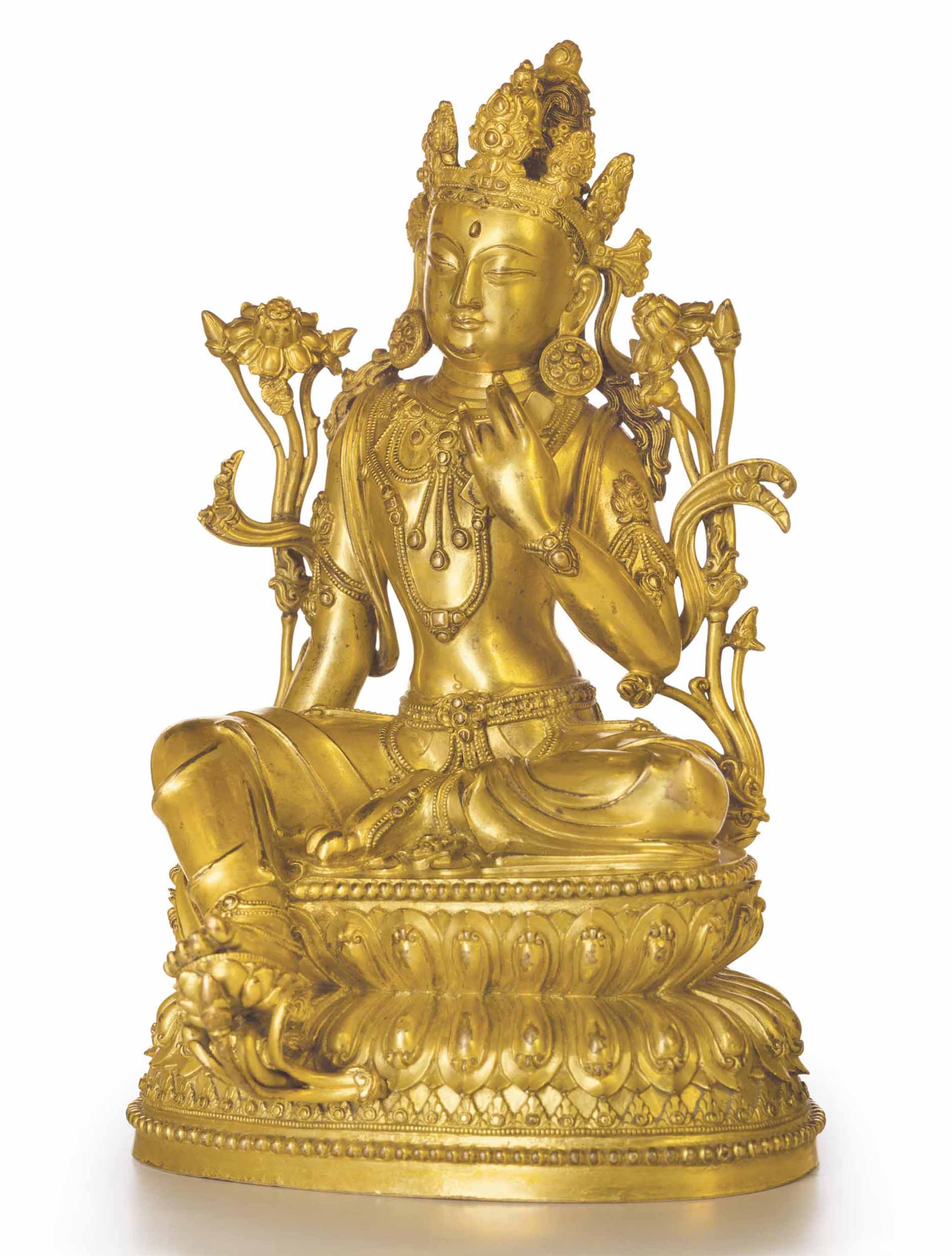 A RARE AND SUPERBLY CAST GILT-BRONZE FIGURE OF AVALOKITESHVARA
CHINA, MING DYNASTY, YONGLE SIX-CHARACTER MARK INSCRIBED IN A LINE AND OF THE PERIOD (1403-1425)
The bodhisattva is shown seated in lalitasana with the right foot supported on a lotus stem that projects from the front of the double-lotus base just above a rare, additional narrow band of circle-centered leaves. The right hand, which rests on the edge of the base, holds one of the two stems that rise to the shoulders from the sides of the base, while the raised left hand holds the Book of Wisdom. The graceful figure wears an elegantly draped dhoti secured with a beaded, festoon-hung sash, beaded necklaces, armlets, large circular earrings and a ribbon-tied tiara with eight foliate points that surrounds a seated figure of Amitabha Buddha and the artfully arranged chignon. The reign mark, Da Ming Yongle nian shi, “Bestowed in the Great Ming Yongle reign,” is inscribed in a line at the front of the base. The figure is richly gilded, and the base is sealed with a plate inscribed with a double vajra.
这尊菩萨像以游戏坐(lalitasana)姿态呈现,右足踏于一朵自双层莲座前部伸出的莲花茎上,莲座下方紧接一条罕见且额外添加的窄带,饰以圆心叶片纹。右手搁于莲座边缘,执持其中一茎花枝,花枝自莲座两侧蜿蜒升至肩部;左手抬起,持握《般若经》。造像姿态优雅,身披一袭轻柔垂坠的长裙,系以串珠装饰、垂挂花鬘的圣带;佩戴串珠项链、臂钏、大型圆耳珰,以及一条系带宝冠,冠上有八叶形装饰,中央环绕着阿弥陀佛的坐像,并饰有匠心独运的高髻。莲座正面横刻一行年号款:“大明永乐年施”。此像通体鎏金浓郁,底座以阴刻金刚交杵纹(double vajra)的封底板密封。
来源:
Christie's New York, 21 March 2001, lot 88.
This exquisite sculpture represents Avalokiteshvara (Chinese, Guanyin), the bodhisattva of compassion, as indicated by the presence in the headdress of a small seated image of the Amitabha Buddha (Chinese, Emituofo), the Buddha of Infinite Light, who presides over the Western Paradise. Considered a spiritual emanation of Amitabha, Avalokiteshvara is the only bodhisattva in whose crown or headdress Amitabha appears; thus, Amitabha's presence there definitively identifies this figure as Avalokiteshvara. Though Avalokiteshvara appears in many different forms, or manifestations, all show an image of Amitabha in the crown. Avalokiteshvara is sometimes also called Padmapani (“Holder of the Lotus”) or Lokeshvara (“Lord of the World”).
Avalokiteshvara typically holds such iconographic attributes as a lotus blossom, a vase, a ritual kundika vessel for holy water, or is portrayed in association with a willow branch, a Buddhist symbol of both physical and spiritual healing. Apart from those that constitute the base, two lotus blossoms flank the bodhisattva, one at each shoulder. In addition, in this rare sculpture the bodhisattva holds a book in the proper left hand, which Buddhist scriptures note is appropriate for at least three of Avalokiteshvara's manifestations: Vishnukanta Lokeshvara, Manjunatha Lokeshvara, and Vajrakhanda Lokeshvara. It is possible that this sculpture represents the last-named, Vajrakhanda Lokeshvara. (Jacob N. Kinnard, Imaging Wisdom: Seeing and Knowing in the Art of Indian Buddhism, Oxon, England, and New York, 1999, p. 166, and note 59); and “108 Forms of Avalokitesvara,” Excerpt from Benoytosh Bhattacharyya, The Indian Buddhist Iconography, Appendix, 1958, p. 420, fig. 78(A). Images of Vishnukanta Lokeshvara and Manjunatha Lokeshvara are also illustrated, p. 425, fig. 99(A) and p. 424, fig. 96(A), respectively.
A bodhisattva, or “enlightened being,” is a compassionate being who has gained enlightenment but who has postponed entry into final nirvana in order to assist other sentient beings in gaining enlightenment. Because they will become a Buddha, once all other sentient beings have attained enlightenment, a bodhisattva is portrayed in the guise of an Indian prince, which the Historical Buddha was before he became the Buddha - that is, in his early life. Gautama Siddhartha (traditionally, 563-483 BCE) was the crown prince of a small state in the foothills of the Himalayas, but then he rejected worldly life, renounced all claim to his inheritance and to his father's throne, espoused the religious life, gained enlightenment and became the Buddha Shakyamuni. Thus, as did the Buddha in his youth, a bodhisattva wears a dhoti around the waist, hips and legs and a scarf over the shoulders and around the arms, and is adorned with a wealth of jewelry, from necklaces and earrings to bracelets, armlets and anklets, as does this magnificent figure of Avalokiteshvara. The long hair typically is arranged in a high chignon on top of the head, the crown encircling the chignon a reference to the Historical Buddha's princely status in his youth.
The Lotus Sutra (Sanskrit, Saddharma Pundarika Sutra) is the scriptural basis for teaching the doctrines of Avalokiteshvara. Chapter 25 of that sutra, which is devoted solely to Avalokiteshvara and sometimes stands alone as the Avalokiteshvara Sutra, presents the bodhisattva as a compassionate being who hears the cries of sentient beings and who works ceaselessly to help those who call upon his name.
Although Tibetan Buddhist imagery began to appear in the repertory of Chinese art by the Yuan dynasty (1279-1368), Tibetan influence on Chinese Buddhist art became far more pronounced in the Ming dynasty (1368-1644), particularly during the Yongle era (1403-1425), when the imperial court looked favorably upon Buddhism and made a concerted effort to build secular and religious alliances with Tibet, even inviting Tibetan monks to the capital, Beijing, to conduct religious services. Such Tibetan influence manifests itself in the sensuousness of the art, witnessed in this figure's elegant proportions, S-curved posture, dazzling jewels, refined gestures, abundant and meticulously rendered details and compressed double-lotus base. As important as Tibetan-influenced works of art were early in fifteenth-century China, particularly in the Yongle and Xuande (1425-1435) reigns, Tibetan-style Buddhism probably was little practiced outside the imperial court, so most such images likely were made for the court, as indicated by the imperial inscriptions.
A stylistically similar Avalokiteshvara, which also has a Yongle reign mark, and is shown seated in a similar position with one foot supported by a lotus “growing” from the base, is in the Museum Reitberg, Zurich, and illustrated by Helmut Uhlig in On the Path to Enlightenment, Zurich, 1995, pp. 98-99, no. 52. (fig. 1)
这件精美绝伦的造像表现的是观音菩萨(梵文Avalokiteshvara,中文称Guanyin),即慈悲之主,其身份由头冠中一尊小型阿弥陀佛(中文称Emituofo)坐像所指示。阿弥陀佛是统御西方极乐世界的无量光佛。观音被视为阿弥陀佛的精神化现,也是唯一在其宝冠或头饰中出现阿弥陀佛的菩萨;因此,阿弥陀佛的出现确凿地证明了此尊身份为观音。尽管观音显现为多种不同的形相或化身,所有化身均在冠中带有阿弥陀佛形象。观音有时也被称为Padmapani(“莲华手”)或Lokeshvara(“世间自在”)。
观音通常持莲花、宝瓶、用于盛装圣水的仪式军持(kundika),或者与柳枝一同表现——柳枝是佛教中身心疗愈的象征。除构成底座的部分外,两朵莲花分侍菩萨左右,各在一侧肩旁。此外,在这尊稀有的造像中,菩萨的左手(观者视位的右手)持有一本经书。佛教典籍记载,这至少符合观音的三种化现:Vishnukanta Lokeshvara、Manjunatha Lokeshvara以及Vajrakhanda Lokeshvara。此像很可能表现的是最后一种——Vajrakhanda Lokeshvara(参见Jacob N. Kinnard,《Imaging Wisdom: Seeing and Knowing in the Art of Indian Buddhism》,英国牛津及纽约,1999年,第166页及注59);另见Benoytosh Bhattacharyya所著《The Indian Buddhist Iconography》附录中的“观音一百零八相”(1958年,第420页,图78(A))。Vishnukanta Lokeshvara与Manjunatha Lokeshvara的图像亦分别见于该书第425页图99(A)及第424页图96(A)。
菩萨(bodhisattva),即“觉有情”,是已证得觉悟却推迟进入究竟涅槃的慈悲者,旨在帮助其他有情众生获得觉悟。因其终将成佛——待一切众生皆得觉悟之后——菩萨被描绘成印度王子的形象,这正是历史上的佛陀(释迦牟尼佛)在成佛之前、即其早年生活的样貌。乔达摩·悉达多(传统纪年为公元前563–483年)曾是喜马拉雅山麓一小国的王太子,但他后来厌离世俗生活,舍弃所有继承权及父王王位,皈依宗教生活,证得觉悟,成为释迦牟尼佛。因此,如同佛陀青年时代,菩萨腰、髋及腿部围系长裙,肩臂披搭帛带,并佩戴众多珍宝首饰——包括项链、耳珰、手镯、臂钏及足镯——正如这尊庄严的观音像所示。长发通常于头顶结成高髻,宝冠环绕高髻,这典故源自历史上佛陀青年时期的太子身份。
《法华经》(梵文Saddharma Pundarika Sutra)是宣说观音教义的经典依据。该经第二十五品(即《观世音菩萨普门品》)完全以观音为主,有时独立成经称为《观音经》,其中将菩萨描绘为一位听闻众生呼救、持续不断地帮助称其名号者的慈悲者。
尽管藏传佛教造像在元朝(1279–1368)时已开始进入中国艺术的题材范畴,但藏传佛教对中国佛教艺术的影响在明朝(1368–1644)变得更为显著,尤其是在永乐年间(1403–1425)。当时朝廷对佛教持好感,并努力与西藏建立世俗与宗教上的联盟,甚至邀请西藏僧侣进京(北京)举办佛事活动。这种藏传影响体现在艺术品的感性特质上——从这尊造像优雅的比例、S形曲线姿态、璀璨的珠宝、精妙的手势、丰富而精细的细节处理以及紧凑的双层莲座中可见一斑。尽管受藏传影响的艺术品在15世纪早期的中国(尤其是永乐与宣德年间,1425–1435)十分重要,但藏传佛教本身可能在宫廷之外鲜有实践,因此大多数此类造像很可能是为宫廷制作,正如御制款识所表明的那样。
一尊风格类似的观音像,亦带有永乐年号款,呈相近姿态坐于莲座上,一脚踏于自底座“生出”的莲花上,现藏于苏黎世雷特伯格博物馆(Museum Reitberg, Zurich),并刊载于Helmut Uhlig所著《On the Path to Enlightenment》(苏黎世,1995年,第98–99页,第52号,图1)。

