
侧边栏

15世纪西藏木雕帕巴拉康观音菩萨立像(巴黎佳士得)
尺寸:高96 cm
年代:15世纪
质地:木雕
风格:西藏
来源:拍卖会
成交:217,000欧元(2011.06)
参阅:外部链接
鉴赏:
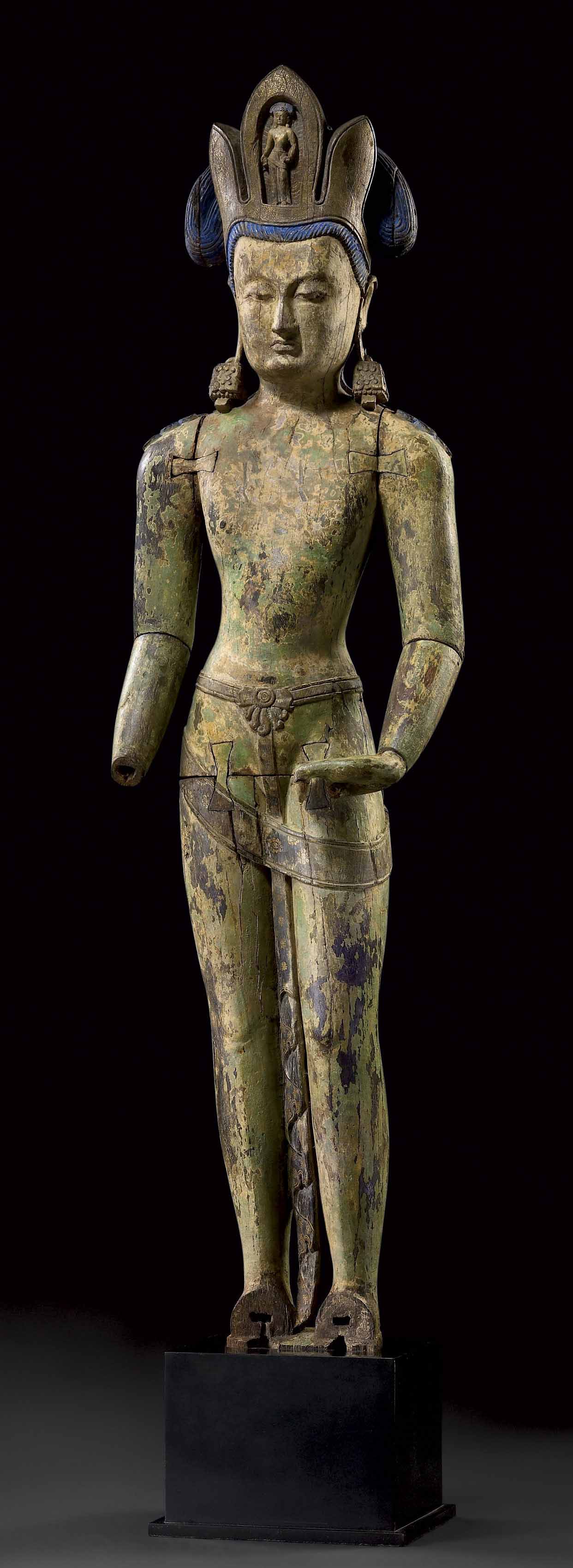 RARE STATUE DE PHAGPA LOKESHVARA EN BOIS POLYCHROME
TIBET, CIRCA XVEME SIECLE
RARE STATUE DE PHAGPA LOKESHVARA EN BOIS POLYCHROME
TIBET, CIRCA XVEME SIECLE
Représenté debout en léger tribhanga, la main gauche devant sa cuisse, le bras droit tendu, vêtu d'un dhoti retombant en un élégant plissé entre les jambes, maintenu par une ceinture, le visage serein, les cheveux tressés, le front ceint d'une tiare portant une représentation d'un Bodhisattva, une ouverture au dos, socle
珍罕彩绘木雕帕格拉观音像
西藏,约十五世纪
此像呈轻微三屈式站立,左手置于大腿前侧,右臂伸展。下身著裙,裙褶优雅地垂落于双腿之间,以腰带束之。面容寂静,发辫盘绕,额前佩戴宝冠,冠中饰有一尊菩萨像。背部有装藏开口。原配莲座。
来源:
From a Belgian private collection
Acquired at Rossi and Rossi, London, 2004
The RadioCarbon dating by the Laboratory of the University of Groningen, The Netherlands, no. GrA 25205 is consistent with the dating of this lot.
This fine wood image depicts the bodhisattva of Compassion, Avalokiteshvara, in a specific form known as Aryalokeshvara or 'Noble Lord of the World'. Actually he is better known under its Tibetan equivalent Phagpa Lokeshvara. This wood figure seems to be part of a long tradition of copying in this rather specific style. Many are known and have entered public and private collections all over the world. Others are still worshipped in temples in Tibet. Most examples are made in wood, just a few are known to be in bronze or ivory. Nevertheless they all share the same peculiar characteristics as described above. Still it seems often that the craftsmanship is far more recent than the clearly rather archaic, stylistic characteristics suggest. Many seem to have been copied after other replicas instead of being copies of probably the original image.
Recent research (Alsop, I., 'Phagpa Lokeshvara of the Potala' in Orientations, Hong Kong, April 1990, pp.51-61) has suggested that probably the original Phagpa Lokeshvara image, measuring circa one meter, is still worshipped in a chapel in the Potala palace in Lhasa. The chapel where the wood image is venerated is generally considered to be the oldest and most sacred of all Potala shrines. According to tradition this particular chapel existed already since the 7th century and was integrated in the construction of the later Potala building. The original construction was carried out under the 7th century Tibetan king Songtsen Gampo. As this bodhisattva was the tutelary deity of the Songtsen Gampo it is not to be ruled out that this particular image could be well identical with the one associated with this king. Several 14th and 15th century texts confirm the association of king Songtsen Gampo with the bodhisattva Phagpa Lokeshvara.
The original wood sculpture could stylistically be work of a Newari artist. Interesting, no sculptures in this specific style seem to have survived from Nepal itself. As there seems to be slightly different facial types found among the published group it is not to be excluded that another possible source could be the Northeast Indian Pala style, as suggested by Gilles Beguin. Some display indeed comparable defined faces with rather aquiline noses, like the presented lot.
This particular wood icon stands out from the known group, not only by its imposing size, but also by its rather natural and flowing style. As far known it is only matched in size by another example sold in these Rooms, 11 June 2008, lot 216.
For a smaller wood example see, G. Béguin, Art ésotérique de l'Himalaya: la donation Lionel Fournier, Paris 1990, pl.5.
荷兰格罗宁根大学实验室进行的放射性碳定年检测(编号GrA 25205)与本拍品的年代相符。
这尊精美的木雕描绘了观音菩萨的一种特定化身,名为圣观音(Aryalokeshvara,意为“高贵的世间主”)。实际上,其藏文名称Phagpa Lokeshvara更为人所知。此木雕似乎源自一个在特定风格下长期复制的传统。同类作品为数众多,已入藏世界各地的公私收藏,另有部分仍供奉于西藏的寺庙之中。此类作品大多为木雕,仅少数为铜铸或象牙雕刻。尽管如此,它们均具有上文所述之共同特征。然而,其工艺往往似乎比明显古拙的风格特征所暗示的年代要晚得多。许多作品似乎是复制自其他复制品,而非直接复制于原始造像。
近期研究(见Alsop, I.,《Phagpa Lokeshvara of the Potala》,载于《Orientations》,香港,1990年4月,第51-61页)指出,原初的帕格拉观音像(高约一米)很可能仍供奉于拉萨布达拉宫的一间佛殿之中。供奉此木像的佛殿被普遍认为是布达拉宫最古老、最神圣的殿堂。据传统,此殿早在七世纪即已存在,后融入布达拉宫后期的建筑之中。其最初建造是在七世纪藏王松赞干布的主持下完成的。由于此菩萨是松赞干布的本尊神,因此不能排除这尊特定造像与松赞干布相关联的可能性。若干十四、十五世纪的文献证实了松赞干布与圣观音菩萨之间的联系。
这尊木雕原作在风格上可能出自纽瓦尔艺术家之手。有趣的是,在尼泊尔本地似乎并未存世此种特定风格的造像。鉴于已发表作品中发现的面部类型略有差异,另一种可能性(如Gilles Beguin所提出)是其来源或可为印度东北部的帕拉风格。其中一些作品确实呈现出轮廓分明、鼻梁较为高挺的面容特征,与本拍品相似。
此尊木雕圣像在已知同类作品中脱颖而出,不仅因其宏伟的尺寸,更因其自然流畅的风格。据目前所知,仅在尺寸上可与之匹敌的,是另一尊售于本公司2008年6月11日拍卖会上的拍品(编号216)。
关于一件较小的木雕例作,可参见G. Béguin,《Art ésotérique de l'Himalaya: la donation Lionel Fournier》,巴黎,1990年,图版5。

