
侧边栏

5世纪犍陀罗晚期黄铜释迦牟尼佛立像(伦敦大英博物馆)
尺寸:背光高度31.5 cm
年代:5世纪
质地:黄铜
风格:犍陀罗晚期
来源:伦敦大英博物馆
参阅:外部链接
鉴赏:
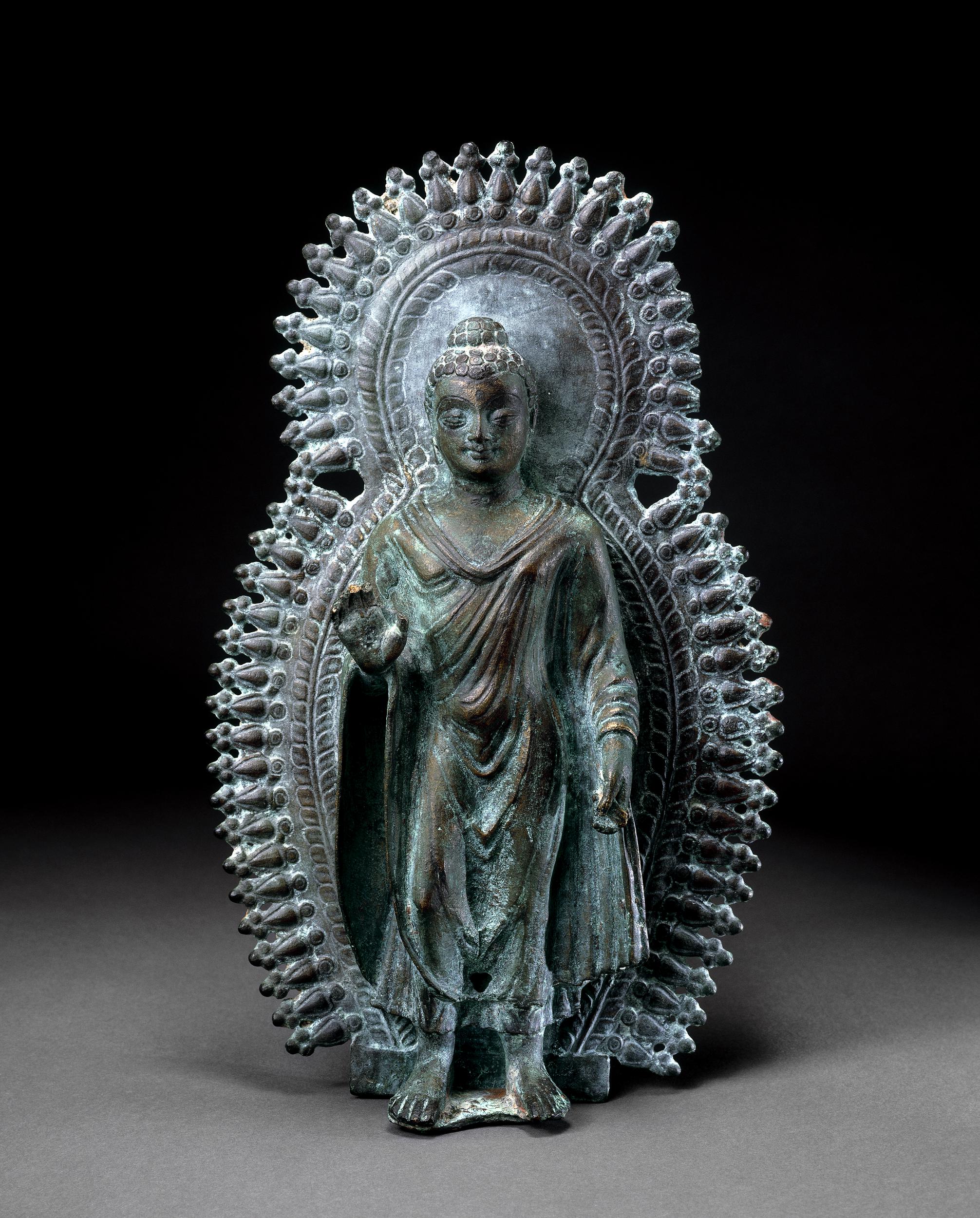 Standing Buddha in 'abhaya-mudra'. The over-robe covers both shoulders with a wide neckline and prominent folds form a 'V' on the front, which barely indicate the backthrow. It has to be noted that the backthrow does not appear under the left forearm. The garment is worn close-fitting, almost in the fashion of wet drapery; the breasts, abdomen and legs, particularly the flexed right knee, are plainly indicated and the ridged and grooved indications of folds are accentuated between the legs and above the left hand which grasps a short and looped length of drapery, while gathered drapery hangs below. The usual two undergarments appear below the drapery fall of the 'abhaya-mudra' arm. The shoulders are broad and enhanced by the width of the neckline and the grooved neck, while the torso appears foreshortened, the waist thin, the legs mechanically rounded and the toes and feet summarily modelled. The hands are large, the right with curved fingers, a membrane between index and thumb and a circle ringed with dots on the palm. The head is round to oval and the face full. The snail-shell curls are formed of originally applied and incised small discs continued into the large uṣṇīṣa and forming a peak over the forehead. Incised brows form wide arches over long and protruding globular eyes under low lids; the nose is straight with a sharp ridge; and the shaped mouth, with a fuller lower lip, is set into the broad lower face above a full chin. The damaged ears are close to the head and probably had long lobes.
The backplate has the form of an aureole combining a mandorla and nimbus. It is outlined with a foliate band and with radiating projections formed of a circular bead and a pointed drop or leaf, both with a border, ending in three plain circular beads. Traces of dotted and continuous lines on the front of a metal strip at the base of the backplate suggest the presence of an inscription.
发现地:
Found/Acquired: Sahri Bahlol
Asia: South Asia: Pakistan: North West Frontier Province: Sahri Bahlol
铭文:
Inscription position: base of the backplate
Inscription note: The inscription was first reported in Errington and Cribb, 1992: 218, with readings of single “akṣaras”.
Curator's comments
Zwalf 1996:
Although metal technology from tool-making to the abundant minting of a money economy was clearly well understood, Buddhist metal sculpture has proved elusive, with the examples known today being few, of modest size and mainly late. See also 1958.0714.1.
The face may be compared with others of the stucco tradition and Gupta-period Mathura Buddhas.
The term ‘backthrow’ refers to that part of the over-robe or outer-garment which is thrown over the left shoulder after the body has been draped. Two recurrent features of the draped Buddha image relate to the fall of the drapery, which can be represented as cloth gathered over the left wrist and falling from it (see 1947.0511.1), or as an edge under the length of the left forearm. This edge represents the backthrow, which goes along the left forearm and is held to secure the robes in the left hand by a corner which, together with a corner grasped from the first layer of cloth (the undergarment), usually appears looped (see 1899.0715.1).
Zwalf 1985:
This very different example from the few surviving Gandharan bronzes belongs to a group from a single findspot and perhaps atelier. The ridged drapery is very conventional, and the face recalls not only the later Gandharan stucco sculpture but, even farther afield, Gupta-period Buddhas from central India such as that from Mankuwar dated to AD 448-9 (or 429). The backplate, common to the whole group, has a radiating ornament which appears early in Gandhara, but its closest resemblance is with painting dated to the 7th century.
保存状态:
1.Brass, chipped, cracked, patinated and with soil incrustation.
2.Figure substantially complete with small losses and cracks (on right hand and on plate below feet).
3.Drilled in the middle of the back to accommodate a pin from the backplate and with rectangular lug behind shoulders, pierced to receive vertical pin to secure figure to backplate.
4.Two vertical and pierced lugs below each foot for insertion into lost pedestal.
5.Clay and corrosion products on back are partly covered with corrosion from backplate. 6.Backplate, also substantially intact, is partly covered in clay back and front, pierced to receive lug and has a pin fitting hole in back. Small tenon in middle below fitted into lost pedestal.

