
侧边栏

3-4世纪犍陀罗石雕释迦牟尼佛说法坐像(纽约佳士得)
尺寸:高74.9 cm
年代:3-4世纪
质地:片岩石雕
风格:犍陀罗
来源:拍卖会
成交:475,000美元(2021.03)
参阅:外部链接
鉴赏:
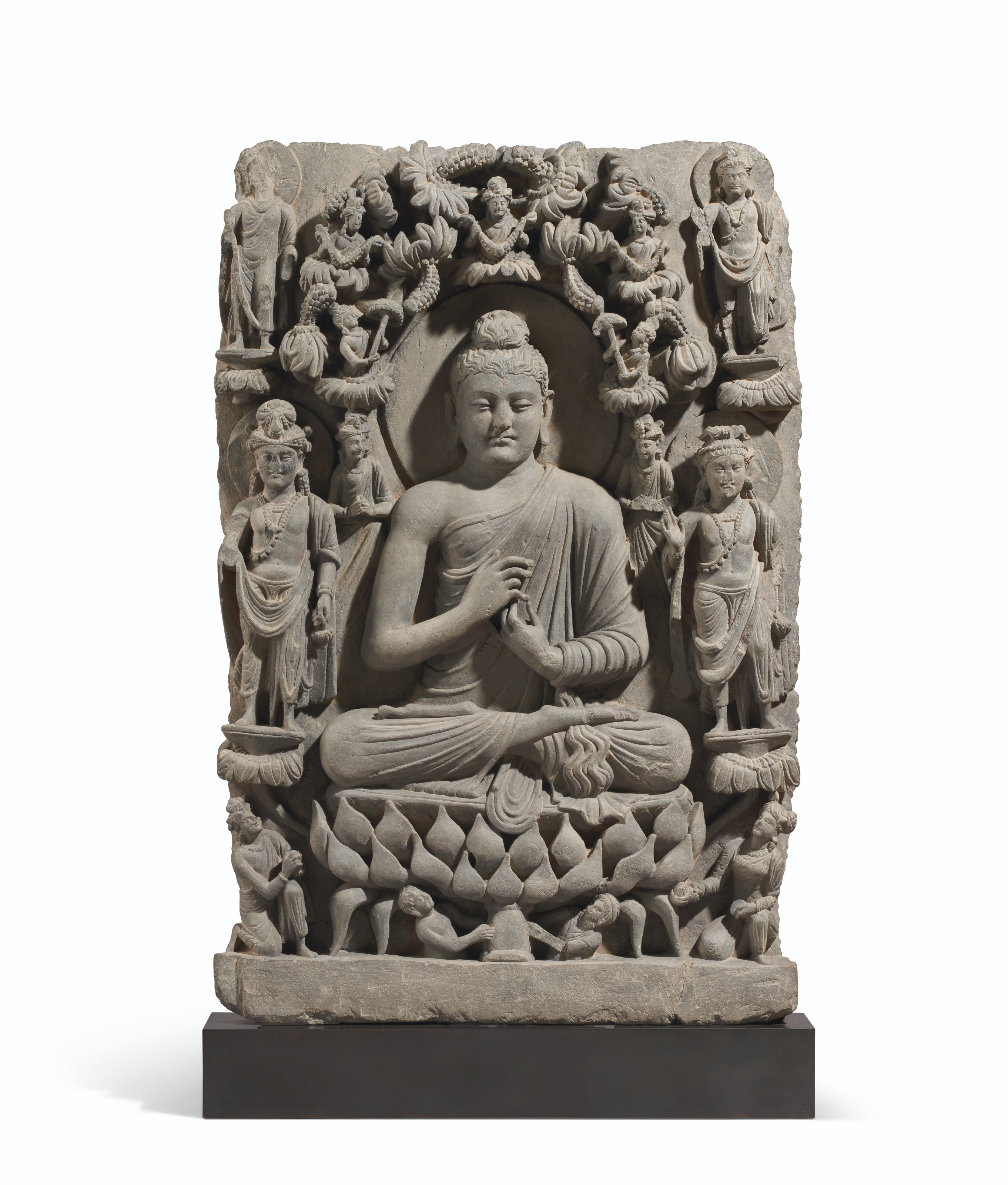
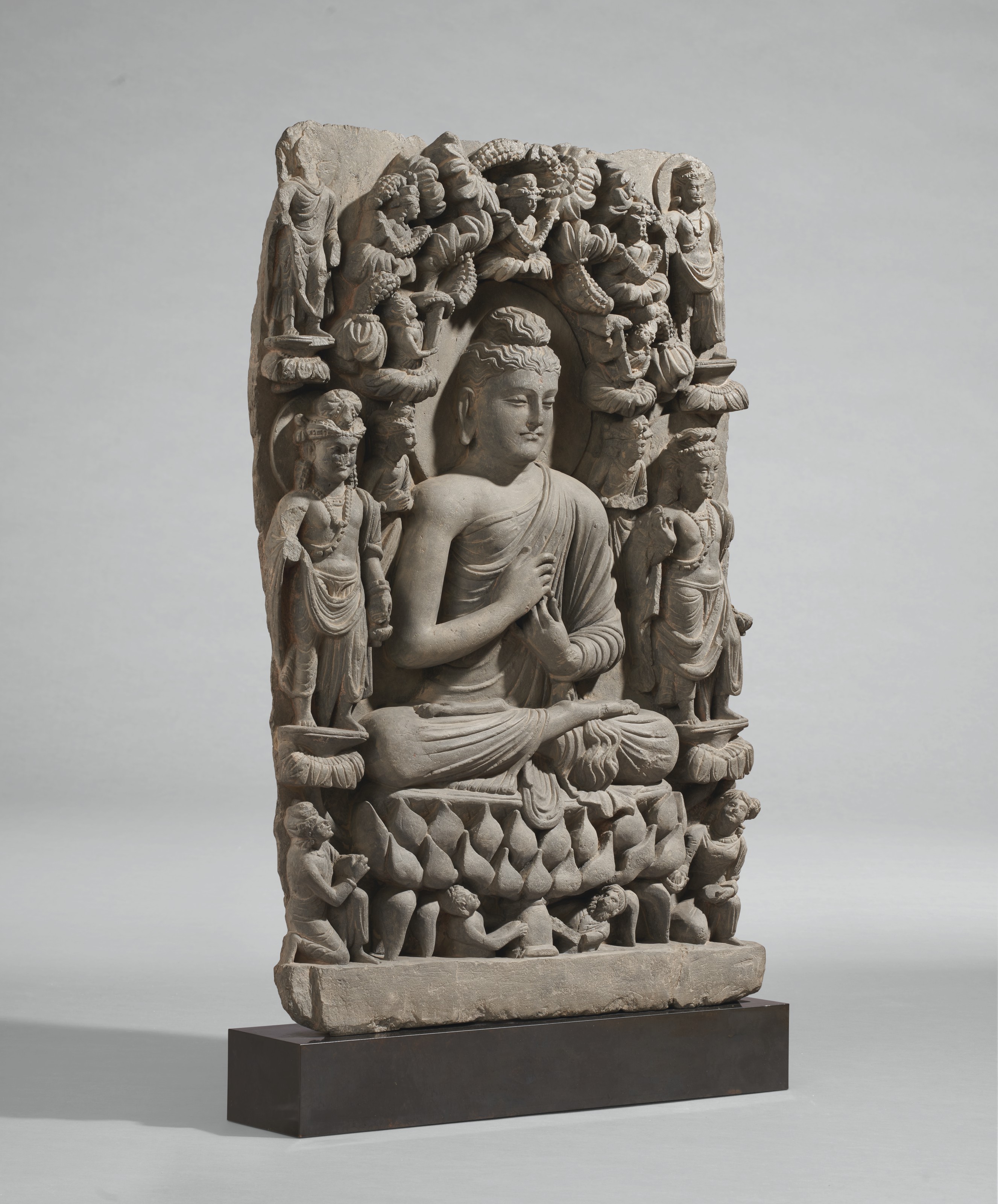
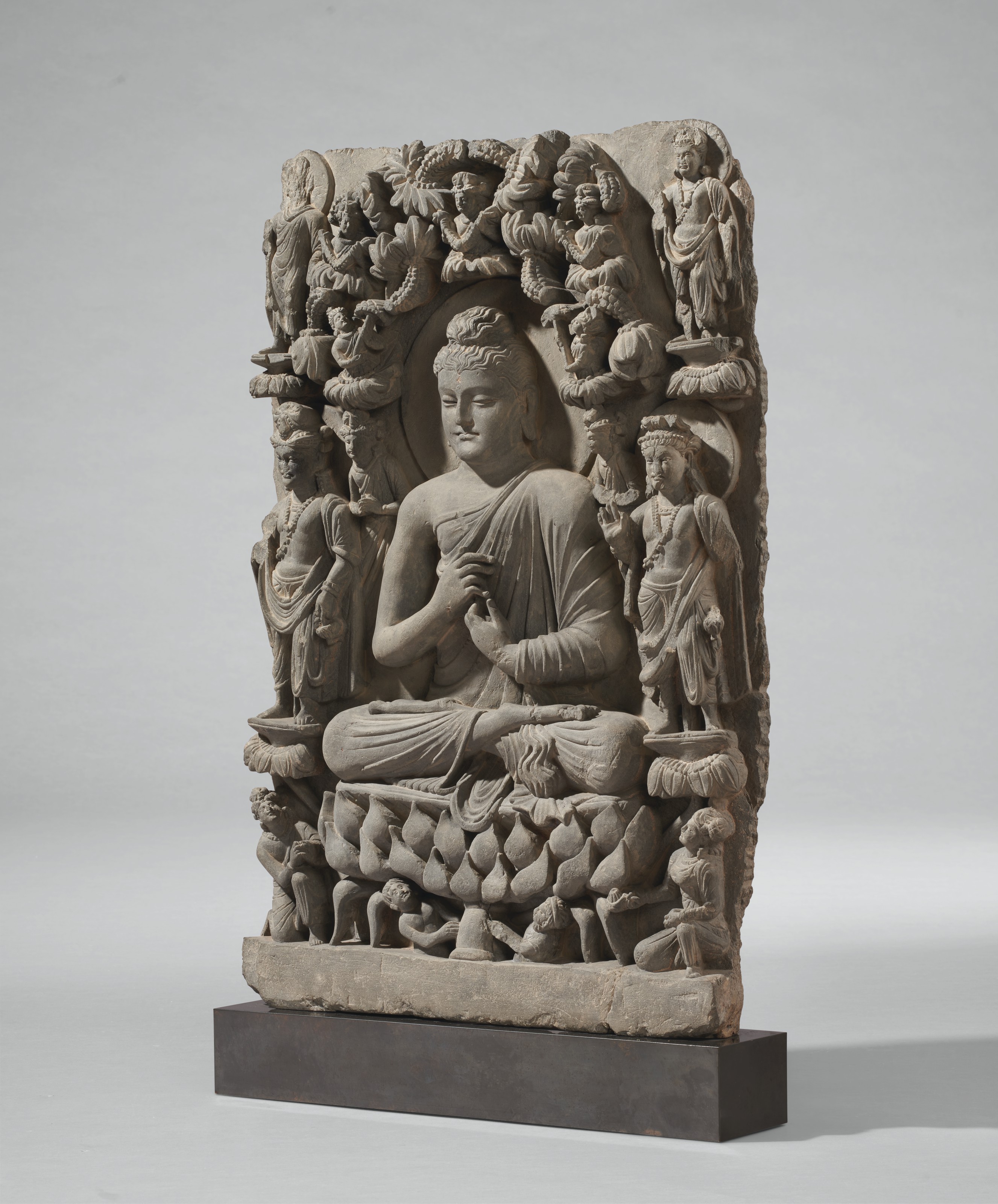 A RARE GRAY SCHIST RELIEF TRIAD OF BUDDHA SHAKYAMUNI FLANKED BY BODHISATTVAS
ANCIENT REGION OF GANDHARA, 3RD-4TH CENTURY CE
29 ½ in. (74.9 cm.) high; 19 3/8 in. (49.2 cm.) wide
Provenance
Private collection, Europe, by 1988, by repute.
Important private collection, Japan, by 1990.
Literature
I. Kurita, Gandharan Art, vol. I, Tokyo, 1988, p. 201, fig. 405.
M. Akira, ed., Iconography of Nirvana and Maitreya - from India to Central Asia, Tokyo, 1992, no. 129.
M. Akira, Gandharan Art and Bamiyan Site, Tokyo, 2006, p. 62, no. 27.
Exhibited
Tokyo, Fujii Gallery, Gift from Ancient - selected by N. Horiuchi, 9-23 February 1988, no. 4.
Lot Essay
Exceptionally carved in deeply detailed relief, this large stele depicts Buddha Shakyamuni in retinue with Avalokiteshvara, the Bodhisattva of Compassion, and Maitreya, the Buddha of the Future. Accompanied by splendid portrayals of nature, the figures of Buddha and his attendants are elegantly modeled, appearing at points to be nearly in the round.
The scene depicted in this relief and similar compositions has been subject of dispute over the past century. The much-cited early scholar of Gandharan art, Alfred Foucher attributes the type to 'The Great Miracle at Shravashti,' where Buddha performs several miracles to repute challenges from the heretics (see A. Foucher, The Beginnings of Buddhist Art, London, 1917, pp. 147-184). Among his miracles, and perhaps the most significant, is Buddha’s self-multiplication. According to Buddhist doctrine, Buddha sat cross-legged upon a lotus flower created by the naga kings Nanda and Upanda. As he entered a state of contemplation, a second lotus was created atop the first, and atop the new lotus, a second seated Buddha appeared.
While writing on the comparable Mohammed Nari Stele at the Lahore Museum (see A. Proser, The Buddhist Heritage of Pakistan: Art of Gandhara, 2011, New York, p. 163, cat. 68 for illustration) Juhyung Rhi questions the attribution to this triad type as the Miracle at Shravashti (see, J. Rhi, “Complex Steles: Great Miracle, Paradise, or Theophany” in The Buddhist Heritage of Pakistan: Art of Gandhara, 2011, New York, pp. 65-72). Rhi points out that the composition could alternatively be identified as Sukhavati, the paradise of Buddha Amitabha. The composition of the present triad, and similar examples, draws parallels to the depiction of Sukhavati in early East Asian art, which depict a seated Buddha flanked by standing Bodhisattvas. Reference the seventh-century Tang dynasty murals in Cave 332 at Dunhuang, or images of Amitabha with Bodhisattvas within Qianxisi Cave at the Longmen Grottoes for early Chinese Amitabha triads, which parallel the present configuration.
Either assertion lends an interesting interpretation of the present relief. If the Miracle at Shravashti is indeed portrayed, the scene is reduced to its essential elements. In this work, Buddha is depicted seated upon a twice-layered lotus, stylistically reminiscent of bases accompanying bronze figures of Swat Valley (see lot 442). Two figures emerge waist-up from the bottom of the stele and appear to hoist the lotus out from the water. Two princely figures kneel in devotion from either lower corner, suggesting the presence of Nanda and Upananda. Buddha is flanked by bodhisattvas standing upon their own lotus bases, likely Avalokiteshvara, grasping a lotus, on the proper right and Maitreya, carrying a water vessel, on the left. Indra and Brahma are each nestled between the bodhisattvas and Buddha, emerging from the background, rather than firmly placed figures. A second figure of Buddha stands upon a lotus base in the top right corner. In the opposite, corner stands a bodhisattva, who may be identified as either Maitreya or Siddhartha, although it lacks definitive attributes in its present condition. Several proto-yaksha figures rest in the flowering tree, holding parasols and garlands over Buddha.
The present stele demonstrates the work of a highly skilled artisan; while only a few inches thick, the relief manages to incorporate considerable detail and depth. A stand out among more common lower-relief works depicting similar subjects, the present lot may be compared to a rare and well-published dated Buddhist triad from the same private collection sold at Christie’s New York, 23 September 2020, lot 609. Also compare the work to a parcel gilt and polychromed gray schist stele of the Teaching Buddha sold at Christie's New York on 11 September 2012, lot 522; the present stele can be assumed to have had similar polychromy, although traces of such evidence rarely survive into the present day.
这块巨大的石碑以深雕细节的手法精湛雕刻,描绘了释迦牟尼佛与观音菩萨(慈悲菩萨)及弥勒佛(未来佛)随从在一起的场景。佛陀及其侍从的形象配以华美的自然刻画,造型优雅,部分几近圆雕。
过去一个世纪以来,这块浮雕及类似构图所描绘的场景一直是学界争论的主题。 被广泛引用的犍陀罗艺术早期学者阿尔弗雷德·福歇(Alfred Foucher)将此类型归为“舍卫城大神变”,在此事件中,佛陀显现多种神通以驳斥外道的挑战(参见A. Foucher,《佛教艺术的起源》,伦敦,1917年,第147-184页)。在他显现的神通中,或许最为重要的是佛陀的化身无数。根据佛教教义,佛陀结跏趺坐于那伽龙王难陀(Nanda)和优波难陀(Upanda)所创造的莲花之上。当他入定之时,第一朵莲花之上又生出第二朵莲花,而在新莲花之上,出现了第二位坐佛。
在评述拉合尔博物馆收藏的可比作“穆罕默德·纳里石碑”(见A. Proser,《巴基斯坦的佛教遗产:犍陀罗艺术》,2011年,纽约,第163页,图录第68号)时, 李周炯(Juhyung Rhi)对这一三联尊像类型归为“舍卫城神变”提出了质疑(见J. Rhi,“复杂石碑:大神变、净土或神显”,载于《巴基斯坦的佛教遗产:犍陀罗艺术》,2011年,纽约,第65-72页)。李指出,这一构图也可能被认定为“ Sukhavati “,即阿弥陀佛的净土。本件三联尊像及类似作品的构图,与东亚早期艺术中对” Sukhavati “(极乐世界)的描绘有相似之处——后者通常表现一尊坐佛,两侧胁侍立姿菩萨。可参考敦煌第332窟七世纪的唐代壁画,或龙门石窟潜溪寺中阿弥陀佛与菩萨像共存的早期中国阿弥陀佛三联尊像构图,与本件作品的配置有相通之处。
无论采纳哪种说法,都为本件浮雕提供了有趣的解读视角。 如果确实描绘的是”舍卫城大神变”,那么场景被精简至其核心要素。在这件作品中,佛陀被表现为坐于双层莲花之上,其风格令人联想到斯瓦特河谷铜像的底座(参见第442号拍品)。两个人物从石碑底部半身升起,似乎正将莲花从水中托举而出。两位王子般的虔敬人物从下方两角跪拜,暗示了难陀和优波难陀的存在。佛陀两侧胁侍着立于各自莲花座上的菩萨,右手边(观者左侧)很可能是手持莲花的观音菩萨,左手边(观者右侧)则是持水瓶的弥勒菩萨。因陀罗和梵天分别置身于菩萨与佛陀之间,从背景中浮现,而非固定的人物形象。一尊第二佛陀的形象立于右上角的莲花座上。在对角(左上角)站立着一尊菩萨,在其现存状态下缺乏明确的标识特征,可能是弥勒菩萨或悉达多太子。几位药叉(夜叉)原型的形象栖息于花树之中,在佛陀上方持举着伞盖和华鬘。
本件石碑展现了一位技艺高超的工匠的杰作; 尽管仅有数英寸厚,浮雕却成功地融入了相当的细节与深度。在表现相似题材、更为常见的浅浮雕作品之中,本件拍品脱颖而出。可将其与同一私人收藏中的一尊有纪年、罕见且广为人知的佛教三联尊像进行比较,后者售出于纽约佳士得,2020年9月23日,第609号拍品。亦可与一件售出于纽约佳士得(2012年9月11日,第522号拍品)的灰片岩说法佛(部分鎏金并施彩绘)石碑相比较;本件石碑推测曾有过类似的彩绘,只是此类痕迹极少能留存至今。

