14世纪西藏西部唐卡大日如来(纽约苏富比)
尺寸:不详
年代:14世纪
质地:唐卡
风格:西藏
来源:拍卖会
成交:100,000美元(2016.03)
参阅:纽约苏富比
鉴赏:
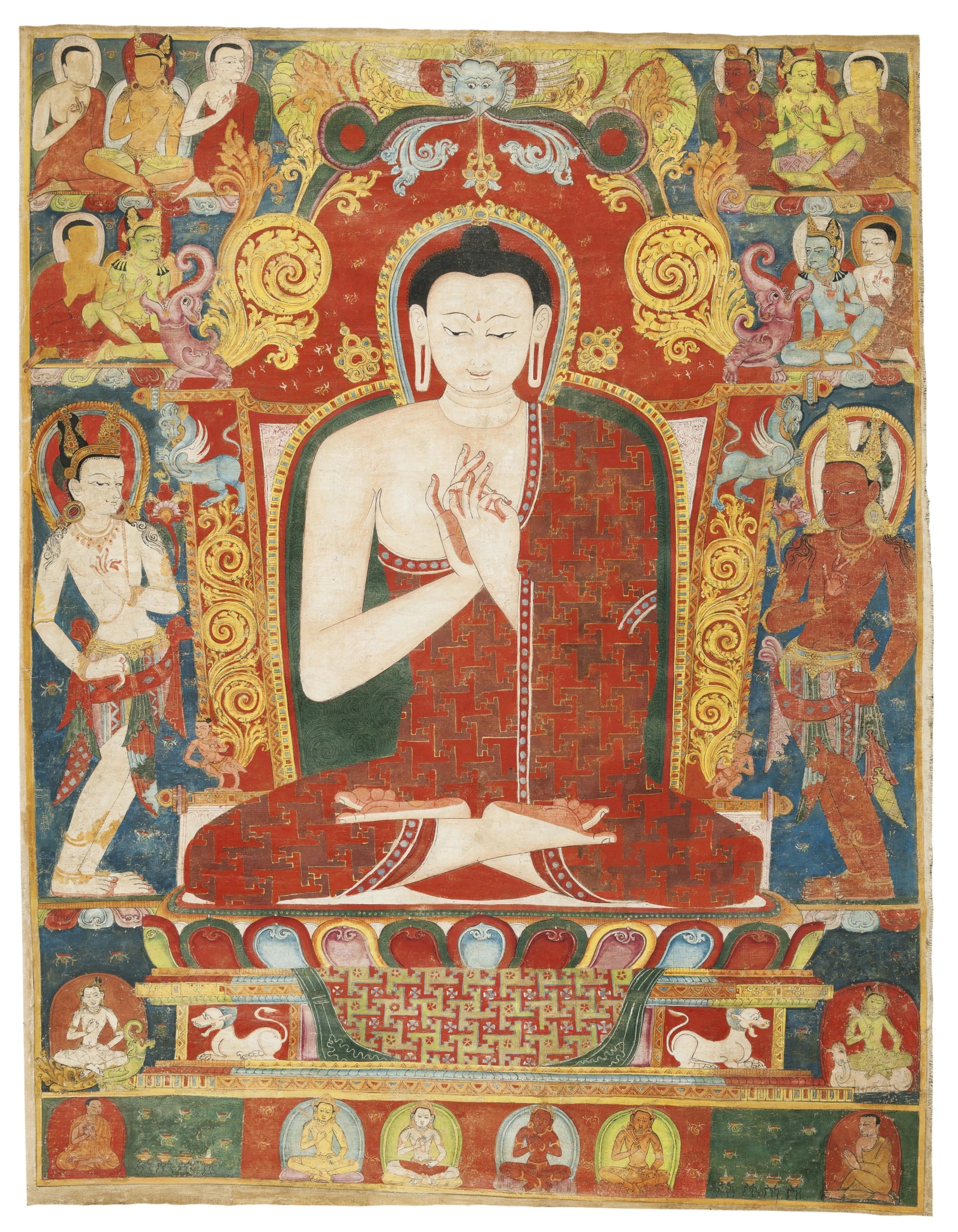 Himalayan Art Resources item no. 13071.
Condition
Areas of rubbing and pigment loss throughout. One inch crack in pigment at center, on Vairocana's lower robe. With areas of pigment consolidation and some loss to details in the upper left and right quadrants, as viewed in catalogue illustration. Areas of re-weaving and textile conservation along the proper right edge of painting, visible at verso. Inscribed with consecration mantra and the Buddhist creed in Tibetan at verso. Mounted in traditional-style modern frame.
In response to your inquiry, we are pleased to provide you with a general report of the condition of the property described above. Since we are not professional conservators or restorers, we urge you to consult with a restorer or conservator of your choice who will be better able to provide a detailed, professional report. Prospective buyers should inspect each lot to satisfy themselves as to condition and must understand that any statement made by Sotheby's is merely a subjective qualified opinion.
NOTWITHSTANDING THIS REPORT OR ANY DISCUSSIONS CONCERNING CONDITION OF A LOT, ALL LOTS ARE OFFERED AND SOLD “AS IS” IN ACCORDANCE WITH THE CONDITIONS OF SALE PRINTED IN THE CATALOGUE.
Catalogue Note
Under the patronage of the Buddhist kings of Guge, the artistic traditions of Kashmir and the Western Himalayas were imported into Western Tibet beginning in the 11th Century, and this artistic legacy is strongly articulated in the current work. The central figure of this thangka likely depicts the dhyani buddha Vairocana, flanked on either side by his bodhisattva disciples Ananda and Kasyapa.
Although dhyani buddhas are commonly depicted with the regal jewelry and adornments of the bodhisattva, a number of earlier and contemporaneous paintings from the Western Himalayas depict examples of Vairocana with an unadorned Buddha appearance, such as in the current work; see a 14th Century thangka from Spiti depicting Vairocana from the Koelz Collection in the University of Michigan Museum of Anthropology, HAR item no. 92011; and also a 13th Century thangka depicting Vairocana flanked by Ananda and Kasyapa in the Soma Lhakhang at Alchi, Ladakh, see Pratapaditya Pal, Tibetan Paintings, 1984, pl. 10.
Other stylistic elements which can be considered typical of Western Tibetan painting include the kirtimukha above the central figure at the top of the throne; the elongated, tubular physiognomy of the limbs; the graceful arch and flick of the eyebrows; the high, pointed crowns on the bodhisattvas; and the elegantly curled petal tips on the lotus throne.
Of particular note in the current work are the decorative embellishments rendered in jewel-like tones: the jewelled halo and nimbus of Vairocana; the red and maroon abstract yungdrung or swastika patterning on the robe of Vairocana and on the lower throne; the row of green pearls along the upper throne; and the multicolored lozenge bands which outline the throne. Foliate elements and addorsed makara, rampant vyala, leogryphs and garuda abound—also note the playfully rendered elephant vahana of the green female deity in the lower right.
在古格佛教国王的庇佑下,克什米尔与西喜马拉雅地区的艺术传统自11世纪起传入西藏西部,这一艺术遗产在眼前这幅作品中得到了充分体现。这幅唐卡中央的主尊很可能为禅定佛毗卢遮那,其两侧分立着菩萨弟子阿难与迦叶。
尽管禅定佛通常佩戴菩萨的庄严珠宝与装饰,但在西喜马拉雅地区早期及同时期的绘画中,不乏如本作品这般以朴素佛相呈现毗卢遮那的例子:例如来自斯比提地区的一幅14世纪唐卡(藏于密歇根大学人类学博物馆科尔兹收藏,HAR编号92011)中描绘的毗卢遮那;以及拉达克阿尔奇寺索玛拉康殿内一幅13世纪唐卡中阿难、迦叶胁侍的毗卢遮那(见Pratapaditya Pal著《西藏绘画》,1984年,图版10)。
其他可视为西喜马拉雅绘画典型风格的要素包括:宝座顶端中央主尊上方的“荣光面”(kirtimukha);四肢修长呈管状的形体特征;优雅的弓形眉梢与上扬弧度;菩萨佩戴的高耸尖顶冠饰;以及莲花宝座上优雅卷曲的花瓣尖梢。
本作品尤值一提的是以宝石色调呈现的装饰纹样:毗卢遮那的宝石光环与头光;其袈裟与宝座下部装饰的红褐色抽象雍仲(卍字)图案;宝座上缘的绿色珍珠排链;以及勾勒宝座轮廓的彩色菱形纹带。叶状纹饰、相背的摩竭鱼、腾跃的威拉兽、狮鹫与金翅鸟遍布其间——此外需留意右下角绿色女神所乘大象坐骑的俏皮表现手法。