8-9世纪泰国合金铜鎏金释迦牟尼佛立像(纽约大都会博物馆)
尺寸:H. 27 in. (68.6 cm); W. 10 1/4 in. (26 cm); D. 5 3/8 in. (13.7 cm)
年代:8-9世纪(Mon-Dvaravati时期)
质地:合金铜鎏金
风格:泰国
来源:纽约大都会博物馆
参阅:外部链接
鉴赏:
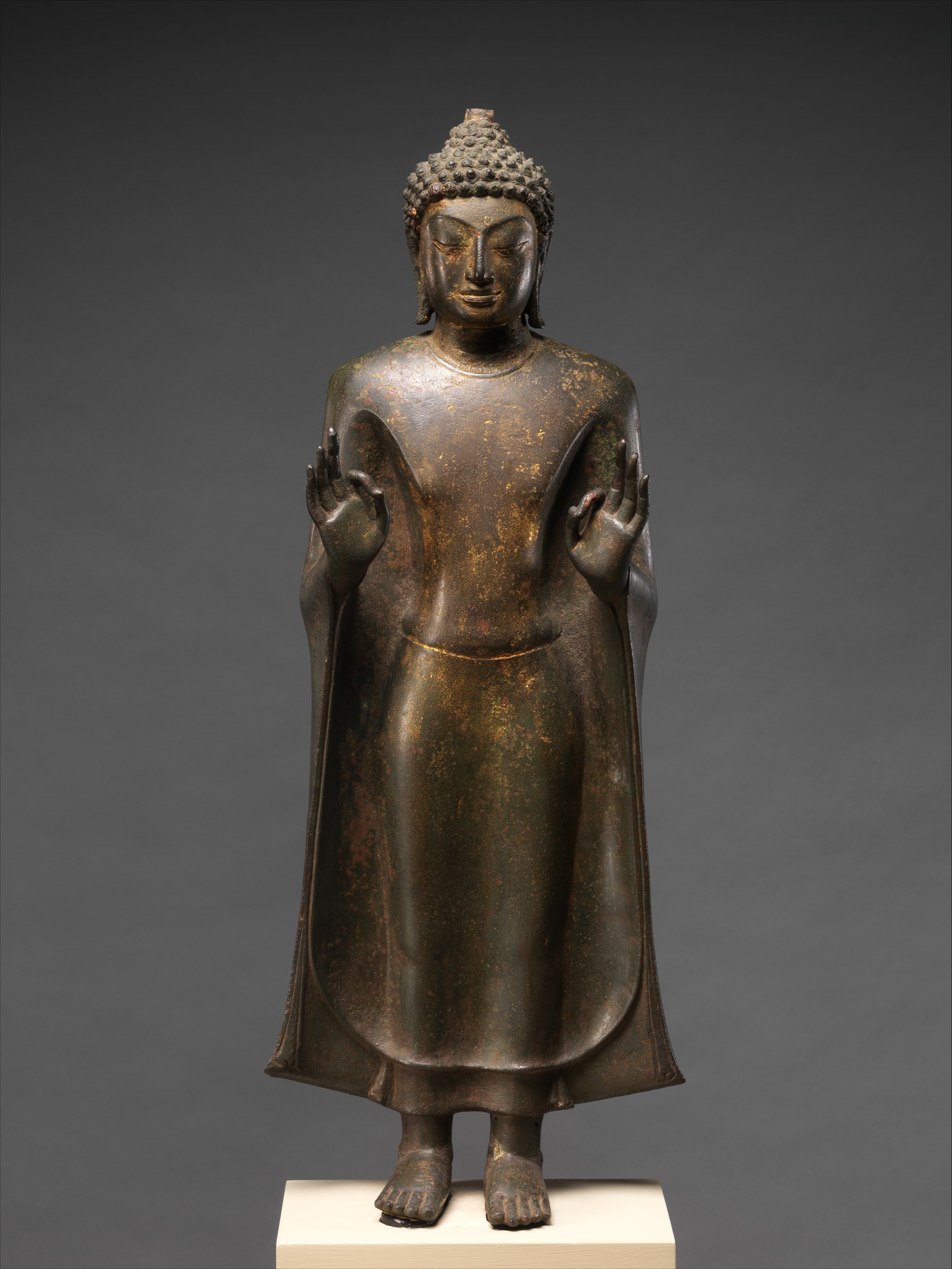
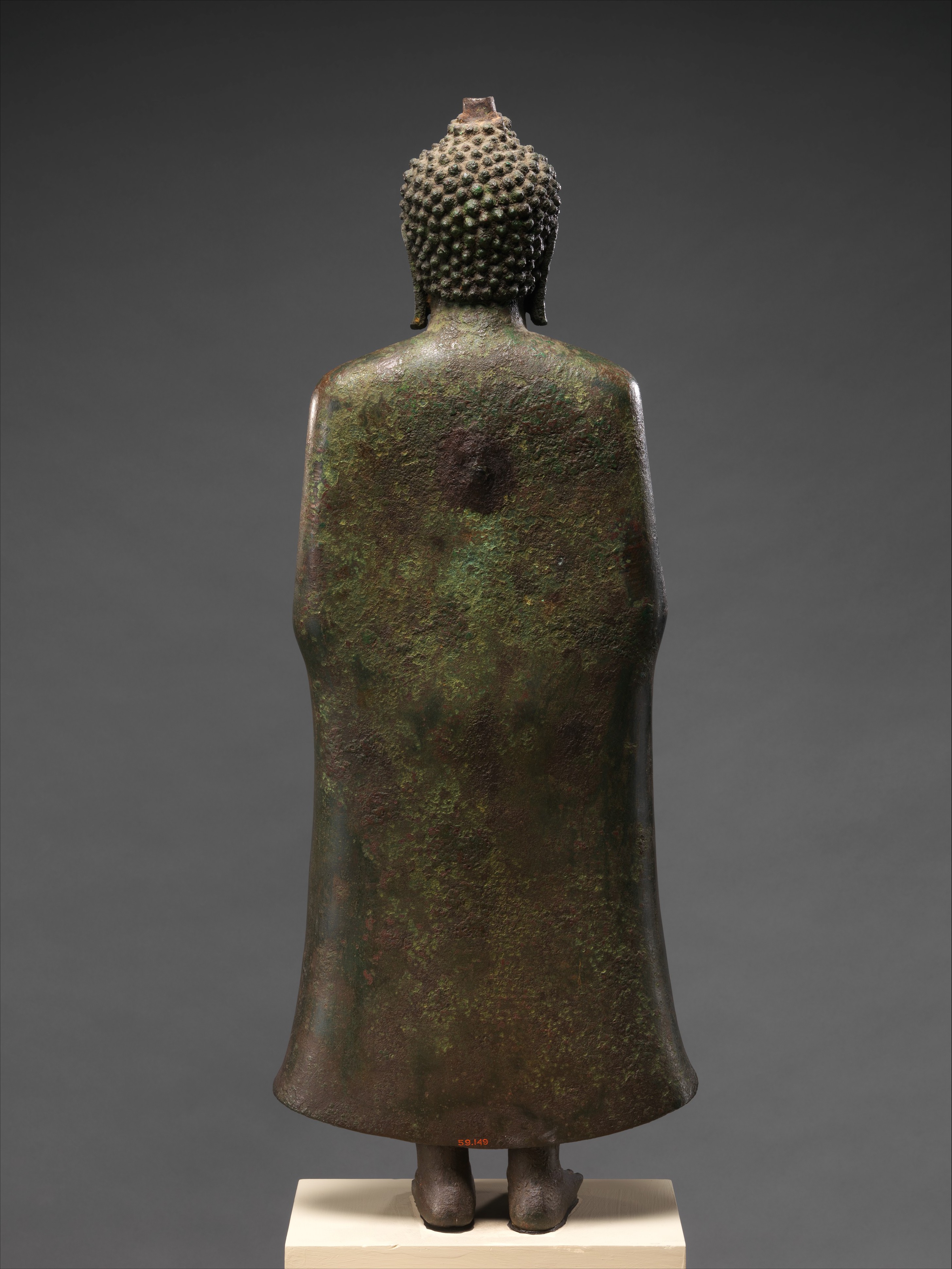 双手都是说法印或无畏印的形象是Mon-Dvaravati时期的一个创新, 在印度的释迦造像只局限于右手.
Standing Buddha
8th–9th century
Thailand (Nakhon Pathom Province)
Considerable innovations in religious iconography were developed during the Mon-Dvaravati period. For example, many Buddhas hold both of their hands in a gesture of exposition or teaching (vitarkamudra) that in India is confined to the right hand. Images from the related site of Prakhon Chai also exhibit this double hand gesture, but otherwise it is unknown in the Buddhist world. Another iconographic innovation was to place a standing Buddha and flanking attendants on the back of Garuda, a semidivine winged creature that usually appears as the vehicle (vahana) of Vishnu.
来源:
[ John J. Klejman , New York, by 1959, sold to MMA]
著录:
Lippe, Aschwin. “A Dvaravati Bronze Buddha from Thailand.” The Metropolitan Museum of Art Bulletin, n.s., 19, no. 5 (January 1961). pp. 124–132, fig. 6.
Seckel, Dietrich. The Art of Buddhism. Translated by Ann E. Keep. New York: Crown Publishers, 1963, pl. 11.
Lippe, Aschwin. “The Religions of Asia.” Apollo Magazine 82, no. 43 (September 1965) pp. 220–29, on p. 227, pl. 22.
Lerner, Martin. “The Florence and Herbert Irving Galleries for the Arts of South and Southeast Asia.” Orientations 25, no. 3 (March 1994) p. 41, fig. 5.
Guy, John. Lost Kingdoms: Hindu-Buddhist Sculpture of Early Southeast Asia. Exh. cat. New York: The Metropolitan Museum of Art, 2014, pp. 267–72, fig. 151.
Schorsch, Deborah, Lawrence Becker, and Federico Carò. “Enlightened Techology: Casting Divinity in the Gupta Age.” Arts of Asia 49, no. 2 (March–April 2019). pp. 131–43, figs. 10, 24.