7世纪犍陀罗晚期或克什米尔铜释迦牟尼佛立像(纽约佳士得)
尺寸:高48.9 cm
年代:7世纪
质地:合金铜
风格:犍陀罗晚期 克什米尔
来源:拍卖会
成交:723,750美元(2013.03)
参阅:外部链接
鉴赏:
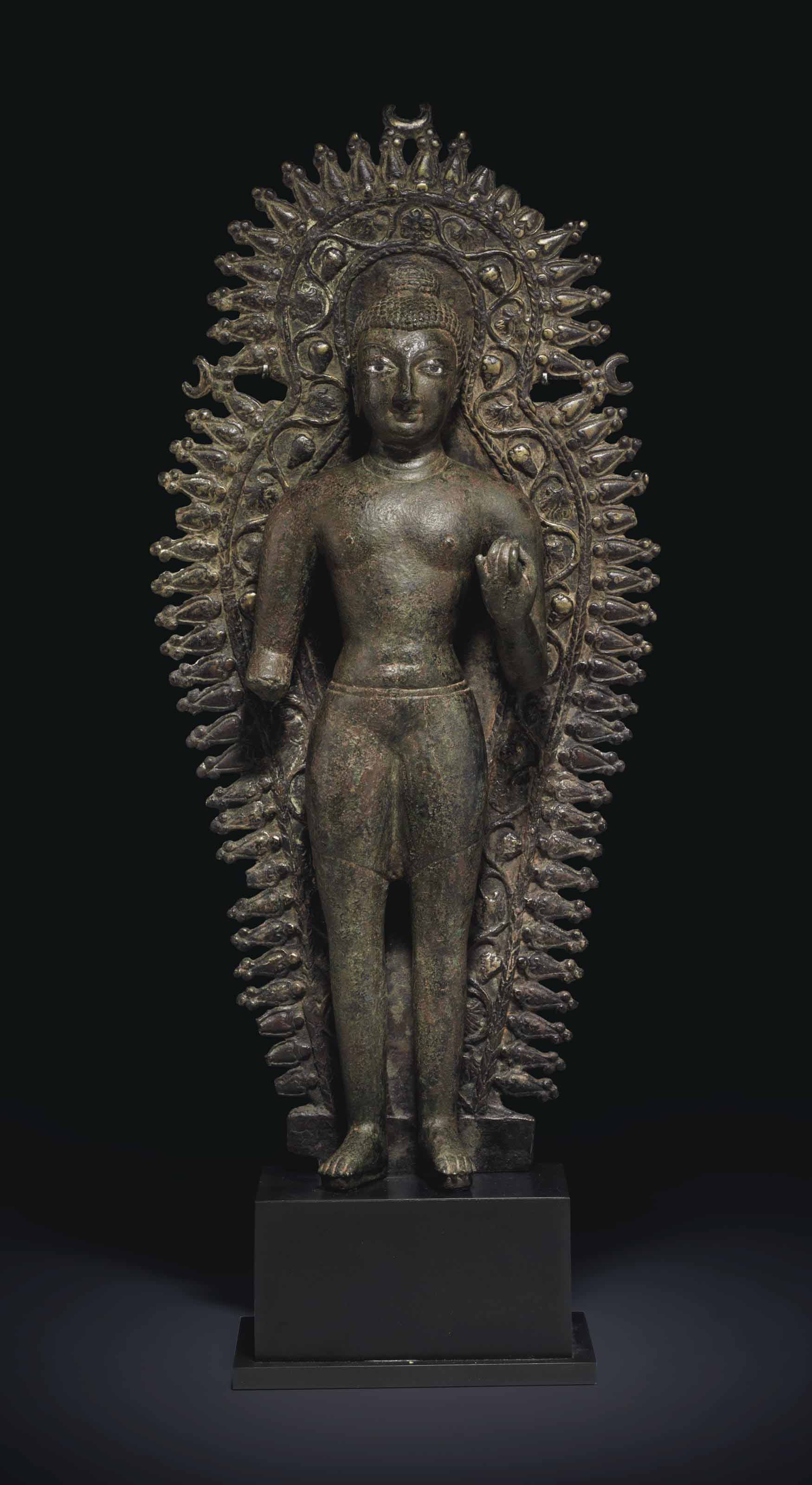 A highly important and rare silver-inlaid bronze figure of the youthful Buddha
Gandhara or Kashmir, circa 7th century
Standing with his left arm raised in a rare mudra, wearing a short dhoti with the pleated tail gently incised, the youthful body sensitively modeled with soft belly, powerful thighs, and fleshy neck, the face with elongated silver-inlaid eyes in a gentle and direct gaze surmounted by a high ushnisha, backed by a convergent halo and aureole outlined with an oval-and-pearl pattern, with three crescent moons at the top and upper sides and with an internal border filled with a fruit-laden vine
左臂上扬结罕见手印,身着短款兜提,褶裥尾端以柔和阴刻呈现。少年身姿造型精妙:腹部柔润,大腿雄健,颈项丰腴。面容静谧端庄,银嵌杏目修长,目光温煦直透人心;头顶肉髻高耸。身后汇聚式身光与背光以椭形连珠纹勾勒轮廓,顶端及上侧饰三轮新月,内缘填满果实累累的葡萄藤纹。
19¼ in. (48.9 cm.) high
Provenance
Private collection, Tokyo
Eurasian Art, acquired in 1980
Private Collection, Kyoto, 1980-2004
Private collection, New York, 2004-2013
这件极为重要的早期印度佛教艺术珍品,其精妙的造型与罕见题材,源于公元6至8世纪克什米尔/斯瓦特河谷地区后犍陀罗与早期笈多美学理念的交汇。作品诞生于艺术创新的转型期——彼时犍陀罗的希腊化元素(如高度立体化的肌肉线条、深褶服饰以及束于顶髻的波浪卷发)正逐渐让位于北印度与中印度笈多雕塑特有的柔润肌理、杏形眼眸与沉思韵致。这尊造像正是这一独特历史时刻的见证,存世同类青铜造像寥若晨星。
此雕塑不仅因其稀缺的历史渊源而卓越,更以其宏大的尺寸、尤为罕见的题材与图像学特征著称。造像表现了佛陀由童稚转向青少年的少年时期。尽管姿态神情已具成年佛陀的慈威之相,却仅着孩童式短款兜提,腰际平直,褶裥以刻线呈现,迥异于其成年形象常见的通肩长袈裟。左手结极为独特的手印:掌心向内,中指与拇指相触,余指自然内曲。该手印仅见于少数6至8世纪斯瓦特河谷与克什米尔地区的青铜造像(参见U. von Schroeder《印藏铜佛》1981年版,第83、89、117页,图版5I、8E、15F、15G),此类比对进一步印证了其地域归属与公元7世纪左右的断代。
其他克什米尔/斯瓦特风格特征包括:阴刻眉线、眼睑与露瞳面积均等的垂目、眼睛与白毫处的精妙银嵌、颈间三道纹饰、以及兜提腰带上缘柔润腹肌呈现的象限式起伏。此作与芝加哥艺术博物馆藏婴孩佛陀铜像(风格断代为5/6世纪,参见E. Errington与J. Cribb编《亚洲十字路口》1992年版,第213-214页,编号208)颇多共通之处。虽芝加哥藏品双腿已佚,但其高耸的肉髻、镜像对称的手势、银嵌双眼及兜提样式均与本尊高度相似。芝加哥佛陀体态更显童稚,躯干略短,胸肌线条较柔和,面庞更丰润,可能暗示本尊所表现的是佛陀生命中稍晚的阶段。
立像身后融合背光与身光的组合式背屏极为罕见,其风格演变可追溯至犍陀罗晚期少数存世范例。从U. von Schroeder《印藏铜佛》2008年版第79页图3D所载5世纪作品可见,身光与背光已结合为单层背屏,边缘饰连珠纹,交汇处缀额外珠饰。更多5/6世纪例证(von Schroeder图4A、4B、4C、4F)显示这些珠饰逐渐拉长,最终形成“椭形连珠”纹样——即底部饰单珠、顶端缀三珠的叶状或火焰状突起(关于“椭形连珠”纹的可能涵义,详见拍品210号说明)。此外,本作还展现出环绕像身的内部轮廓从单线卷草纹演变为宽幅饰带,其间填充果实累累的葡萄藤纹。目前已知唯一类似纹例见于另一尊约6世纪末的铜佛立像,其内部轮廓填满繁缛花卉纹,两侧以珍珠纹镶边(参见U. von Schroeder《印藏铜佛》1981年版第76页编号59,TMMA 1981.188a,b)。此类便携铜像对艺术风格与装饰母题的传播至关重要:如葡萄藤纹源自5世纪秣菟罗雕塑中,坐像背光内填满花卉藤蔓、莲瓣与放射状尖饰的同心圆纹(参见J. Vogel《秣菟罗雕塑》载《亚洲艺术》1930年图版XXXVII a、b,及M.C. Joshi等著《古典印度黄金时代:笈多王朝》第145-151页图8-10)。
本雕塑卓越的艺术品质与南亚艺术转型巅峰期铸造工艺的精妙融合,使之成为犍陀罗与笈多时期交汇点上青铜人物雕塑的典范之作。
Lot Essay
The sensuous modeling and rare subject matter of this highly important work of early Indian Buddhist art results from the convergence of post-Gandharan and early Gupta aesthetic ideals that took place in the Kashmiri/Swat Valley region during the 6th - 8th centuries. Expertly crafted during an innovative transitional period, when Gandhara's Hellenistic elements, such as highly modeled musculature, deeply pleated garments, and waving hair loosely gathered in a topknot, were gradually giving way to the supple, fleshy contours, almond eyes, and contemplative grace that characterize Gupta sculpture from North and Central India, the figure is testament to a unique historical moment from which only a small number of bronzes survive.
This sculpture is not only remarkable for its rare historical origins, but also for its large scale and particularly its highly rare subject matter and iconography. The figure depicts the Buddha at the time in his youth when he transitions from childhood to adolescence. Although he displays an adult Buddha's benevolent yet authoritative stance and facial features, here he is clothed only in a child's short dhoti with a simple straight waist and incised pleated tail, as opposed to the long sanghati in which he typically appears as an adult. His left hand forms an extremely rare mudra, in which the palm faces his body and the third finger meets the thumb with the rest of the fingers gently curled inwards, a gesture that appears in a limited number of other bronzes produced in the Swat Valley and Kashmir between the 6th and 8th centuries (see U. von Schroeder, Indo-Tibetan Bronzes, 1981, pp. 83, 89, 117, figs. 5I, 8E, and 15 F, G); such comparisons further situate the figure within this region and corroborate a date of circa 7th century. Further Kashmiri/Swat features include the incised brows, heavy-lidded eyes with the lidded area perfectly equal to that of the exposed eye and lower lid, the sophisticated silver inlay in the eyes and urna, rings of beauty encircling the neck, and the supple belly with a quadrant form gently articulated just above the waistband of the dhoti.
The present example shares much in common with a bronze figure of the Infant Buddha in the collection of the Art Institute of Chicago, dated stylistically to the 5th/6th century (see E. Errington and J. Cribb (eds.), Crossroads of Asia, 1992, pp. 213-214, cat. no. 208). Though the legs are missing in the Art Institute's work, the high ushnisha, hand position (in mirror image), silver-inlaid eyes, and style of dhoti are remarkably similar. The Art Institute's Buddha has a more childish body type, with a slightly shortened torso, less clearly defined upper chest, and a fuller face, possibly indicating that the present work in comparison is meant to depict the Buddha at a slightly later moment in his life.
The convergent aureole and halo backplate behind the standing figure is extremely rare, and its stylistic development can be traced through a limited number of surviving comparables from late Gandhara. Beginning with a 5th-century example published in U. von Schroeder's Indo-Tibetan Bronzes, 2008, p. 79, fig. 3D), the halo and aureole are combined into a single backplate bordered by globular beads, with an extra bead at the point of intersection. Additional 5th/6th century examples (von Schroeder, figs. 4A, 4B, 4C and 4F) reveal that these beads become progressively elongated and then eventually form the “oval and pearl” pattern, a leaf- or flame-like projection with a bead at the base and three beads at the tip (see lot 210 for further discussion of the possible significance of the “oval and pearl” motif). In addition, the present example shows that the internal outline directly around the figure changes from being a single vine to a wider band encompassing an actual fruit-laden vine in the middle. The sole other example presently known with a similar motif is another bronze Buddha figure, circa late 6th century, in which the internal outline is filled with an elaborate floral pattern bordered on either side by pearls (see again U. von Schroeder, Indo-Tibetan Bronzes, 1981, p. 76, cat. no. 59, TMMA 1981.188a,b). Such portable bronzes would have been instrumental in the transmission of style and decorative motifs; the vine motif for example draws from 5th-century sculpture from Mathura, in which the halo behind the seated figure has concentric circles filled with floral vines, lotus petals, and radiating spikes (see J. Vogel, “La Sculpture de Mathura,” Ars Asiatica, 1930, plate XXXVII a and b, and also M.C. Joshi, et al., The Golden Age of Classical India: The Gupta Empire, pp. 145-151, figs. 8-10).
The exceptional qualities of this sculpture combined with a sensitivity of casting at the peak of a transitional moment in the history of Southern Asian art make this figure of Buddha a masterpiece of bronze figural sculpture from the juncture of the Gandharan and Gupta periods.