
侧边栏

13-14世纪尼泊尔红铜鎏金莲花手观音菩萨坐像(牛津大学阿什莫林博物馆)
尺寸:9.9 x 7 x 4.5cm
年代:13-14世纪
质地:红铜鎏金
风格:尼泊尔
来源:牛津大学阿什莫林博物馆
参阅:外部链接
鉴赏:
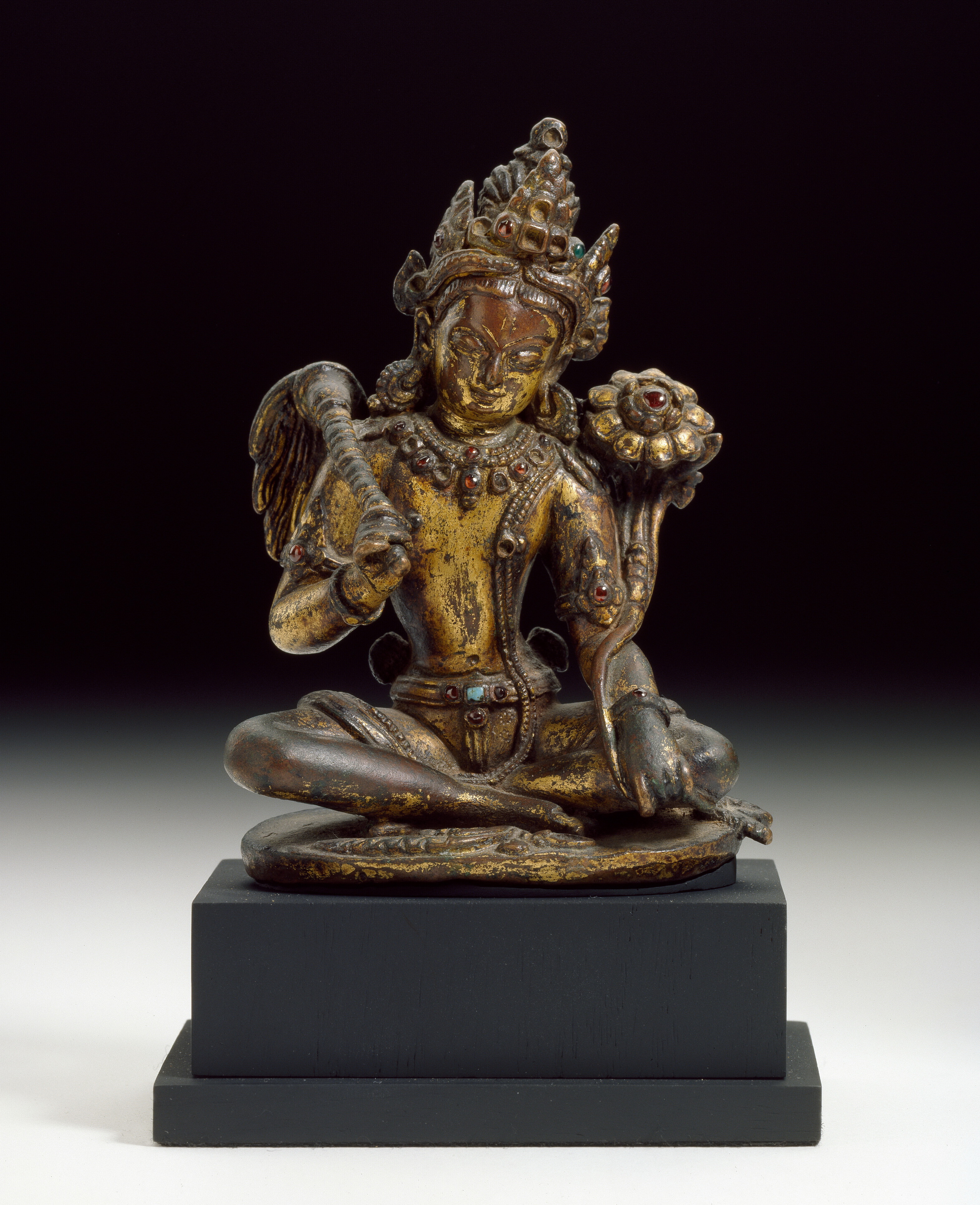
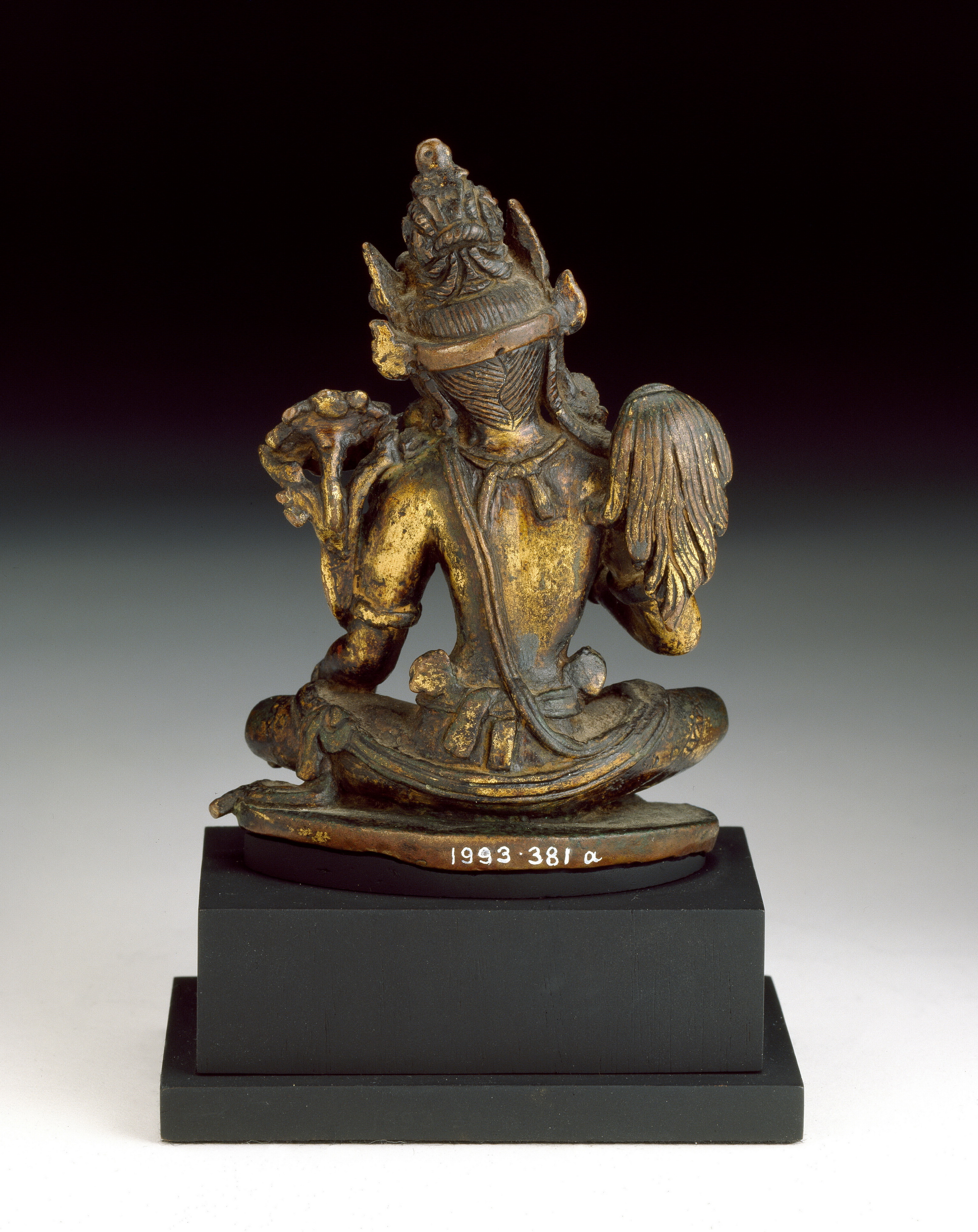 Seated figure of Padmapani with base
gilt bronze, inset with precious stones
馆藏时间:
Purchased, 1993.
This very refined image of Padmapani (‘Lotus-in-hand’: an aspect of the Bodhisattva Avalokitesvara), together with a matching Vajrapani figure, originally flanked a larger image of Vasudhara, goddess of prosperity and wealth [1]. The use of gilt copper and inset cabochon stones, the graceful modelling, and the serene expression of this image are characteristic of sculpture of the early Malla period. In Tibetan Buddhist iconography, Avalokitesvara assumes the aspect of a benign demeanour and white body colour, holding a fly-whisk and lotus, when acting as an attendant to the Buddha Sakyamuni or the goddess of long life Ushnishavijaya [2]. In Nepal, the same aspect is also found, as here, when Avalokitesvara attends Vasudhara. Padmapani gazes gently downward, his face inclined slightly to the right. His seated posture is perfectly balanced, his ankles loosely crossed beneath him and the right shoulder aligned slightly forward. His left hand holds the stem of the jewelled lotus, while his raised right hand holds the yak-tail fly-whisk which trails over his shoulder, covering the rear of his upper arm.
The image is as finely modelled at the rear as in front. The chignon has high and intricate coils, the hair is carefully combed in vertical lines above the crown band; below the band it is combed diagonally to form trailing plaits. The crown has three vertical panels, inset with rubies and semi-precious stones to create a geometric pattern, and two lateral fans, formerly also inset with stones. There is no image of Amitabha in the crown. The earrings are concentric discs with beaded edges and a single suspended bead. The necklaces are strands of beads with a central stone and a second strand with several stone pendants. The beaded sacred thread was also inset with a stone in mid-torso. The waist is very slender, slightly inclining to the left, while the hips face forward. The flat abdomen is emphasized by the inset turquoise and rubies of the belt, which circles the hips and is tied at the back with two hanging ends. The dhoti has an imprinted pattern of diminutive circular florets. A sash is draped over the thighs and below the hips at the back; it is knotted at the back of the left thigh, the ribbon ends falling behind the leg, while the other end of the sash protrudes beneath the right foot.
The separately made, copper repoussé lotus pedestal, now detached from the image, has suffered damage to several of its petals at the front and rear [3].
[Footnotes:]
1 All three sculptures are published by von Schroeder, Indo-Tibetan Bronzes, nos. 93A–C (the present image is 93A). The Vasudhara is now in the Museum Rietberg, Zurich (Berti Aschmann Foundation of Tibetan Art): Uhlig, On the Path to Enlightenment, no. 97; the Vajrapani is published in Weldon, 'Tibetan Sculpture Inspired by Earlier Foreign Styles', fig. 10; see also Introduction above, figs. 21–2.
2 de Mallmann, Iconographie du Tantrisme Bouddhique, p. 106.
3 Acc. no. ea 1993.381b.
In: Heller, Amy, Early Himalayan Art (Oxford: Ashmolean Museum, 2008)
这尊制作极为精美的莲花手菩萨立像(Padmapani,意为“手持莲花者”,是菩萨观世音的一种化身),与一尊与之相配的金刚手菩萨像,最初应是一组造像中的胁侍,共同环绕着一尊更为高大的主尊——财富女神财续佛母(Vasudhara)[1]。此像采用了红铜鎏金工艺,并镶嵌有弧面切割宝石,其造型优雅,神态宁静,充分展现了马拉王朝(Malla)早期的雕塑艺术特征。在藏传佛教图像学中,当观世音菩萨作为释迦牟尼佛或长寿佛尊胜佛母(Ushnishavijaya)的胁侍时,常呈现此温和相,身色洁白,手持拂尘与莲花 [2]。在尼泊尔,当观世音作为财续佛母的胁侍时,也可见到同样的形象,此像即为一例。莲花手菩萨目光柔和下视,面容微微偏向右侧。其坐姿极为均衡,脚踝在身下松散地交叠,右肩则稍稍向前。左手持一茎有珠宝装饰的莲花,右手轻抬,握着一柄牦牛尾拂尘,拂尘自然垂落于肩后,遮住了上臂的后部。
此像的背面与正面同样塑造得一丝不苟。高耸的发髻(chignon)有着复杂而精美的发卷,发丝在头冠带上方被精心梳理成垂直的线条;头冠带以下,发丝则斜向梳理,形成垂落的小辫。头冠由三块纵向饰板组成,其上镶嵌着红宝石与半宝石,构成几何纹样;两侧有扇形的装饰,原本也应嵌有宝石。冠中未见化佛(阿弥陀佛)。耳饰为同心圆环,边缘饰有连珠纹,并悬有一颗珠子。颈饰为数串珠链,中央嵌有一颗主石;另有一串较长的璎珞,垂挂着若干宝石坠饰。身上佩戴的具珠络(神圣的线)在胸部中央也嵌有宝石。菩萨腰身极为纤细,微微向左侧轻扭,臀部则朝向正面。平坦的小腹因腰带镶嵌的绿松石和红宝石而更显突出,腰带环绕髋部,于身后打结,两端飘垂而下。下身所着的裙(dhoti)上印有细小的圆形花纹。一条束帛飘带搭于双腿之上,并从身后绕过髋部下方;它在左大腿后侧打结,飘带尾端垂于腿后,束帛的另一端则在右脚下微微露出。
这尊像原配的莲花座为单独打制的红铜锤鍱(repoussé)工艺作品,现已与主像分离。莲座正面与背面的部分莲瓣有所损伤 [3]。
(附注原文的脚注信息,供参考)
[1] 这三尊造像皆收录于 von Schroeder 所著的《Indo-Tibetan Bronzes》中,图版编号 93A–C(本件作品为 93A)。其中增禄佛母像现藏于苏黎世莱特博格博物馆(Museum Rietberg, Zurich),为贝尔蒂·阿斯曼西藏艺术基金会(Berti Aschmann Foundation of Tibetan Art)藏品,见 Uhlig 所著《On the Path to Enlightenment》,图版编号 97;金刚手菩萨像发表于 Weldon 所著《'Tibetan Sculpture Inspired by Earlier Foreign Styles'》,图版 10;亦可参阅前述导论,图版 21–2。
[2] de Mallmann 所著《Iconographie du Tantrisme Bouddhique》,第 106 页。
[3] 馆藏编号:ea 1993.381b。
—— 引自:Heller, Amy 所著《Early Himalayan Art》(牛津:阿什莫林博物馆,2008年)
著录:
Topsfield, Andrew, Art of India and Beyond, (2021), page mentioned: 192, page illustrated: 192, Cat. No.: 82

