
侧边栏

12世纪大理国铜鎏金阿嵯耶观音菩萨立像(香港佳士得)
尺寸:高46.5 cm
年代:12世纪 大理国时期
质地:铜鎏金
风格:大理
来源:拍卖会
成交:9,040,000港元(2015.06)
参阅:外部链接
鉴赏:
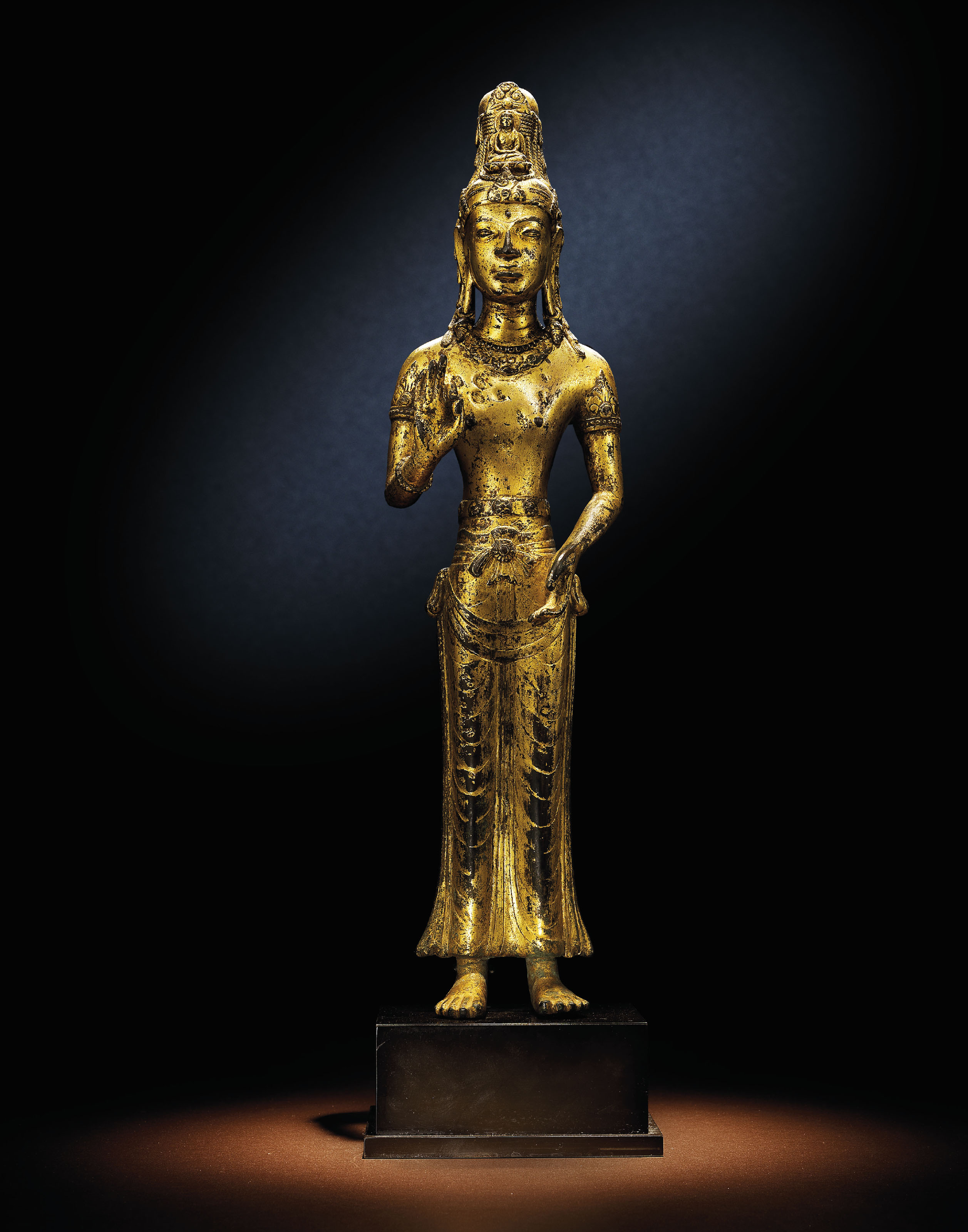 A RARE AND FINELY CAST GILT-BRONZE FIGURE OF ACUOYE GUANYIN
DALI KINGDOM, 12TH CENTURY
The tall, slender figure shown standing with right hand raised in vitarkamudra and left hand in varadamudra. The finely cast hair drawn up into a tall topknot elaborately dressed with narrow braids arranged in a band and pendent loops which centre an image of Amitabha Buddha seated in dhyanasana. Detailed with strands of hair falling to the shoulders behind the elongated ears adorned with earrings. Further embellished with jewelled and cloud-decorated necklace, foliate arm bands and a belt decorated with florets encircling the slim waist above the folded-over top of the dhoti secured by a sash drawn through a jewelled medallion that is tied into a bow. The thin fabric of the skirt falling in U-shaped folds to the bare feet and overlaid with another long sash pulled into loops at the hips before trailing down the sides, with long rectangular tabs projecting from the bottom of the feet. Cast with an aperture in the back of the skirt.
这尊高挑纤细的造像呈站立姿势,右手高举结说法印(vitarkamudra),左手垂下结施与印(varadamudra)。精细铸造的头发向上梳成高髻,以窄编发辫精心盘绕成带状和环状装饰,中央安奉阿弥陀佛结跏趺坐像。发缕垂落于佩戴耳珰的修长耳后肩头。造像还饰有宝珠及云纹项链、叶纹臂钏,以及一条饰有小花图案的腰带,系于纤腰之上,围裹着翻折裙腰的缠裤(dhoti)——该裙腰以穿过宝珠纹饰板的帛带系成蝴蝶结。轻薄裙布垂落裸足处形成U形衣褶,外覆另一条长帛,于髋部盘成环结后沿身侧垂下,足底伸出长条形榫头。裙摆背部铸有开口。
来源:
Gallery Bodhicitta Ltd., London, acquired October 1998
There was little known information on Dali bronzes until the American scholar Helen Chapin published, in 1944, a scroll painting known as the Long Scroll of Buddhist Images by the late 12th century Yunnanese artist, Zhang Shengwen. The scroll is in the National Palace Museum Collection, Taipei, and bears two colophons dating to 1173-1175 and 1180. From the scroll, Chapin identified a group of similar bronzes in Western collections as those of Yunnan origin by comparing their styles and iconography. Further interests in Yunnanese bronzes developed when in the late 1970s an important find of Buddhist reliquary was found stored within the roof rafters of the Qianxun Pagoda. This group was discovered when restoration work was undertaken on the pagodas roof. One of the finds included a standing Guanyin, identical to the present figure in style (fig. 1). The discovered figure, 28 cm. high, was cast in solid gold and attached with a silver mandorla. For an illustration and discussion of the Yunnanese Guanyin, see A. Lutz, Buddhist Art in Yunnan, Orientations, February 1992, fig. 5, pp. 46-50.
Bronzes of this type were made for the Dali court and such images were also known in the Nanzhao tuzhuan scroll, dated to AD 947, in the Fujii Yurinkan Collection, Kyoto (fig. 2). The scroll illustrates the founding of the Nanzhao kingdom and recorded the local legend of this deity as the transformation of an Indian monk who as an incarnation of Guanyin visited Yunnan in the 7th century (see, A. Lutz, ibid, p. 48). This form was known as the Acuoye Guanyin, Ajaya Avalokitesvara or the All Victorious Guanyin. These figures were thought to have been cast as talismans for the royal family, W. Zwalf (ed.), Buddhism: Art and Faith, British Museum, 1985, p. 206; where the author illustrates a smaller figure in the British Museum (44.7 cm.), no. 206.
A similar bronze in the San Diego Museum of Art bears an inscription and a date between 1147-1172. See H. Chapin, Yunnanese Images of Avalokitesvara, Harvard Journal of Asiatic Studies, vol. 8 1944-1995, pp. 131-186, pls. 3, 4, 5 and 6. Compare also the figure included in the exhibition, Treasures from the Metropolitan Museum of Art, China House Gallery, New York, 24 October-25 November 1979, no. 22; and two others from the Musee Guimet and the Freer Gallery of Art illustrated by H. Munsterberg, Chinese Buddhist Bronzes, Vermont and Japan, 1967, pls. 58 and 59 respectively.
Compare with two standing examples, the first with a later gilt-bronze lotus-form base was sold at Christies New York, 19 September 2007, lot 188; and the other with a later inscribed stand, bearing a jiwei cyclical year corresponding to 1919, was sold at Christies New York, 24 March 2011, lot 1294. A related example seated with one leg pendant in ardhaparyankasana, formerly from the Nitta Collection, was sold at Christies Hong Kong, 26 April 1998, lot 606.
在20世纪40年代之前,关于大理青铜器的资料所知甚少,直至美国学者Helen Chapin于1944年发表了一幅由12世纪末云南画家张胜温(Zhang Shengwen)绘制的《梵像卷》(Long Scroll of Buddhist Images)。该画卷现藏于台北故宫博物院(National Palace Museum Collection, Taipei),卷尾有两段题跋,年代分别为1173至1175年和1180年。Chapin通过对比该画卷中造像的风格与图像特征,鉴定出西方收藏中的一组青铜像为云南来源。20世纪70年代末,在对千寻塔屋顶进行修缮时,于其椽架内发现了一批重要的佛教舍利容器,这一发现进一步引发了学界对云南青铜器的兴趣。其中一件出土品为一尊观音立像,风格与本尊造像完全相同(图1)。该像高28厘米,以纯金铸造,并配有银质背光。关于这尊云南观音像的图版与讨论,参见A. Lutz撰《Buddhist Art in Yunnan》,载《Orientations》杂志1992年2月刊,图5,第46-50页。
此类青铜像专为大理宫廷铸造,在京都藤井有邻馆(Fujii Yurinkan Collection, Kyoto)所藏、年代为公元947年的《南诏图传》(Nanzhao tuzhuan)画卷中亦有此类造像的图像记录(图2)。该画卷描绘了南诏国的建国历史,并记载了当地传说:此神祇为一位印度僧人的化身,该僧作为观音的化身于7世纪来到云南(参见A. Lutz,同上,第48页)。此造型被称为阿嵯耶观音(Acuoye Guanyin),即Ajaya Avalokiteshvara,或称“全胜观音”。据认为,这些像是作为皇室护身符而铸造的,参见W. Zwalf编《Buddhism: Art and Faith》(大英博物馆,1985年,第206页);该文作者著录了大英博物馆所藏一件较小的此类造像(高44.7厘米),编号206。
圣地亚哥艺术博物馆(San Diego Museum of Art)藏有一件类似的青铜像,带有铭文,年代在1147年至1172年之间。参见H. Chapin撰《Yunnanese Images of Avalokitesvara》,载《Harvard Journal of Asiatic Studies》第8卷,1944-1995年,第131-186页,图版3、4、5、6。另可比较1979年10月24日至11月25日纽约中国研究所画廊(China House Gallery)举办的“大都会艺术博物馆珍宝展”中的一尊造像(图录第22号);以及吉美国立亚洲艺术博物馆(Musee Guimet)和弗利尔美术馆(Freer Gallery of Art)所藏的两件,分别见于H. Munsterberg著《Chinese Buddhist Bronzes》(佛蒙特州与日本,1967年)图版58、59。
另可比较两件立像实例:其一配有后配的鎏金铜莲座,售出于佳士得纽约,2007年9月19日,第188号;另一件配有后配的带铭文底座,铭文干支为己未年,对应1919年,售出于佳士得纽约,2011年3月24日,第1294号。一件相关的游戏坐(ardhaparyankasana,一腿垂放)造像,旧属新田集藏(Nitta Collection),售出于佳士得香港,1998年4月26日,第606号。

