
侧边栏

唐代五代合金铜六臂如意轮观音(纽约苏富比)
尺寸: H. 16.5 cm
年代: 唐代-五代
质地: 合金铜
风格: 中原
来源: 纽约苏富比
成交: 2,060,000美元(2019.03)
参阅: 外部链接
鉴赏:
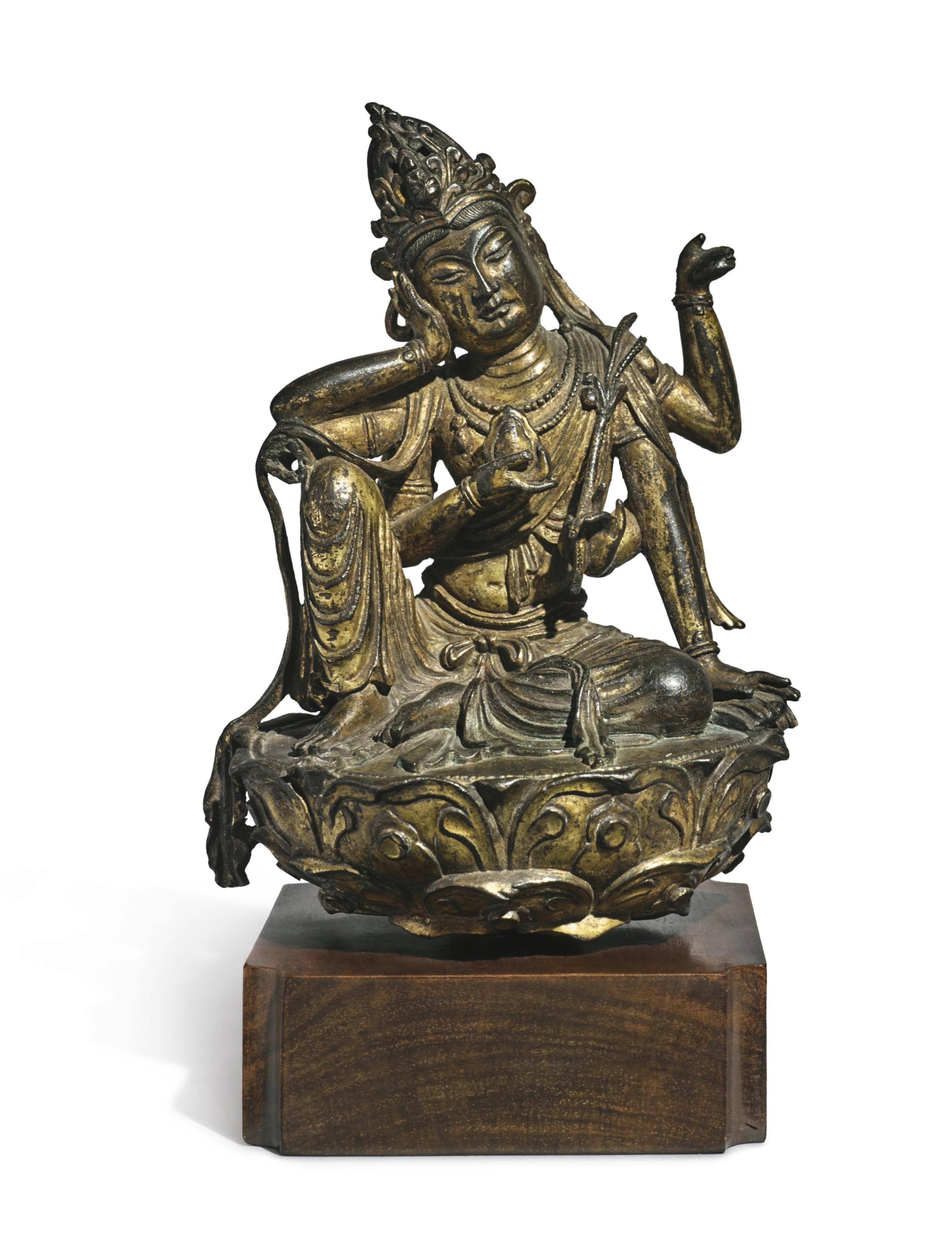 A GILT-BRONZE FIGURE OF CINTAMANICAKRA AVALOKITESHVARA | LATE TANG DYNASTY / FIVE DYNASTIES
该造像有若干处缺损(均如图所示),包括:右臂(自肘部以下)、左手之一的手指、两条飘带的末端,以及莲茎的端部。表面有细微散落的划痕和鎏金剥落痕迹,皆与年代相符。原配底座已佚。
来源:
Collection of Trezevant Branam Winfrey (1912-1999), by 1968.
Acquired from the estate of the above in Kirkwood, Missouri, 1999.
Perhaps the most popular and well-known Buddhist deity in China, Avalokiteshvara, or Guanyin, is known by worshippers in many forms, among them Ekadashamuka, Amogopasha, Shadakshari, Water Moon Guanyin, and more rarely, Cintamanicakra. As Buddhism evolved in China, Avalokiteshvara’s varied forms were introduced through the transmission and translation of different sutras. As Chun-fang Yu mentions in 'Guanyin: The Chinese Transformation of Avalokiteshvara', in Marsha Weidner, Latter Days of the Law: Images of Chinese Buddhism 850-1850, Kansas, 1994, p.154, one of the earliest esoteric Avalokiteshvara texts was translated into Chinese in the Eastern Jin dynasty (317-420 A.D.). In the Northern Zhou dynasty (557-581 A.D.), further esoteric scriptures focusing on Avalokiteshvara were introduced, and through these texts, the tantric forms of the bodhisattva were propagated. Cintamanicakra is often depicted in the same attitude as the present, holding in the six arms the wish-granting jewel (cintamani) in front of the chest, the dharma wheel (chakra) in a raised palm, the stem of a lotus in another hand, a mala in another, and the sixth planted down for support. The murals of the Mogao Caves at Dunhuang, in Cave 14, show a colorfully painted six-armed Cintamanicakra, in the same pose as the present example, and bearing the same attributes, executed in the late Tang period.
Another bronze example of this deity is illustrated in Saburo Matsubara, Chinese Buddhist Sculpture: A study based on bronze and stone statues other than works from cave temples, Tokyo, 1966, pls 295a and b, attributed to the Tang dynasty. A related bronze figure in the collection of the Metropolitan Museum of Art attributed to the 10th century, late Tang or Five Dynasties period, is illustrated in Denise Patry Leidy and Donna Strahan, Wisdom Embodied: Chinese Buddhist and Daoist Sculpture in the Metropolitan Museum of Art, New Haven, 2010, pl. A35 (fig. 1), depicts a different bodhisattva of the same type. The Metropolitan Museum figure has a lotus petal base of the same distinctive design as the present example, as well as other similar related stylistic elements, such as drapery, proportions, and facial modeling. Another gilt-bronze figure of an esoteric bodhisattva, in this case depicting Vajrasattva, from the collection of James W. and Marilynn Alsdorf, illustrated in Hugo Munsterberg, Chinese Buddhist Bronzes, Tokyo and Rutledge, 1967, pl. 81, now in The Art Institute of Chicago and attributed to the late 8th or early 9th century of the Tang period, also has a lotus base strikingly similar to that of the present Cintamanicakra figure. A further example of a gilt-bronze bodhisattva holding a cintamani, attributed to the 8th century and with a similar lotus base, modeling, and proportions, was exhibited in Tang Dynasty: Chinese Gold and Silver in American Collections, Dayton Art Institute, 1984, cat. no. 73.
在中国,最受信徒尊崇与熟知的佛教神祇莫过于观世音菩萨(又称观音),其化身无数,包括十一面观音、不空罥索观音、六字观音、水月观音,以及较为罕见的如意轮观音。随着佛教在中国的发展演变,不同经典的传入与翻译带来了观音菩萨的种种化身形式。正如于君方(Chun-fang Yu)在《观音:中国观音的转型》一文(收录于魏玛莎(Marsha Weidner)编《末法:中国佛教造像(850-1850年)》(Latter Days of the Law: Images of Chinese Buddhism 850-1850),堪萨斯,1994年,第154页)中所指出,最早关于密教观音的经典之一已于东晋(317-420年)时期译成中文。北周(557-581年)时期,更多关于观音的密教经典被引入,菩萨的密教形象也随之传播开来。
如意轮观音的造型常与本例相同,六臂中,当胸捧如意宝珠,一掌扬起持法轮,另一手持莲茎,另有手持念珠,第六臂则垂下依傍。敦煌莫高窟第14窟的壁画中,绘有一尊色彩斑斓的六臂如意轮观音,姿态与本例相同,持物亦一致,为晚唐时期作品。
另一尊同题材的铜铸实例,收录于松原三郎(Saburo Matsubara)《中国佛教雕刻史:以石窟以外金石造像为中心的研究》(Chinese Buddhist Sculpture: A study based on bronze and stone statues other than works from cave temples,东京,1966年,图版295a及b),被定为唐代作品。大都会艺术博物馆藏有一尊相关铜像,定为10世纪晚唐或五代时期,见载于 Denise Patry Leidy(Denise Patry Leidy)与 Donna Strahan(Donna Strahan)合著《智慧化身:大都会艺术博物馆藏中国佛教与道教雕塑》(Wisdom Embodied: Chinese Buddhist and Daoist Sculpture in the Metropolitan Museum of Art,纽黑文,2010年,图版A35,图1),所描绘的虽为另一位菩萨,但属同一类型。大都会的这尊像与本例莲瓣台座的设计特征相同,于衣纹、比例、面部塑造等风格元素上亦有相似之处。另一尊密教菩萨铜鎏金像,系金刚萨埵,出自 James W. 与 Marilynn Alsdorf(James W. and Marilynn Alsdorf)收藏,载于雨果·明斯特伯格(Hugo Munsterberg)《中国佛教铜器》(Chinese Buddhist Bronzes,东京与拉特格市,1967年,图版81),现藏芝加哥艺术博物馆,定为唐代8世纪末或9世纪初作品,其莲座与本例如意轮观音的莲座惊人相似。另有一尊捧持如意宝珠的铜鎏金菩萨像,定为8世纪作品,莲座、造型与比例皆与本例相似,曾参展于《唐代:美国收藏中的唐代金银器》(Tang Dynasty: Chinese Gold and Silver in American Collections,代顿艺术学院(Dayton Art Institute),1984年,图录第73号)。

