
侧边栏

7世纪斯瓦特风格铜错银思惟观音菩萨(香港邦瀚斯)
尺寸:含背光高16cm
年代:7世纪
质地:铜错银
风格:斯瓦特
来源:拍卖会
成交:4,375,625港元(2019.10)
参阅:外部链接
鉴赏:
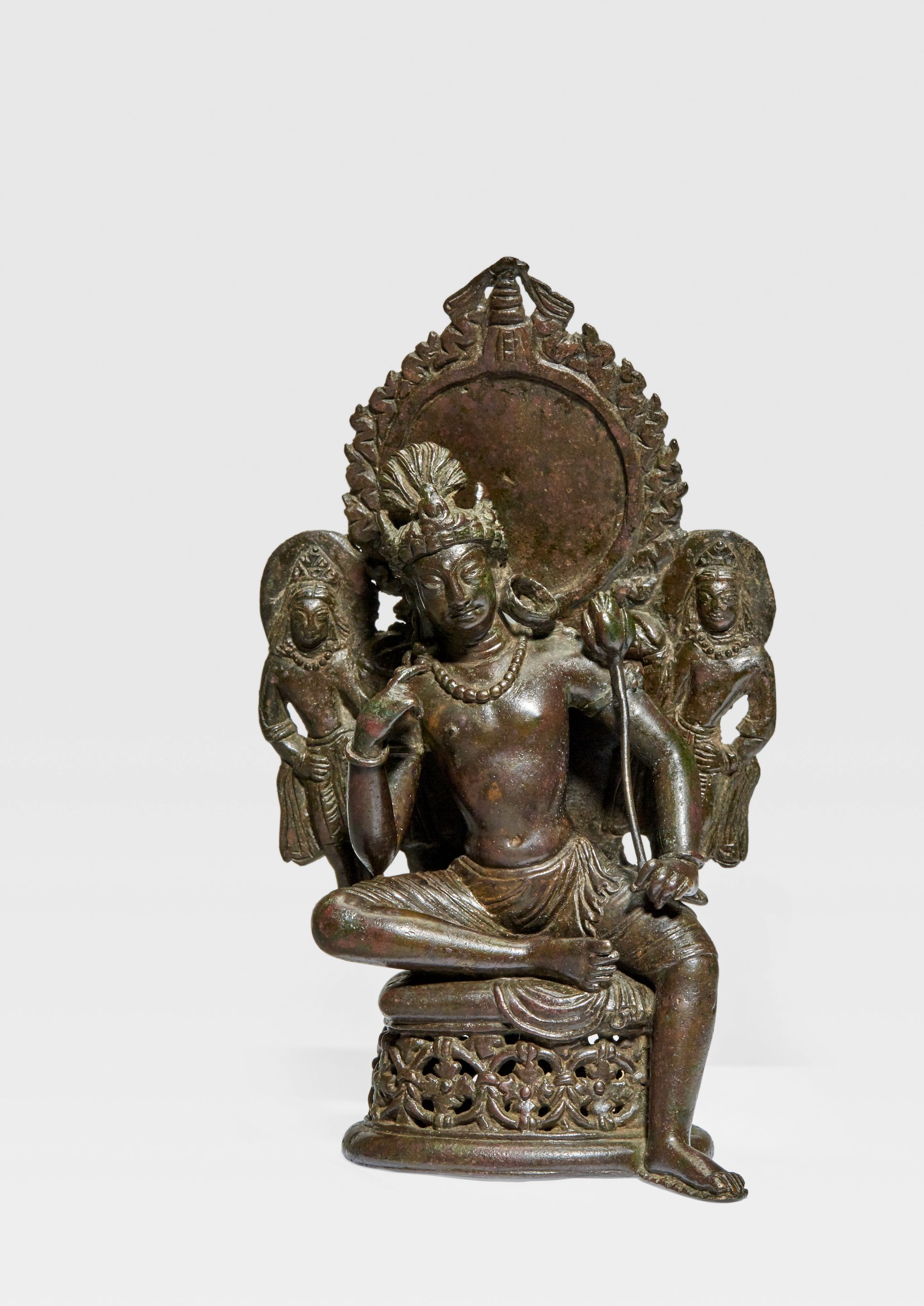
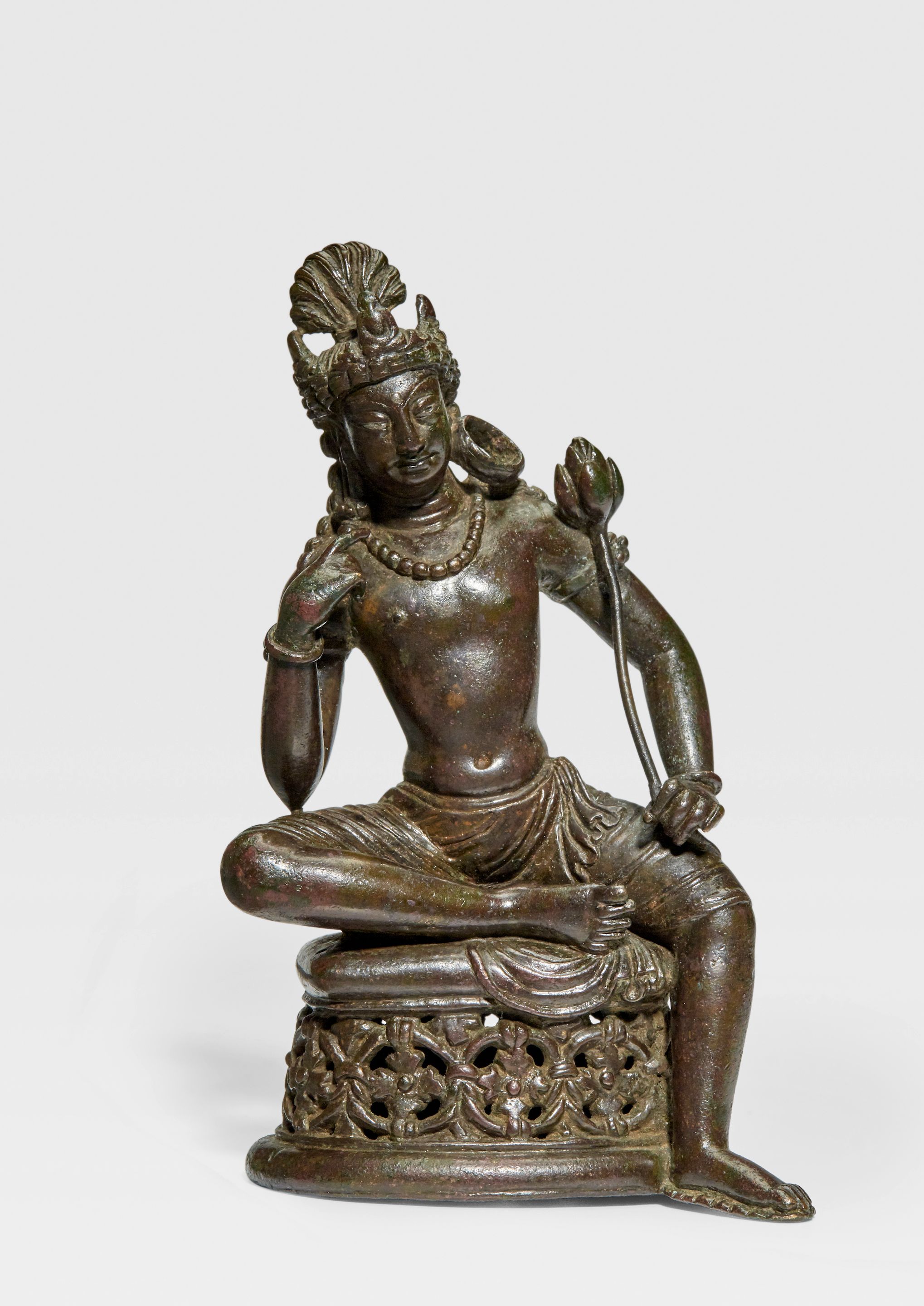
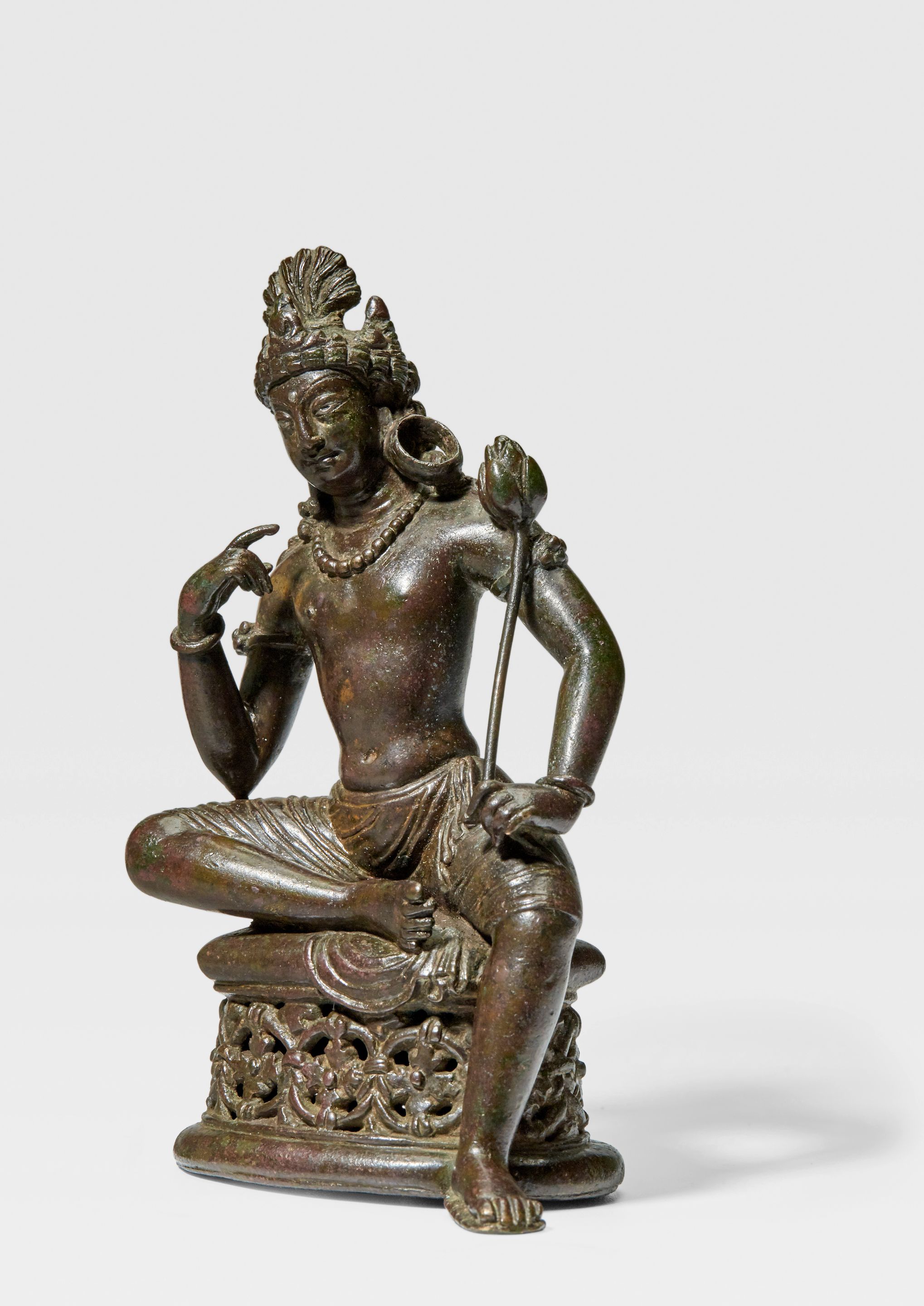
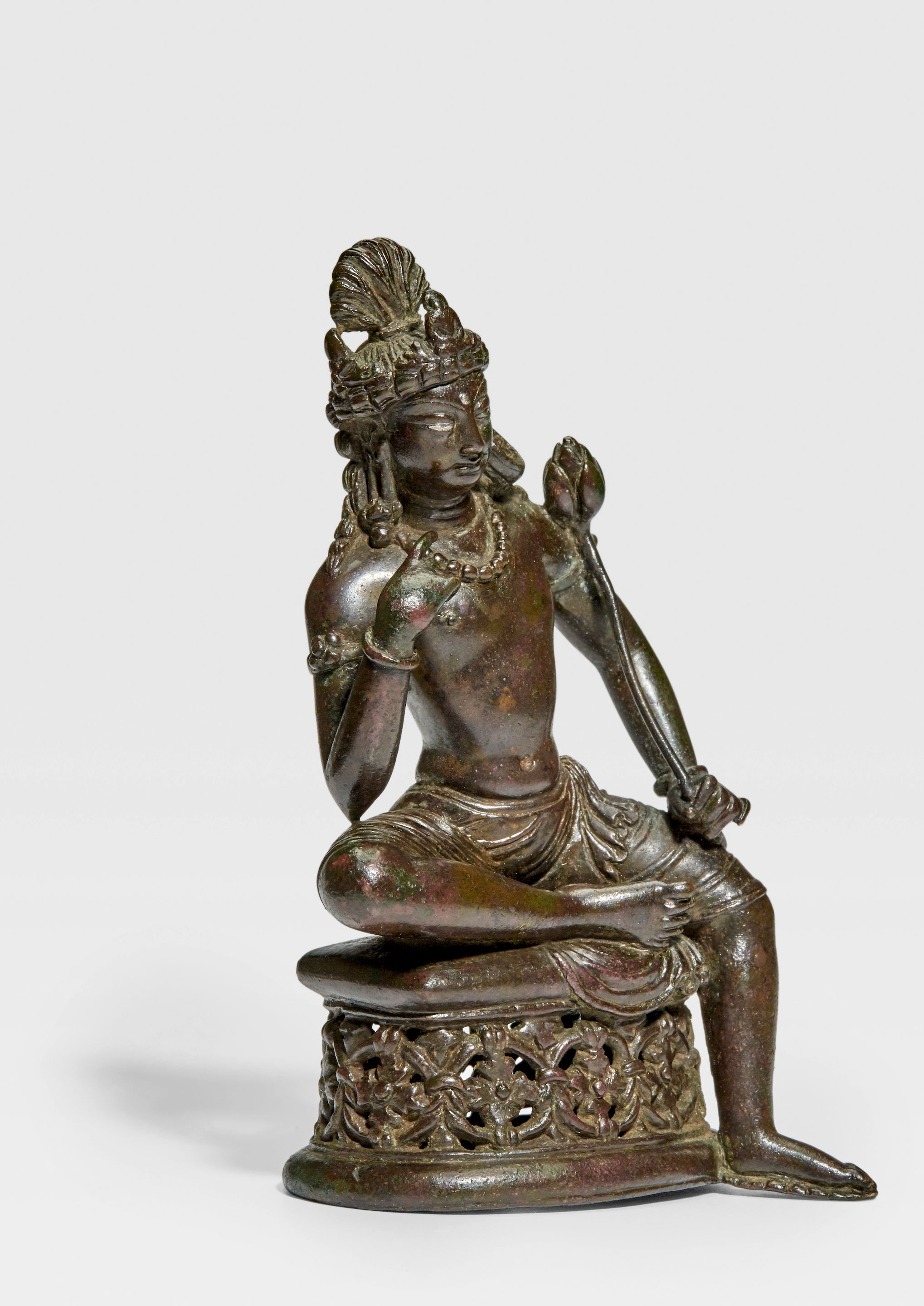
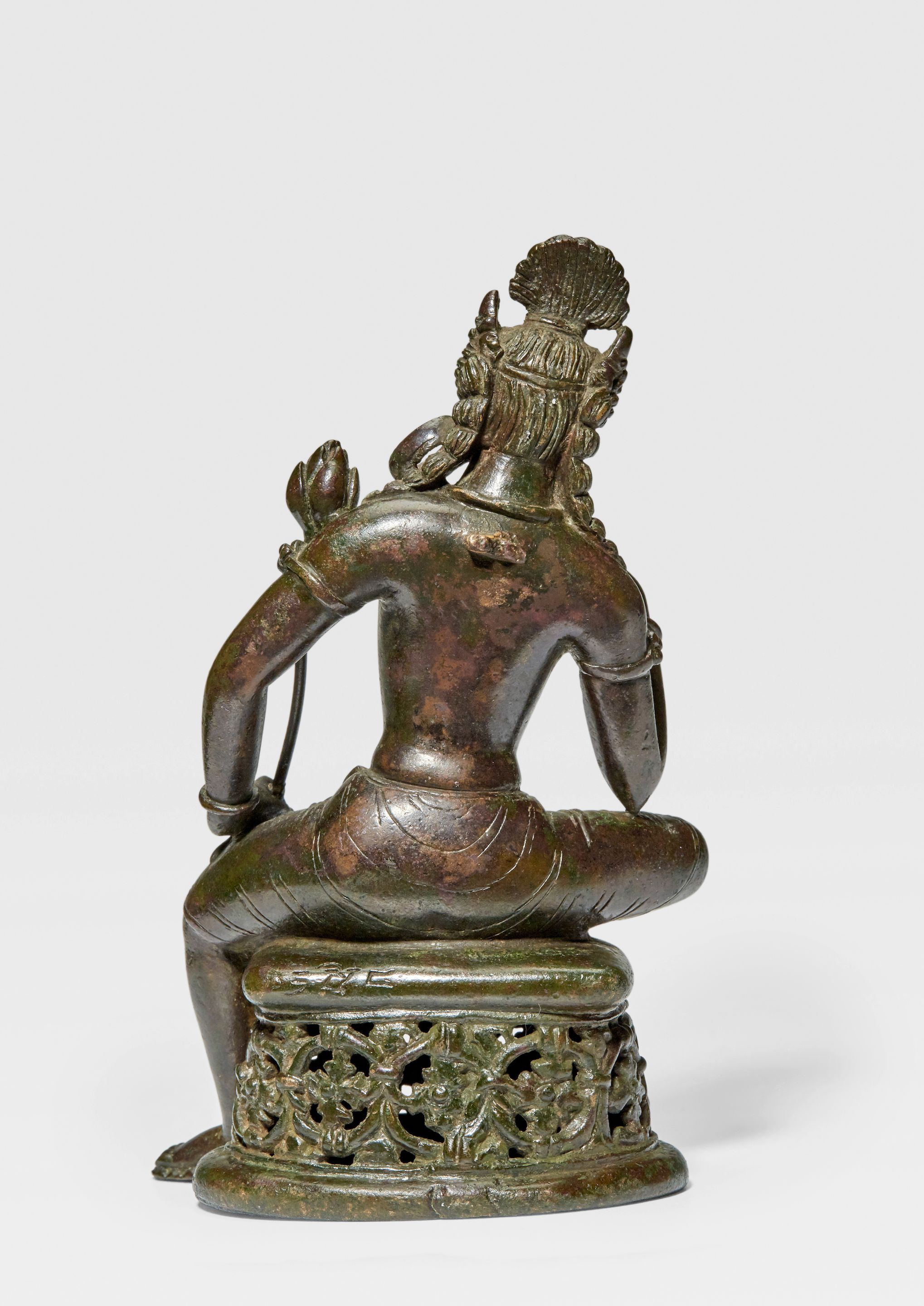
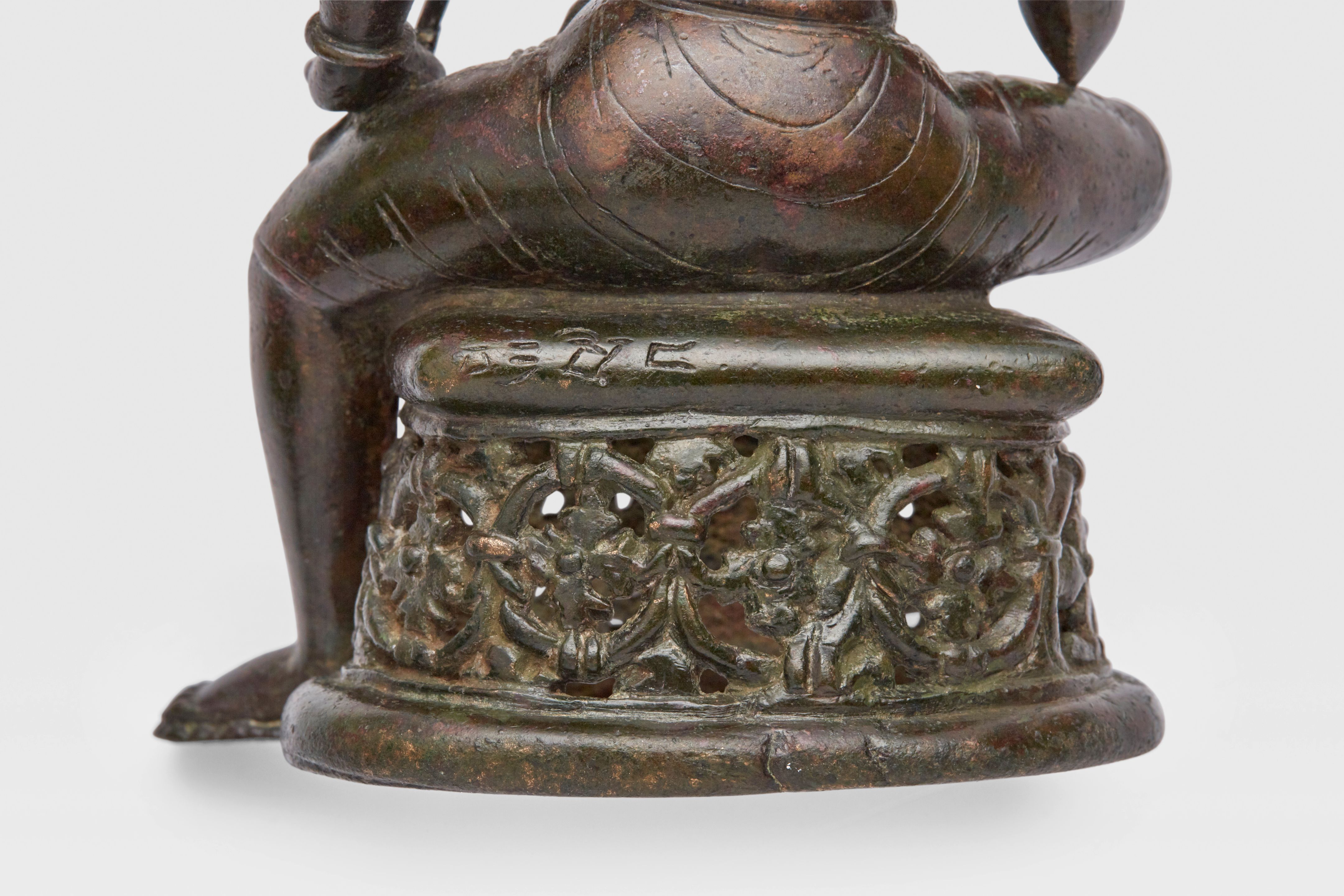
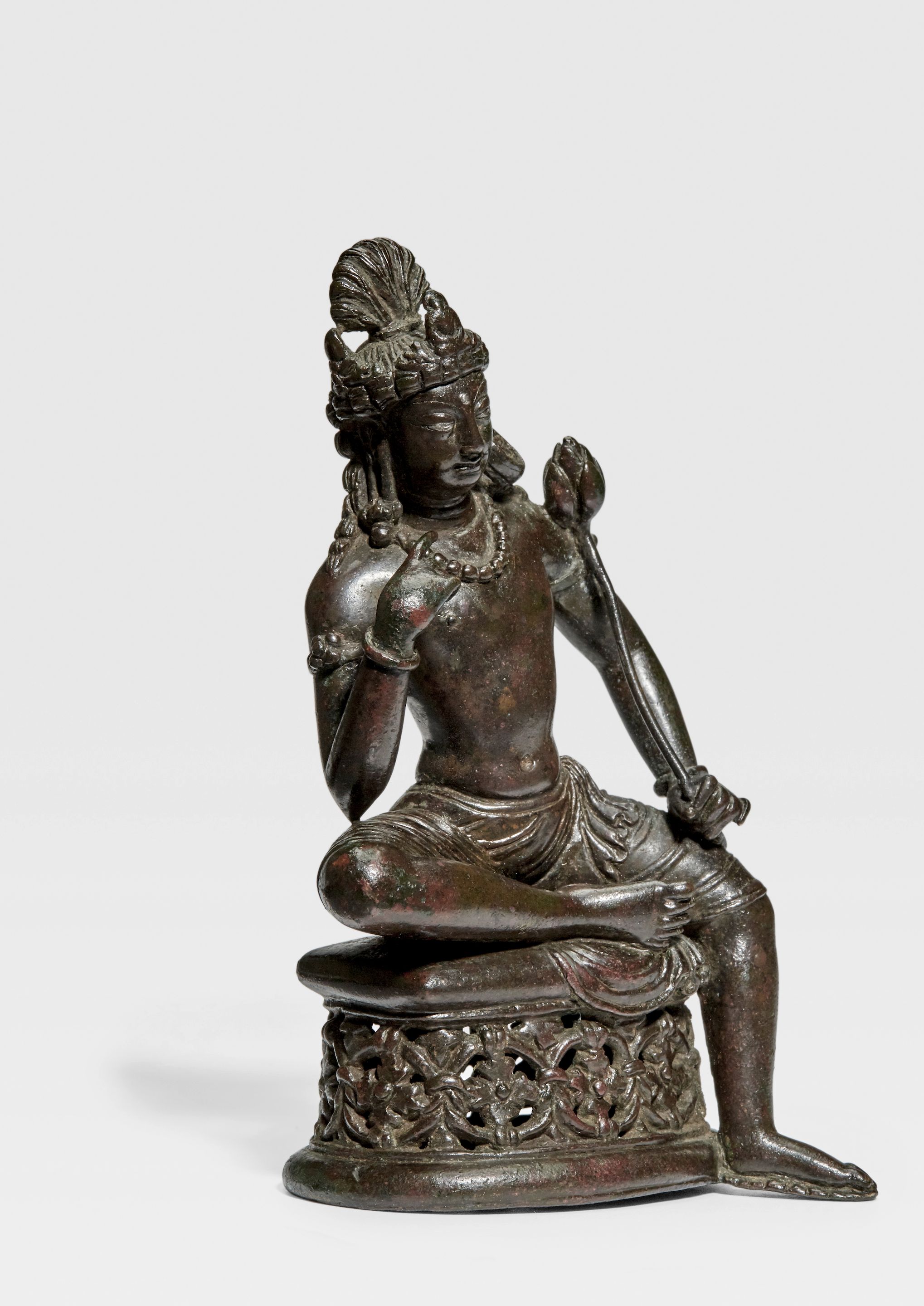
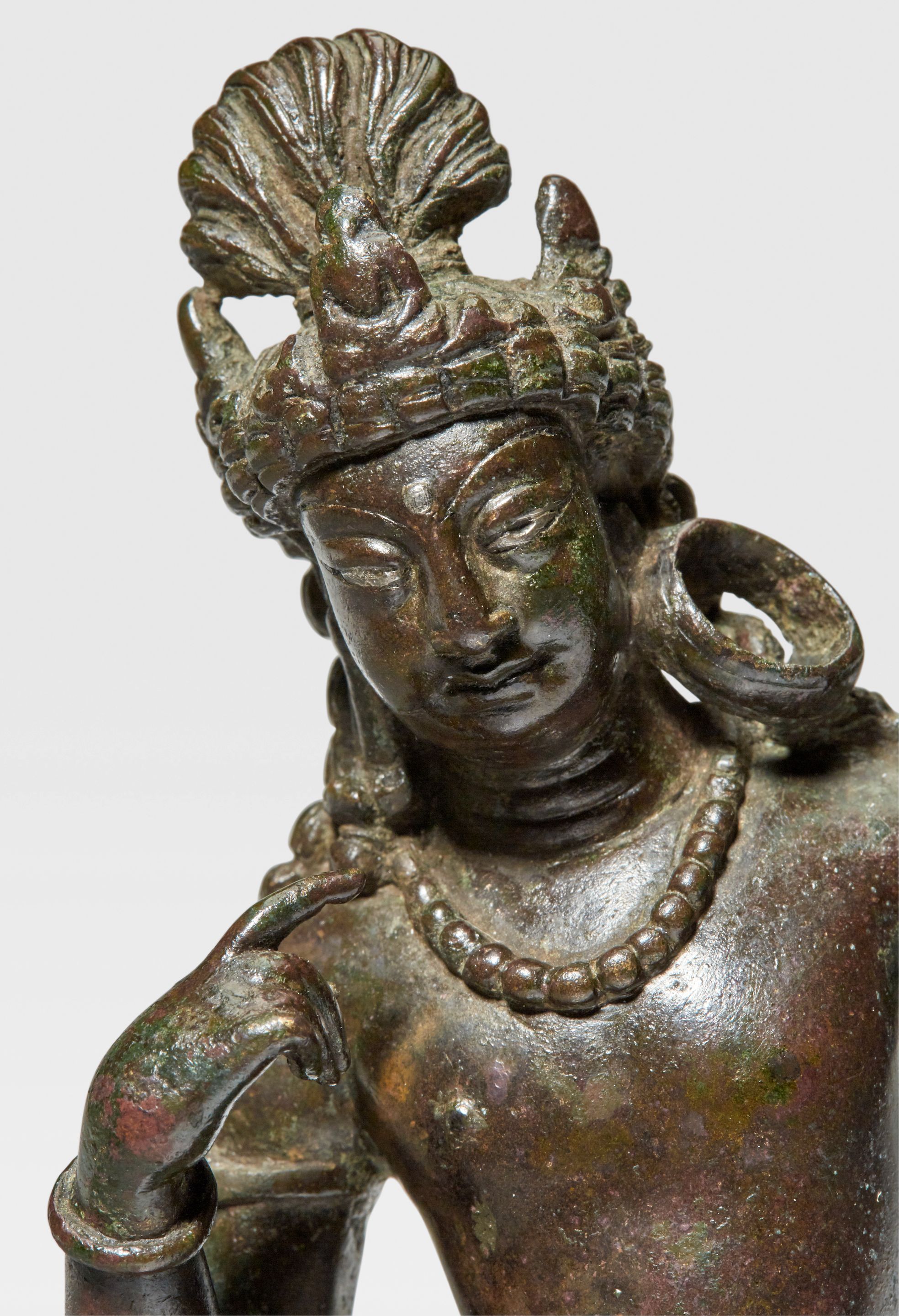 铜错银观音像
斯瓦特,约七世纪
背光为原配,与铜像分别铸造;藤座侧面刻单行铭文,或为供养人之名Vajrasina
喜马拉雅艺术资源网68412号
高12.6厘米(5英寸),不含背光
高16厘米(6 1/4英寸),含背光
著录:
David Weldon与Jane Casey Singer,《The Sculptural Heritage of Tibet:Buddhist Art in the Nyingjei Lam Collection》,伦敦,1999年,页36-7,图版2。
Franco Ricca,《Arte Buddhista Tibetana:Dei e Demoni dell'Himalaya》,都灵,2004年,图IV.2。
展览:
「The Sculptural Heritage of Tibet:Buddhist Art in the Nyingjei Lam Collection」,阿什莫林博物馆,牛津,1999年10月6日至12月30日。
「Arte Buddhista Tibetana:Dei e Demoni dell'Himalaya」,布里凯拉西奥宫,都灵,2004年6月18日至9月19日。
「Female Buddhas of Enlightenment in Tibetan Mysticism」,布鲁斯艺术博物馆,格林威治,2005年7月2日至10月16日。
「Casting the Divine:Sculptures of the Nyingjei Lam Collection」,鲁宾艺术博物馆,纽约,2012年3月2日至2013年2月11日。
来源:
菩萨道收藏
借展于阿什莫林博物馆,牛津,1996年至2005年
借展于鲁宾艺术博物馆,纽约,2005年至2019年
大慈大悲之观世音菩萨结半跏坐于藤椅,银色光泽折射出双目的炯炯神采。其半身微倾一侧,举手投足皆安然随适,右手食指指向面颊,为思惟相。一枝莲花自其左手升起,另一枝稳稳托住左足,使菩萨不沾俗世尘埃。
本尊铜像应为一活跃于六与七世纪之交的杰出匠师精心制作,菩萨身体轮廓柔和健美,勾勒出一位年轻俊朗而具有大能之救主形象。菩萨下裙随身,垂落下优美的褶皱,呈现出丝绸的柔顺质感。数个世纪的光阴在造像的表面留下了平滑明亮的包浆与星星点点的红绿锈痕,讲述着其历经世事变迁依然神韵如初之传奇。
菩萨身后的背光为单独铸造,上有火焰形头光,二位胁侍分立左右。头光顶端为大涅槃塔,象征佛陀涅槃成佛,超越尘世,以仁爱与慈悲普度众生。胁侍与菩萨之相对位置恰到好处,不差分毫,应为原作。背光整体形制与同时期其他作品风格一致,可参考Klimburg-Salter著《The Silk Route and the Diamond Path》,洛杉矶,1982年,图版7;Rossi & Rossi Ltd, 《Gods and Demons of the Himalayas》,伦敦,2012年,编号7;苏富比,纽约,2003年3月26日,拍品15。自整体造像风格、年代、工艺以及品相而言,本拍品当归为斯瓦特地区流传至今的早期作品中最无与伦比的珍宝之一。
古老的斯瓦特坐落于兴都库什山麓,身处印度次大陆与中亚交汇处的枢纽地带,在佛教于印度、西喜马拉雅与东亚间的传播中曾扮演过举足轻重的角色。斯瓦特深受贵霜、笈多与萨珊等强盛一时的印度王朝影响,斯瓦特造像于是也融合了这些艺术传统的风格。此后,斯瓦特造像进而又影响了克什米尔、吉尔吉特与古格艺术。
也正是从斯瓦特河谷的造像中,我们得以窥见那些大乘佛教与密宗重要神祇最早期的塑像,它们见证着斯瓦特与广阔佛教世界之间的连接。本造像之沉思状常见于五至七世纪间中国与朝鲜半岛佛像,此中包含诸多国宝级珍品,例如一件位于首尔的国立中央博物馆所藏六世纪晚期或七世纪早期之铜鎏金思惟菩萨像(国宝83号,德寿3312),与本拍品为同时期铸造。
此处菩萨所坐之藤椅尤为独具一格,为早期大乘佛教艺术中菩萨传统造像特征,与佛陀所坐之莲花座相对。在保存至今的最重要的犍陀罗造像中有一件莫哈默德那利出土石碑,其上描绘了多位身坐各式藤椅的菩萨,其中中央上方便有二尊思惟相菩萨像(见Luczanits编,《The Buddhist Heirate of Pakistan》,纽约,2011年,页163,编号68)。
尽管斯瓦特铜像中将座椅镂空以追求藤条写实感的作品尚存几例,却无一可与本拍品富于装饰性的美感相较,可参考Alain Bordier 基金会收藏中的一件六世纪思惟菩萨像以及一件北京故宫博物院藏八至九世纪同题材铜像,分别著录于冯·施罗德著《Buddhist Sculptures of the Alain Bordier Foundation》,香港,2010年,页11,图版2A,以及《藏传佛教造像》,香港,2008年,编号7。其他现存造像则仅仅刻有藤椅纹,如大都会博物馆藏品1974.273号、纽约亚洲文化协会藏品1993.2号以及位于牛津的阿什莫林博物馆所藏EA1971.44号,且无一能以如此细腻入微而生动自然的手法塑造极尽完美的菩萨形象。本造像毋庸置疑为斯瓦特铜像中极为精致而珍贵的一件。
A SILVER INLAID COPPER ALLOY FIGURE OF AVALOKITESVARA
SWAT VALLEY, CIRCA 7TH CENTURY
With its original, separately-cast backplate, and a single line inscription on the back of the figure's cushion, probably reflecting the donor's name: “vajrasiṅa”.
Himalayan Art Resources item no.68412
12.6 cm (5 in.), height of figure
16 cm (6 1/4 in.), height including mandorla
Published
David Weldon and Jane Casey Singer, The Sculptural Heritage of Tibet: Buddhist Art in the Nyingjei Lam Collection, London, 1999, p.36-7, pl.2.
Franco Ricca, Arte Buddhista Tibetana: Dei e Demoni dell'Himalaya, Turin, 2004, fig.IV.2.
Exhibited
The Sculptural Heritage of Tibet: Buddhist Art in the Nyingjei Lam Collection, Ashmolean Museum, Oxford, 6 October – 30 December 1999.
Arte Buddhista Tibetana: Dei e Demoni dell'Himalaya, Palazzo Bricherasio, Turin, 18 June – 19 September 2004.
Female Buddhas of Enlightenment in Tibetan Mysticism, Bruce Museum of Art, Greenwich, 2 July 2005 – 16 October 2005.
Casting the Divine: Sculptures of the Nyingjei Lam Collection, Rubin Museum of Art, New York, 2 March 2012 – 11 February 2013.
Provenance
The Nyingjei Lam Collection
On loan to the Ashmolean Museum, Oxford, 1996-2005
On loan to the Rubin Museum of Art, New York, 2005-2019
The bronze shows Mahabodhisattva Avalokiteshvara, 'The Lord of Compassion', relaxed above a wicker stool with a jaunty expression enlivened by silver inlay. As if animate, he leans to one side, raising his right index finger towards his temple in a pensive gesture. A lotus flower rises from his left hand, while another protects the sole of his left foot from touching the profane world.
The bronze's creator, a master likely working around the turn of the 6th and 7th centuries, labored over the bodhisattva's modelling, detailing contours of a lithe physique to evoke a young and capable savior. The artist wrapped the bodhisattva's athletic hips in a light lower garment that twists and pools with sumptuous pleats. His creation has survived unspoiled to this day, retaining its fine detail with a smooth rich brown patina of red and green inclusions.
Behind Avalokiteshvara, on a separately cast mandorla, two attendants rejoice in the bodhisattva's presence. They flank his flaming halo, surmounted by a mahaparinirvana stupa, a symbol of the transcendental 'buddha-nature' benevolently permeating our world. Given the precise positioning of the attendants behind Avalokiteshvara's shoulders, the mandorla appears to be original to the piece. It is also stylistically consistent with a handful of other surviving examples from the period (e.g. Klimburg-Salter, The Silk Route and the Diamond Path, Los Angeles, 1982, pl.7; Rossi & Rossi Ltd, Gods and Demons of the Himalayas, London, 2012, no.7; Sotheby's, New York, 26 March 2003, lot 15). In all manner of subject, dating, quality, and condition, the present lot is one of the most exceptional early Buddhist bronzes from the Swat Valley.
Nestled in the foothills of the Hindu Kush mountain range, at the crossroads of the Indian Subcontinent and Central Asia, Swat Valley was an important locus within the development and spread of Buddhist traditions between India, the Western Himalayas, and East Asia. Swat Valley's small corpus of bronzes shows an intriguing synthesis of aesthetic modes from the art of the Kushans, Guptas, and Sasanians: powerful empires who once wielded influence over the region. These bronzes also exhibit exciting precedents for the artistic schools of Kashmir, Gilgit, and Guge.
It is among Swat Valley bronzes that we see some of the earliest depictions of important Mahayana and Vajrayana deities connecting Swat with the broader Buddhist world. For example, the pensive posture adopted by this bronze is also seen throughout Buddhist sculpture of China and Korea between the 5th and 7th centuries. This includes some of Korea's great national treasures, such as National Treasure 83, a late 6th-/early 7th-century gilt bronze Pensive Bodhisattva in the National Museum of Korea (Deoksu 3312), which is contemporaneous to the present lot.
This bronze's rather unique reticulated base continues an iconographic tradition in early Mahayana art of depicting bodhisattvas seated on wicker stools (as opposed to lotus thrones, reserved for buddhas). Among the most important remaining Gandharan sculptures, the Mohammed Nari Stele shows a host of bodhisattvas seated on wicker stools of various designs, including two pensive bodhisattvas by the top center (Luczanits (ed.), The Buddhist Heritage of Pakistan, New York, 2011, p.163, no.68).
There are only a few other Swat bronzes that go so far as to perforate the base to depict the basketry weave realistically, although neither as decoratively as the present lot. These include a c.6th-century Pensive Avalokiteshvara in the Alain Bordier Foundation and a 8th-/9th-century bronze of the same in the Palace Museum, Beijing (see von Schroeder, Buddhist Sculptures of the Alain Bordier Foundation, Hong Kong, 2010, p.11, pl.2A; & Zangchuan fojiao zaoxiang, Hong Kong, 2008, no.7; respectively). Most others merely echo the iconography with chased patterns, such as examples in the Metropolitan Museum of Art (1974.273); Asia Society, New York (1993.2); and the Ashmolean Museum, Oxford (EA1971.14). Neither do they portray Avalokiteshvara's physique and garments with the same level of sophisticated modelling and meticulous detail. The present lot truly stands out as a rare and refined Swat bronze.

