
侧边栏

11世纪尼泊尔铜鎏金莲花手观音立像(香港邦瀚斯)
尺寸:H. 39.5 cm
年代:11世纪
质地:铜鎏金
风格:尼泊尔
来源:拍卖会
成交:未成交(2021.05)
参阅:外部链接
鉴赏:
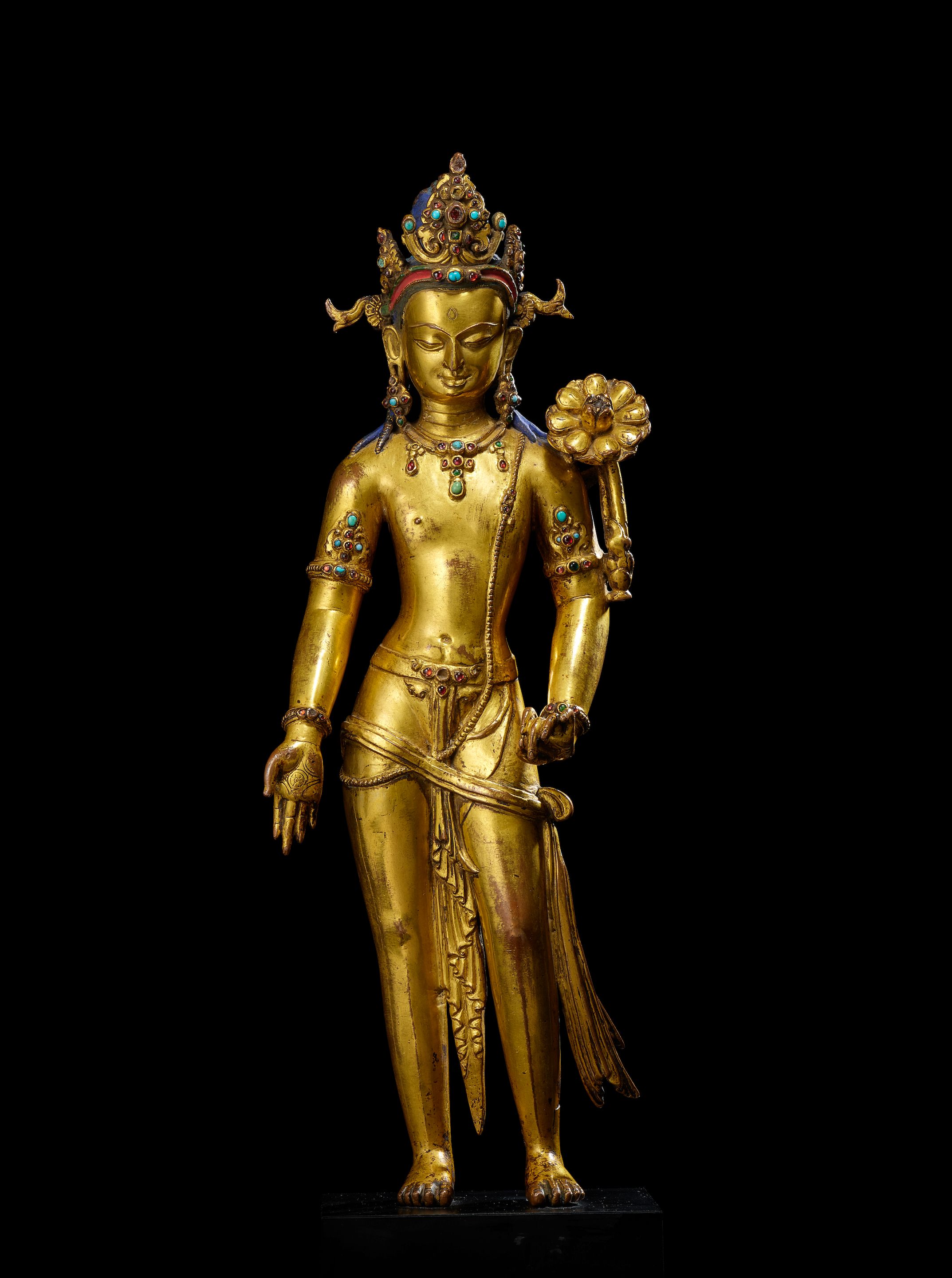
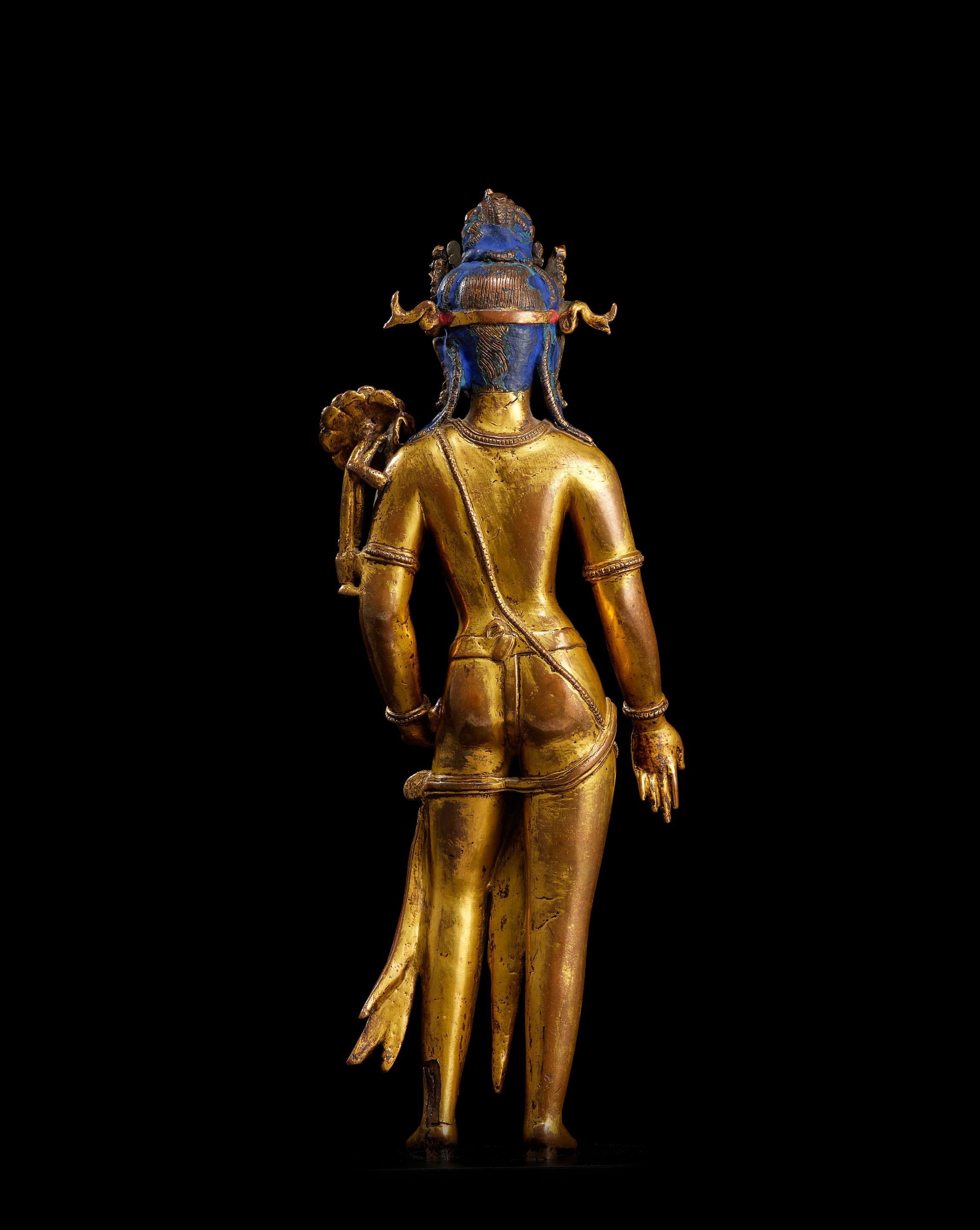
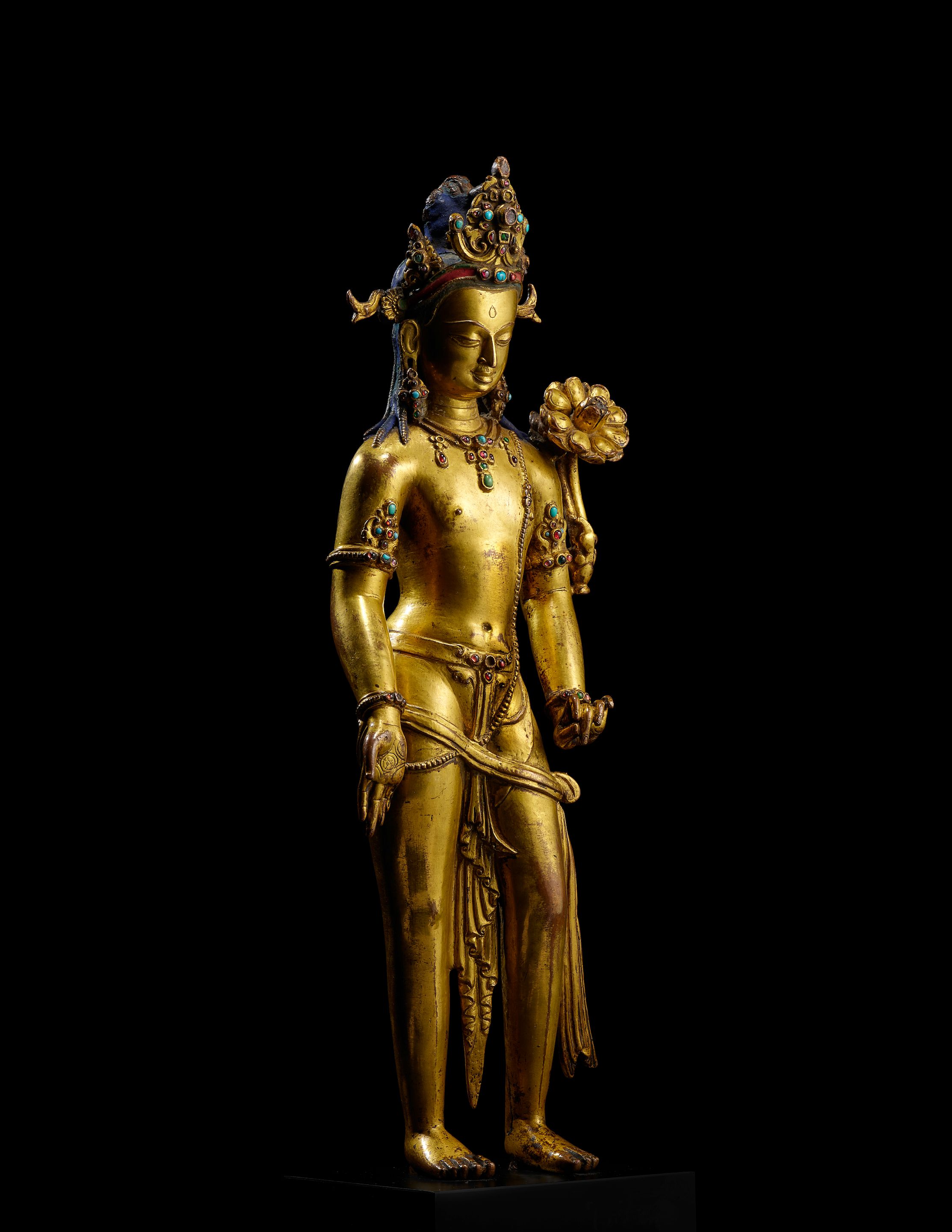
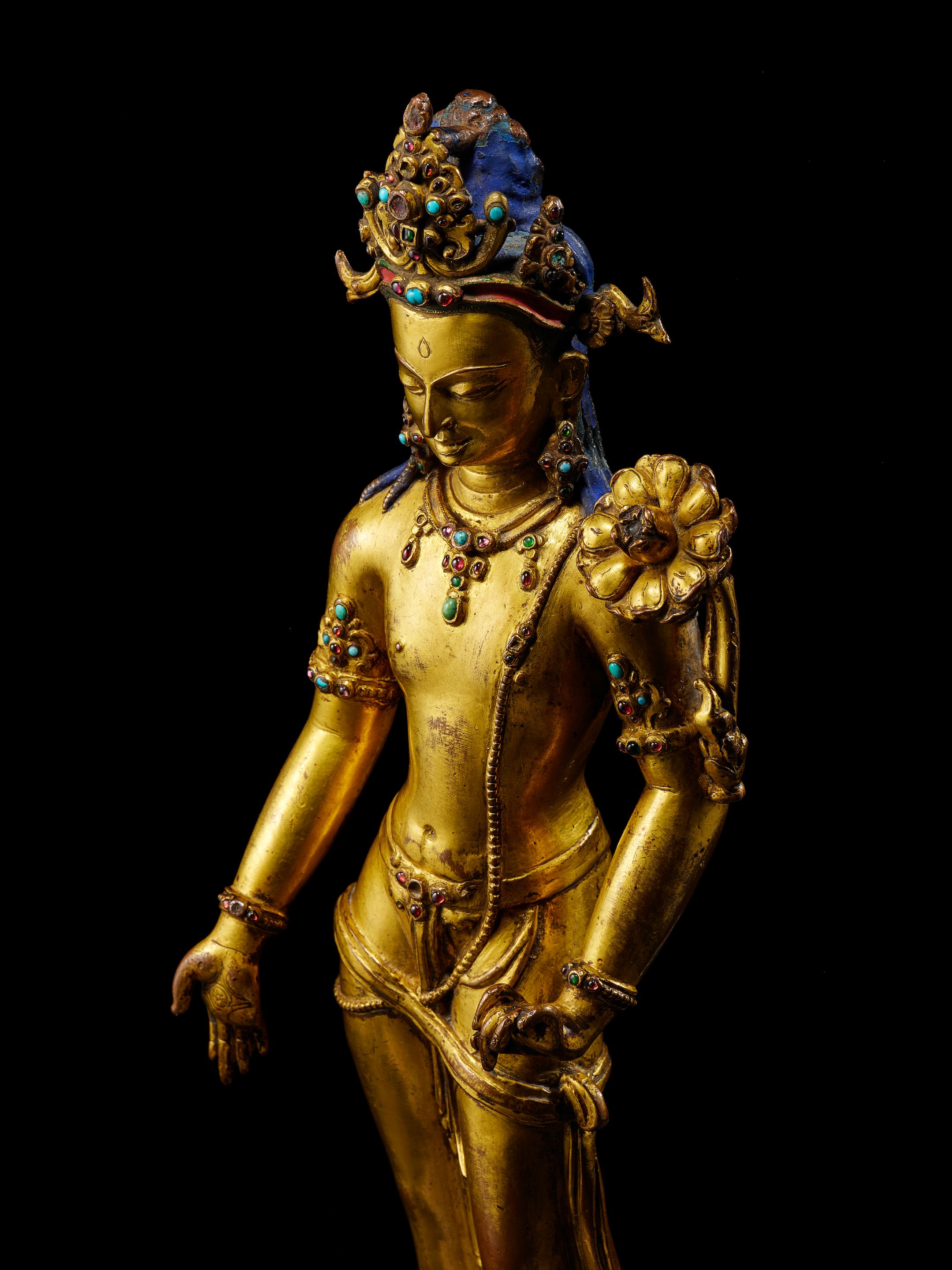
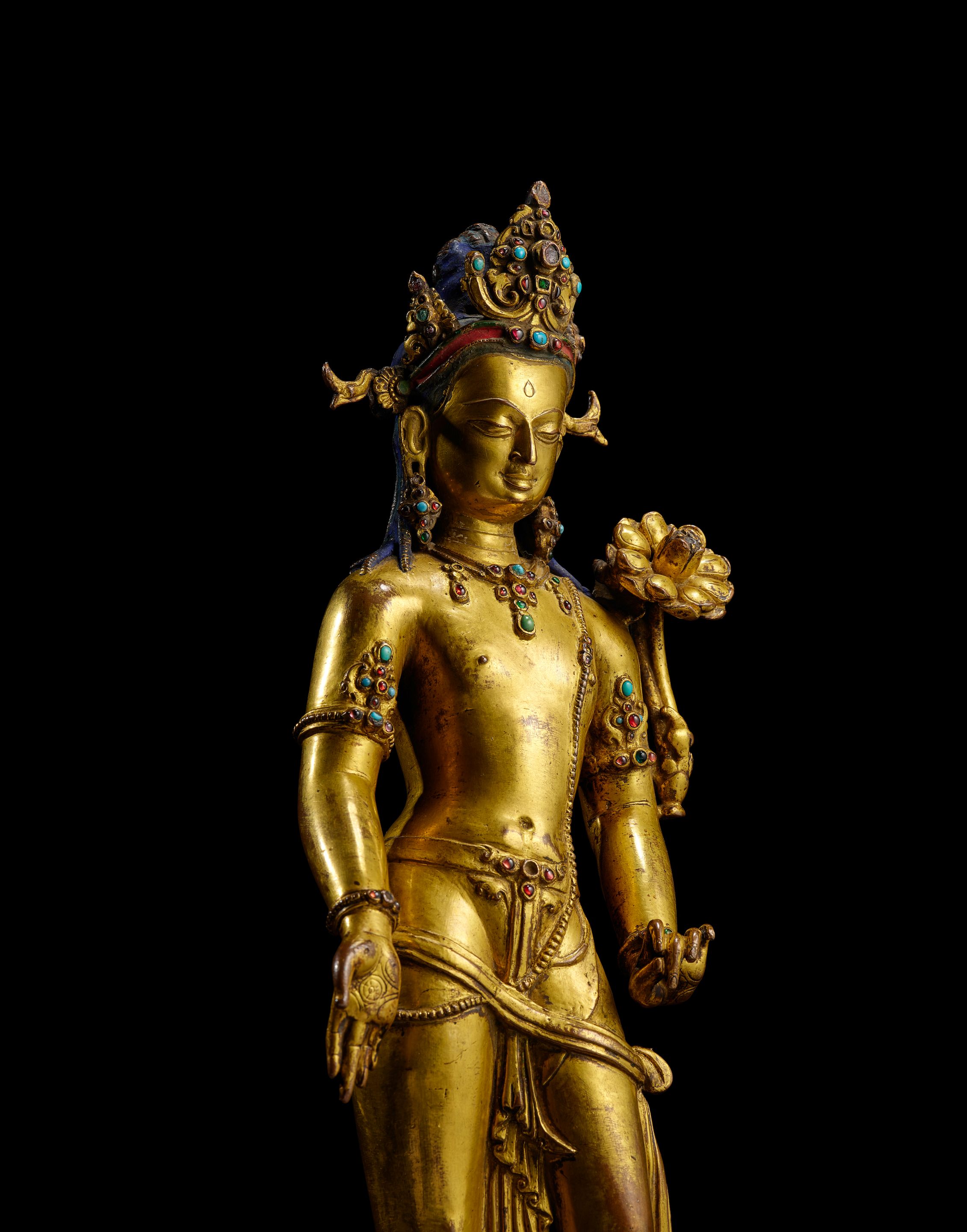
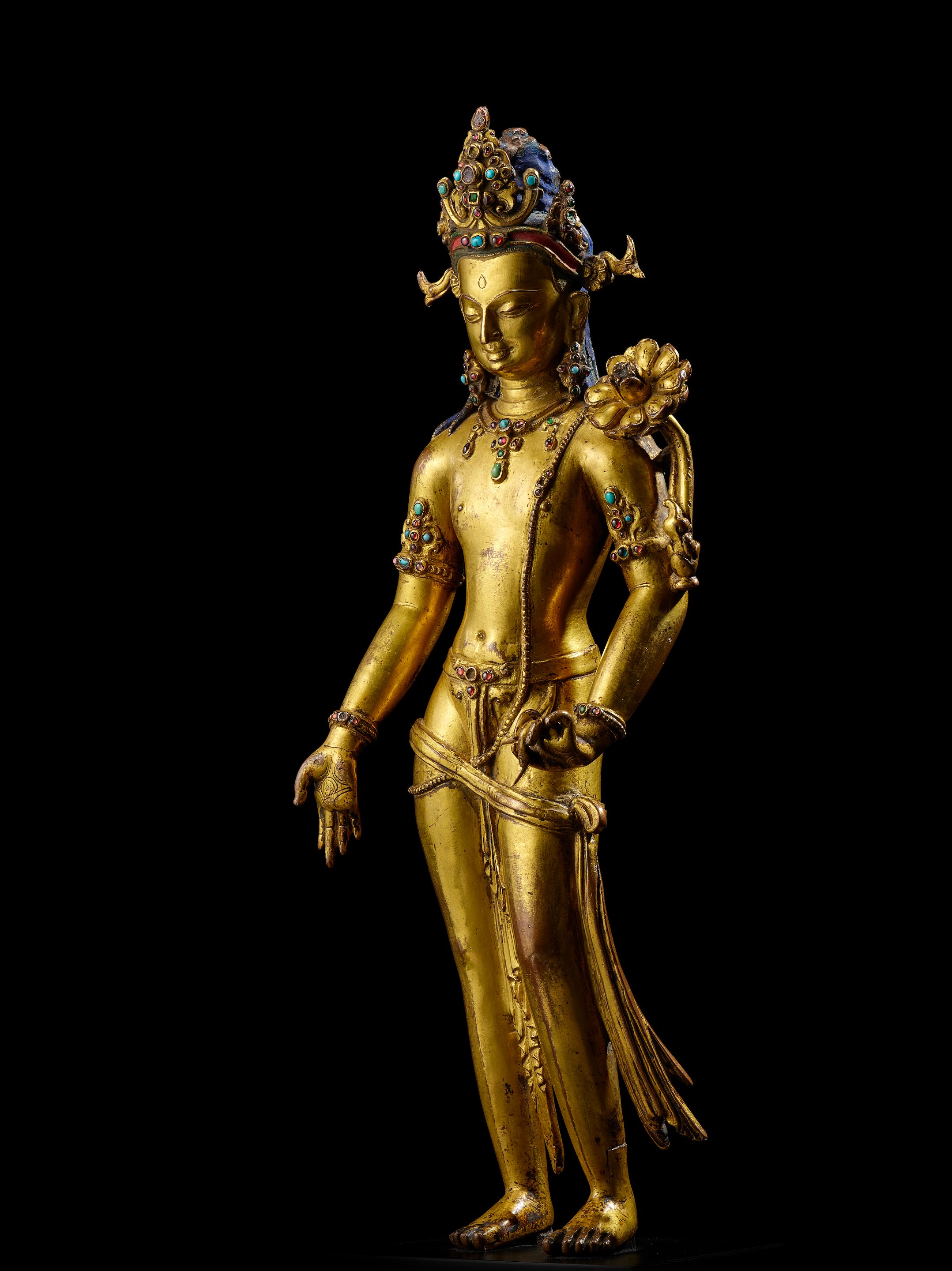 A GILT COPPER ALLOY FIGURE OF PADMAPANI LOKESHVARA
NEPAL, CIRCA 11TH CENTURY
Himalayan Art Resources item no.11839
尼泊爾 約十一世紀 銅鎏金蓮華手觀音像
著录:
1960-2000: Peter Marks Gallery, 40th Anniversary, 40 Selected Works, Peter Marks Gallery, New York, 2000.
来源:
Peter Marks Works of Art, Inc., New York
Pierre Jourdan-Barry, Paris, acquired from the above in the 1980s
Sotheby's, New York, 20 March 2001, lot 91
Private European Collection, 2002-2021
这件拍品传承显赫。彼得·马克斯(Peter Marks, 1935-2010)于1960年开设画廊,在当时尚处萌芽阶段的美国印度、喜马拉雅及东南亚艺术市场中,是一位领先的画商。马克斯将此件作品售予皮埃尔·乔丹-巴里(Pierre Jourdan-Barry),后者精心挑选并组建了西方有史以来最精妙的喜马拉雅艺术收藏之一。乔丹-巴里收藏中的其余部分于2005年被纽约鲁宾艺术博物馆(Rubin Museum of Art)整体购藏,其中包括该馆的许多杰作,如“鲁宾杜尔迦像”(Rubin Durga)。
这尊华美璀璨、工艺精湛的雕塑表现的是观世音菩萨(Avalokiteshvara),即慈悲菩萨,是大乘佛教中受供奉最广的菩萨。在此像中,艺术家于其额头中央描绘的观音白毫相,并非传统的毛发簇,而是一颗轮廓分明的泪珠状宝石,视觉上令人忆起观音因观视众生苦难而为一滴宇宙流下的眼泪,而正是从这滴眼泪中,度母(Tara)化现以作救助。观音颈间佩戴的三颗泪珠状垂饰,也呼应了这一象征意涵。凭借嵌入的宝石和绿松石与菩萨璀璨身肤形成的对比,艺术家引导观者的目光沿着他所铸造的这具曲折躯体向下移动。目光沿着那柔和的胸腔神经丛与腰肢轮廓流转,接着被从左肩垂落、越过右髋婀娜之姿的圣线(yajnopavita)所引领,最终落于那结着慈善布施手印而伸出的右手。每根手指均刻画细致,展开的掌心刻有法轮,这借鉴了将菩萨视为转轮圣王(chakravartin,字面意为“转轮者”)的古老理念——转轮圣王是护持并推广宇宙佛法(Dharma)的统治者。其左手原本应持有一根细线,代表莲花的花梗,莲花由肩侧升起并绽放,以此昭示任何众生皆有能力证悟本具的佛性,而这正是观世音菩萨的使命。艺术家对莲花的精细呈现是一次充满精妙象征意涵的铸造杰作,丰腴饱满的花瓣象征着佛法滋养的智慧,而那些仍含苞待放的更内层花瓣,则托着一颗宝石的嵌座,此宝石乃是观音不懈事业的结晶。
此尊观音像表现的是他广为人知的“莲花手观音”(Padmapani Lokeshvara,意为“手持莲花的世尊”)形象,是尼瓦尔式(Newari)“立姿菩萨”的典范之作,而“立姿菩萨”正是喜马拉雅艺术的标志性形象之一。尼瓦尔人(Newars)是来自尼泊尔加德满都谷地的一个民族,以亚洲最杰出的工匠之一而闻名。他们常受邀前往西藏、蒙古和中国参与重大艺术工程,并在10至14世纪间,为本土及西藏的施主制作了大量体态优雅的大型立姿菩萨。尼瓦尔人以身着轻裳、佩戴璎珞、身姿优雅并辅以曲线柔美的“三折枝”姿态来表现菩萨,从而保存了始于笈多王朝时期——被视为印度文化黄金时代——的艺术传统。立姿菩萨那柔韧的身躯与华丽的衣饰,借鉴了古老的印度图像学象征体系,旨在通过理想化的外在形体来传达精神存在完美的内在意识,并以王子般的装束来彰显其超越凡俗政治层面的崇高精神威权。
尽管尼瓦尔人将立姿菩萨这一主题从一个杰作传承至下一个,但其细节与侧重点的微妙变迁仍可循时间脉络梳理,从而将此尊铜像定为11世纪之作。例如,与纽约鲁宾艺术博物馆所藏的一尊大型残损立姿菩萨像一样,此尊嘴唇的下唇明显饱满,瓦查拉亚(Vajracharya)认为这种特征在11世纪后逐渐消失;而其耳环的菱形形状实际上也正是在11世纪期间出现的。鲁宾藏品与本例中的圣线与松松垂于腰间的腰带相交,其方式可框定在11至12世纪之间——它既不像10世纪的早期尼瓦尔立姿菩萨那样将圣线绕在腰带上并向上穿出,也不像13、14世纪及以后常见的例子那样与腰带平行。11/12世纪的莲花手观音像同样展现出饱满的下唇和相交的圣线,此外还有相似的飘动冠带、叶形腰带饰牌和斜向的腰带。到了13和14世纪,明显的风格差异包括下唇形态和圣线位置的变化,以及圆环形耳环的取代、中央冠叶变得不那么突出、更为抽象化且稍显肿胀的大腿,以及更夸张因而也更僵硬的立姿所铸成的身形,正如前述鲁宾艺术博物馆那尊较晚的莲花手观音像所呈现的那样。
因此,与前后时期制作的其他立姿菩萨像不同,这尊杰出的莲花手观音像受益于一种自然而精妙的姿态,更令人信服地展现了“三折枝”站姿的重力分配与平衡。此像既不像早期直立式样那般僵硬,也不像典型晚期作品那样夸张——既不显得过分纤细,也非丰腴过度。相反,它对观世音菩萨滋养丰满的形体的塑造——这是尼瓦尔美学中理想化身体的一个关键要素——表现得克制而更贴近自然。这尊11世纪的杰作在其适度性中尽显优雅,展现出一种更为克制的华美,与更早期的喜马拉雅雕塑风格相契合,借鉴了古老的印度视觉模式,通过一具不受尘世劳形所累、柔韧且轻饰的身躯,来强调那超然的威权。
This lot has an impressive pedigree. Opening his gallery in 1960, Peter Marks (1935-2010) was a leading art dealer in the then-nascent market for Indian, Himalayan & Southeast Asian Art in the United States. Marks sold this lot to Pierre Jourdan-Barry, who handpicked one of the most sophisticated collections of Himalayan art ever formed in the West. The remainder of Jourdan-Barry's collection was acquired by the Rubin Museum of Art, New York, in 2005, and included many of the museum's masterpieces, including the 'Rubin Durga' (see HAR set no.1771).
This elegant and impressively gilded sculpture depicts Avalokiteshvara, who is the bodhisattva of compassion and the most widely worshipped of the Mahayana bodhisattvas. Here, at the center of his forehead, the artist has depicted Avalokiteshvara's urna (considered a sign of a great spiritual being) not as the traditional tuft of hair, but as a confidently outlined teardrop gem, visually recalling the tear Avalokiteshvara shed for the universe upon surveying its suffering, and from which the bodhisattva Tara famously manifested to help. This symbolism is recalled by three teardrop pendants around Avalokiteshvara's neck. With the inset gems and turquoise stones against the bodhisattva's radiant skin, the artist draws the viewer's eye down across the sinuous physique he has cast. The eye traces the supple contours of the solar plexus and waist before being ushered by the sacred thread (yajnopavita) descending from the left shoulder over the sensuous sway of the right hip, and finally landing on the right hand which is outstretched in an iconographic gesture that signals Avalokiteshvara's charitable benevolence. Each finger is carefully articulated, and the open palm is incised with a wheel, drawing on an ancient concept of the bodhisattva as a chakravartin (lit. 'wheel-turner'), a ruler who protects and furthers the cosmic Dharma. The left hand would have held a thin piece of wire representing the stem of the lotus which rises and blossoms by his shoulder, affirming any being's ability to realize their innate Buddhahood, which is Avalokiteshvara's mission. The artist's detailed presentation of the flower is a casting tour de force saturated with nuanced symbolism, having plump, succulent petals suggestive of Buddhism's nourishing wisdom, while more nascent inner petals remain unfurled and support a setting for a gem, the fruit of Avalokiteshvara's ongoing work.
Depicting Avalokiteshvara in his popular form known as Padmapani Lokeshvara, 'The Lord Who Holds the Lotus', this sculpture is a prime example of the Newari 'standing bodhisattva', which is one of Himalayan art's signature icons. The Newars are an ethnic group from Nepal's Kathmandu Valley renowned for being among the most accomplished artisans in Asia. They were frequently sought after for major artistic projects in Tibet, Mongolia, and China, and produced large, graceful standing bodhisattvas for domestic and Tibetan patrons most numerously between the 10th and 14th centuries. Representing the bodhisattva with an elegant, lightly-clad and bejeweled body accentuated by a sinuous 'thrice-bent' stance (tribhanga), the Newars preserved an artistic tradition established in India during the Gupta period (4th-6th century), regarded as India's cultural Golden Age. The standing bodhisattva's lithe physique and regalia draw on ancient Indic symbolism, which conveys the spiritual being's perfect inner consciousness through an idealized outer physique, cloaked in princely attire to assert his higher, spiritual authority over our worldly, political plane.
While the Newars preserved the standing bodhisattva leitmotif from one masterpiece to the next, subtle shifts in detail and emphasis can be charted chronologically, leading to an attribution to the 11th century for this bronze. For example, as with a large, fragmentary standing bodhisattva in the Rubin Museum of Art, New York (C2003.24.1; HAR 65315), the mouth has a noticeably plump bottom lip, which Vajracharya argues is gradually abandoned after the 11th century, while the diamond shape of its earrings in fact appeared over the course of the same century (Vajracharya, Nepalese Seasons, New York, 2016, p.69). The yajnopavita on both the Rubin piece and the present example intersects with the slack sash around the hips in a manner which can be narrowed to the 11th and 12th centuries, neither looping up and over the sash like earlier Newari standing bodhisattvas from the 10th century, nor running parallel to it as is commonly seen in examples from the 13th and 14th centuries and beyond (see Bonhams, Hong Kong, 29 November 2016, lot 111, and the Rubin Museum of Art, New York [C2005.16.8; HAR 65430]; respectively). An 11th-/12th-century Padmapani Lokeshvara in the Metropolitan Museum of Art, New York (1982.220.2) similarly displays the bottom lip and intersecting sacred thread, as well as comparably wispy crown ribbons, foliate belt medallion, and diagonally-oriented sash. By the 13th and 14th centuries, noticeable stylistic differences include changes to the bottom lip and scared thread, as well the replacement of ring-shaped earrings, a less-prominent central crown leaf, more abstracted, slightly swollen thighs, and a general physique cast in a more exaggerated and thus more rigid standing posture, as seen in the later Padmapani Lokeshvara in the Rubin Museum of Art cited above.
Therefore, in contrast to other standing bodhisattvas produced before and after, this outstanding Padmapani Lokeshvara benefits from a naturalistic and nuanced pose that more convincingly distributes the weight and balance of the thrice-bent stance. The figure is neither as stiff as more upright earlier examples, nor as exaggerated as later examples typically are—and neither attenuated nor plump. Rather, its portrayal of Avalokiteshvara's well-nourished form, which is a critical component of the idealized body within the Newari aesthetic, is understated and truer to nature. This 11th-century masterpiece is elegant in its moderation and shows a restraint in opulence more aligned with earlier Himalayan sculpture, drawing on ancient Indic visual modes that emphasize sublime authority through a supple, lightly-adorned body unencumbered by worldly toils.

