
侧边栏

11世纪克什米尔黄铜莲花手观音立像(纽约邦瀚斯)
尺寸:高26.1 cm
年代:10-11世纪
质地:黄铜合金
风格:克什米尔
来源:拍卖会
成交:106,250美元(2017.03)
参阅:外部链接
鉴赏:
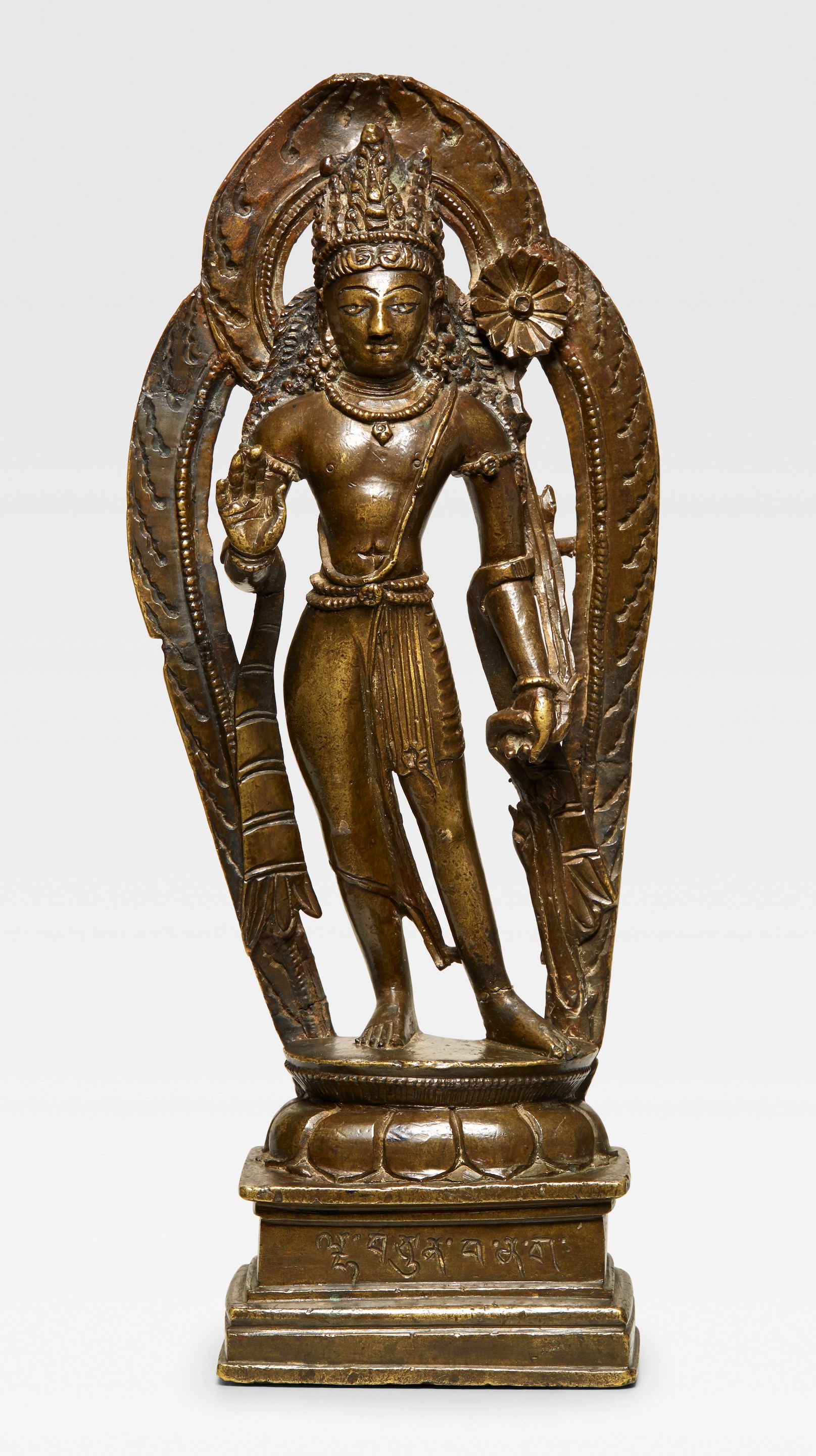
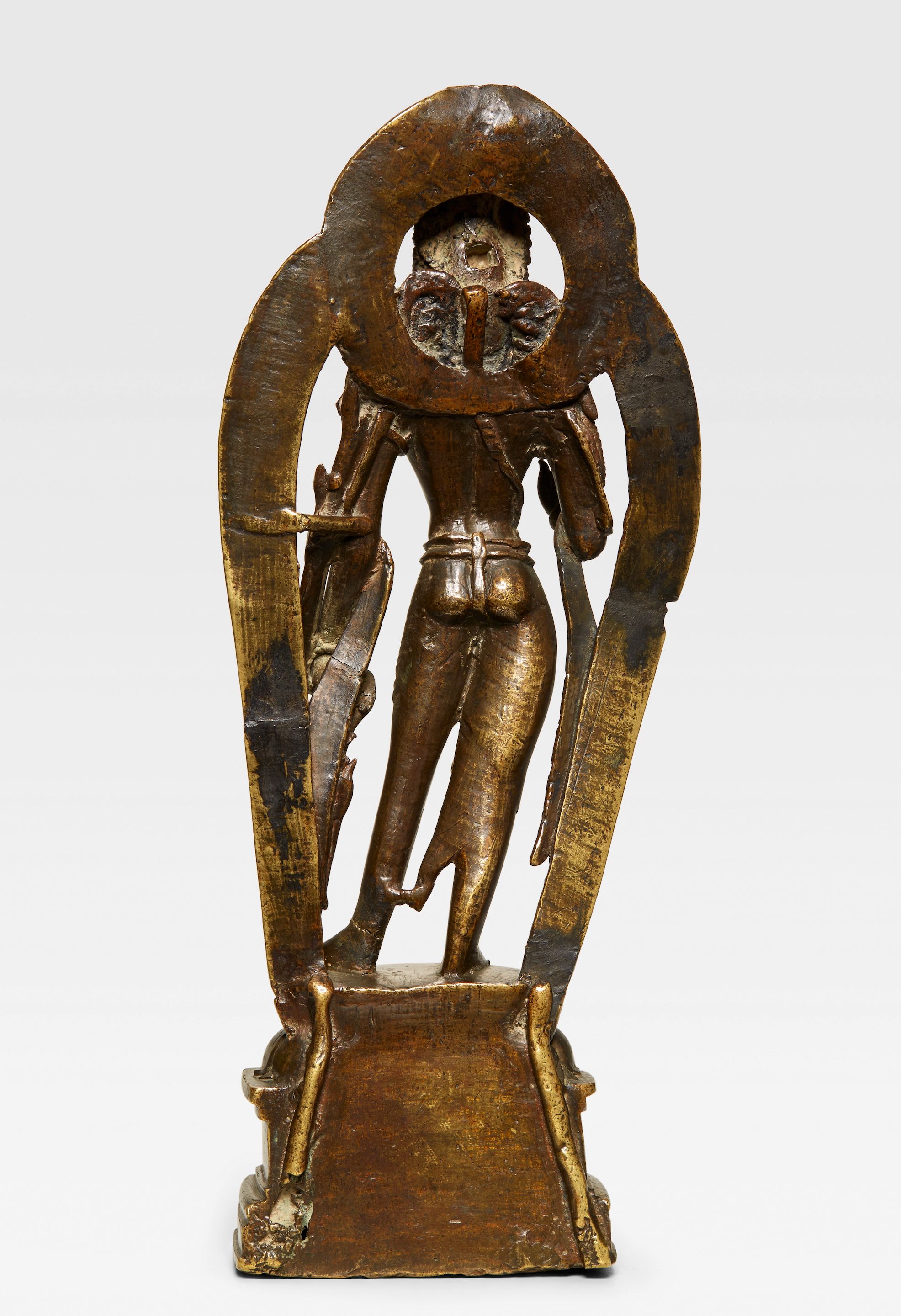
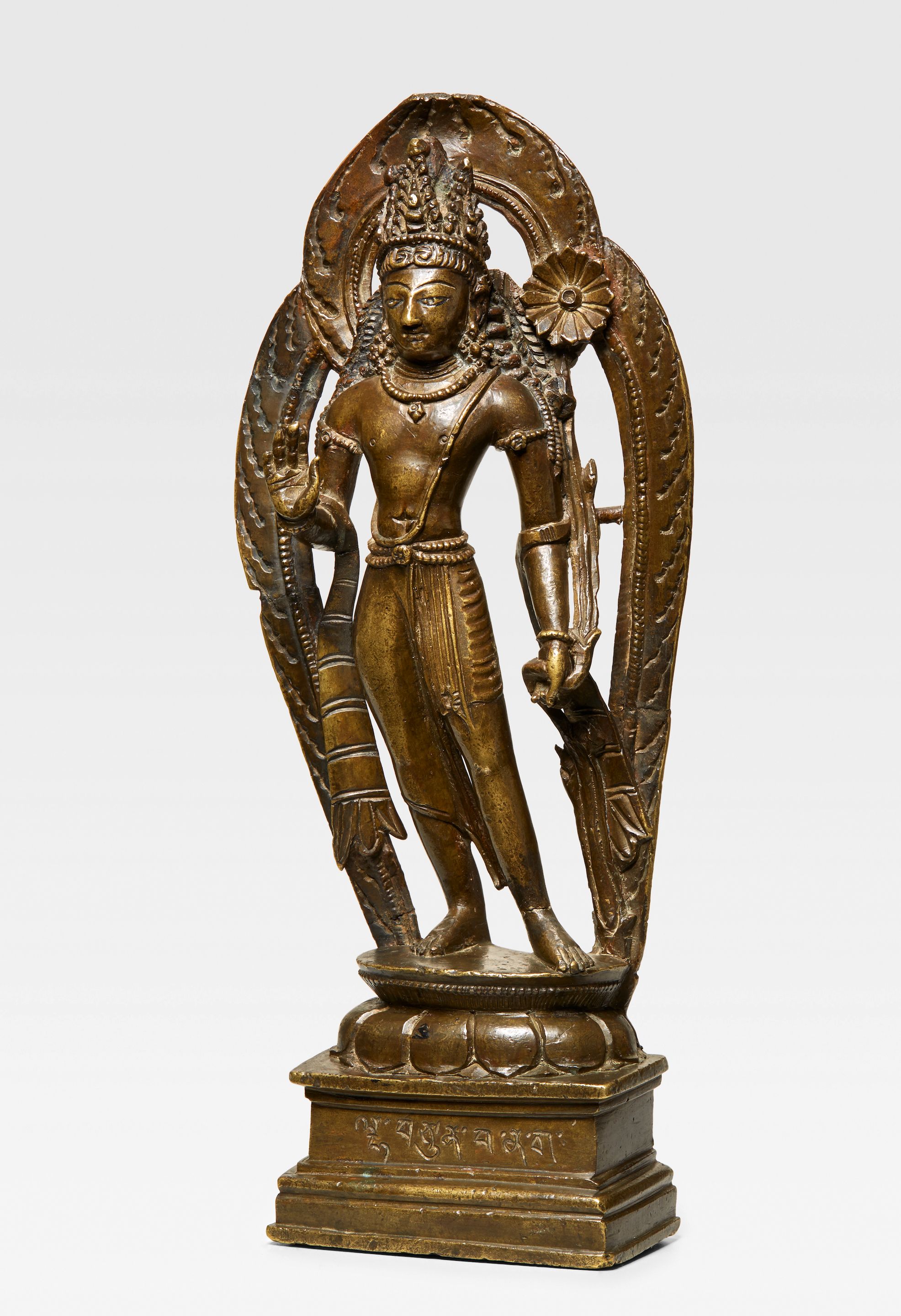 黄铜观音菩萨像
克什米尔,约1000年
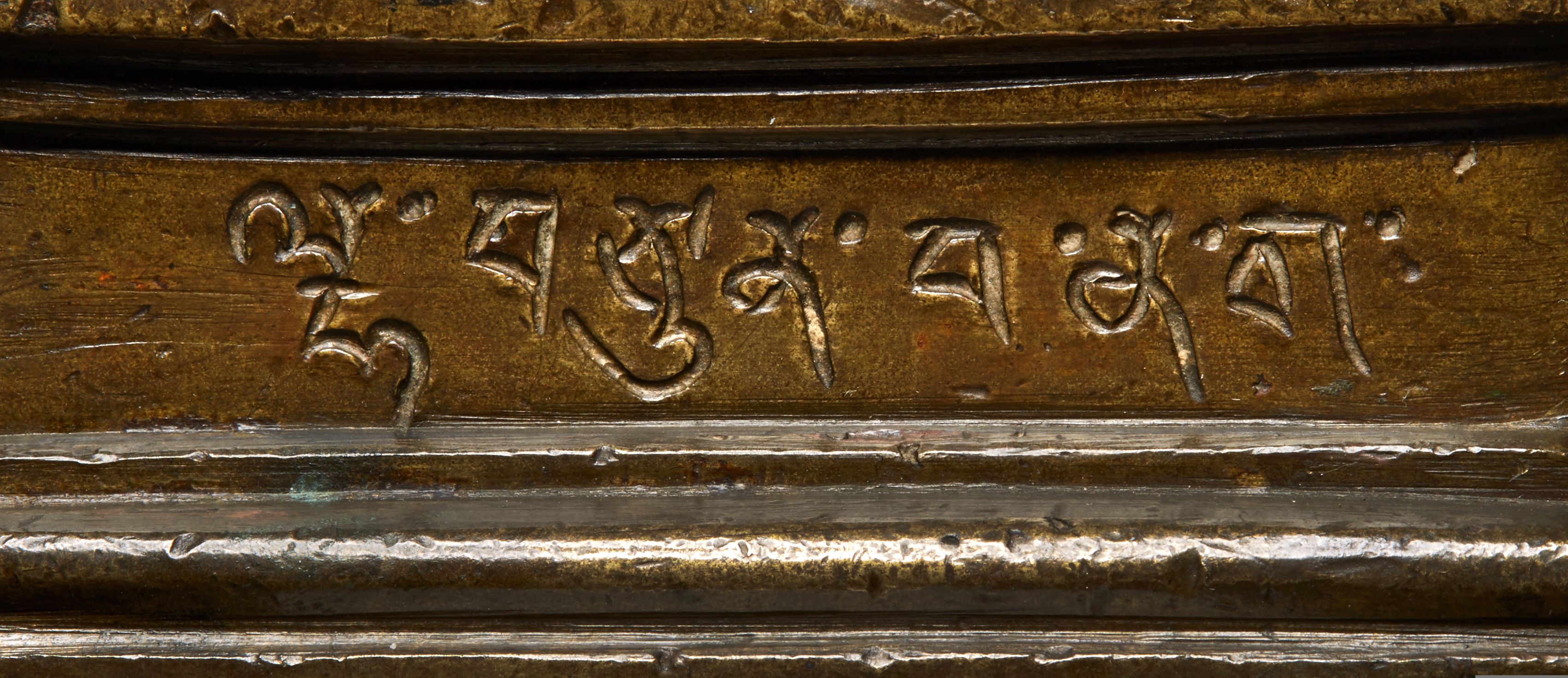
底座上有一行藏文铭文:“lha btsun ba na ga”,译为“拉尊[王室僧侣]那伽拉贾[龙王子](Latsun [Royal Monk] Nagaraja)”。
喜马拉雅艺术资源网编号:2374
高10 1/4英寸(26.1厘米)
铭文表明这尊造像曾为西藏西部古格王国(Guge Kingdom)国王益西沃(Yeshe-O,约959-1040)之子的王室收藏。那伽拉贾王子(Nagaraja,约988-1026)是“持达”(chidar,又称“后弘期”)的推动者之一,即10至12世纪间佛教在西藏的第二次传播。其父王曾邀请印度高僧阿底峡(Atisha,982-1054)前来复兴和改革西藏佛教,这一事件被视为后弘期的开端。倘若藏人未曾从北印度(如克什米尔)的寺院寻求一种“更纯粹”的佛教形式,那么印度佛教庞大的密续体系可能会在1175-1206年穆罕默德·古尔(Muhammad Ghur)的征服过程中,与其寺院建筑一同被毁灭。
2003年,冯·施罗德(von Schroeder)公布了一份已被确认为那伽拉贾收藏的造像清单。克利夫兰艺术博物馆(Cleveland Museum of Art,藏号1966.30)和布达拉宫(Potala Palace)中高达一米的大型佛像上有更长的铭文,更明确地说明它们曾属于拉尊那伽拉贾,这为这位11世纪克什米尔与西藏西部造像收藏家的学术研究提供了坚实基础。(关于该清单及后者,参见冯·施罗德《Buddhist Sculptures in Tibet》,第I卷,香港,2003年,第84页及第126-127页,第28A-D号。)
林罗特(Linrothe)在其关于西藏西部历史上的佛教造像“收藏家”的研究中解释道,克什米尔黄铜像(如本尊)被认为能够“对寺院、其居民及供养者的繁荣与宗教信仰产生积极影响……”(林罗特编,《Collecting Paradise》,香港,2014年,第7页)。
在讨论那伽拉贾的特定收藏时,卢扎尼茨(Luczanits)总结道:“从他拥有的造像——其中包括来自吉尔吉特(Gilgit)和克什米尔的极为早期且极其精湛的作品——来判断,那伽拉贾是一位真正的西喜马拉雅造像鉴赏家。”(同上,第115页。)
这一评价对于本尊黄铜像而言恰如其分。它描绘了一尊优雅纤巧的观音菩萨莲花手(Padmapani),其宝冠中的阿閦佛(Akshobya)剪影以及肩头盛开的俏皮莲花表明了其身份。尤其是从侧面观察时,铸匠巧妙地使金属在脚部与肩部之间呈现出向前凸出的弧线,从而突出了造像优雅的“三折枝”(tribhanga)姿态。其大腿表面因长期供奉摩挲而呈现出光润的包浆。光滑的右腿与因腰带波纹而形成棱纹的左腿之间的差异,为拇指触感营造出愉悦的感官对比。
在众多10/11世纪克什米尔风格的实例中,与本尊观音像最为接近的作品可见于布达拉宫、里特贝尔格博物馆(Museum Rietberg)以及拉希里(Lahiri)收藏。(分别参见:冯·施罗德《Buddhist Sculptures in Tibet》,第I卷,香港,2003年,第146页,第37A-B号;乌利希(Uhlig)《On the Path to Enlightenment》,苏黎世,1995年,第88-89页,第43号;以及帕尔(Pal)《Himalayas: An Aesthetic Adventure》,芝加哥,2003年,第140页,第89号。)
这些造像的面部特征、衣饰及纤细躯体的统一性促使帕尔博士提出,它们很可能是仿照一尊尚未确认的大型且极具重要性的区域性崇拜像而制作的“后裔”。(同上。)当然,在印度、中国及喜马拉雅地区,崇拜像与复制品的现象在诸如帕巴·洛觉世音(Phakpa Lokeshvara)、邬仗那佛(Uddiyana Buddha)和菩提伽耶佛(Mahabodhi Buddha)等实例中表现得最为明显。
展览:
「Pathway to Enlightenment: Art of Tibet from Australian Collections」,珀克区域美术馆(Perc Tucker Regional Gallery),汤斯维尔(Townsville),澳大利亚,2002年9月5日至11月2日。
来源:
苏富比帕克-伯内特(Sotheby's Parke-Bernet),1984年6月28/29日,纽约,拍品421号
苏富比,伦敦,1987年11月23日,拍品44号
Gerry Virtue 收藏,悉尼
Parkham Place 画廊,悉尼
Phillip Adams 收藏,澳大利亚
菲利普·亚当斯(Phillip Adams)收藏,第一部分
菲利普·亚当斯是澳大利亚人,在小学时期便接触到西藏艺术与文化。青少年时期阅读海因里希·哈雷尔(Heinrich Harrer)的《西藏七年》更激起了他的兴趣。1969年,他首次前往印度,从那时起,他的业余时间和精力都投入到了喜马拉雅艺术的学习与收藏中,尤其专注于黄铜造像。
他的研究方法是通过对不同特色器物的仔细研究,追溯西藏艺术的连续性及其与周边文化之间的相互影响。亚当斯于2008年3月在《Orientations》杂志上发表的《元代鎏金铜佛:通往明初的阶梯》(Imperial Yuan Gilt-Metal Buddhist Sculptures: Stepping Stones to the Early Ming)一文,便是他致力于研究领域中未解问题的例证,他的许多藏品也对简化的西藏艺术史叙事构成了挑战。他敏锐的探索形成了一系列稀见且独特的造像收藏,Bonhams 很荣幸将其呈现于拍场。
A BRASS ALLOY FIGURE OF AVALOKITESHVARA
KASHMIR, CIRCA 1000
The single line Tibetan inscription on the base, “lha btsun ba na ga”, translated, “Latsun [Royal Monk] Naga[raja]”.
Himalayan Art Resources item no.2374
10 1/4 in. (26.1 cm) high
The inscription places the bronze once in the royal collection of the son of King Yeshe-O (c.959-1040) of the Guge Kingdom in Western Tibet. Prince Nagaraja (c.988–1026) was an agent of the chidar, otherwise known as the Later Transmission of Buddhism to Tibet, taking place between the 10th-12th centuries. His father famously invited the Indian monk Atisha (982-1054) to revive and reform Buddhism in Tibet, marked as the chidar's inceptive incident. Had Tibetans not sought a 'purer' form of Buddhism from the monasteries of Northern India, like those in Kashmir, the vast tantric systems of Indian Buddhism might have been destroyed along with their edifices during the conquest of Muhammad Ghur in 1175-1206.
In 2003, von Schroeder published a list of bronzes that had been identified as part of Nagaraja's collection. Grand, meter-high examples of Buddha in the Cleveland Museum of Art (acc.#1966.30) and the Potala Palace bear longer inscriptions stating more explicitly that they once belonged to Latsun Nagaraja, underpinning the scholarship of this 11th-century collector of Kashmir and Western Tibetan sculpture. (For the list and latter example, see von Schroeder Buddhist Sculptures in Tibet, Vol.I, Hong Kong, 2003, p.84 & pp.126-7, no.28A-D.)
In his study of historic Western Tibetan 'collectors' of Buddhist sculpture, Linrothe explains that Kashmir bronzes, like the present lot, were perceived to, “positively affect the prosperity and religiosity of the monastery, its inhabitants and supporters…” (Linrothe (ed.), Collecting Paradise, Hong Kong, 2014, p.7).
In discussing Nagaraja's particular collection, Luczanits concludes, “Judging from the bronzes he had in his possession, among them very early and extremely sophisticated works from Gilgit and Kashmir, Nagaraja was a true connoisseur of Western Himalayan bronzes.” (ibid., p.115.)
It is a fitting statement for the present bronze, depicting an elegant and lithe Avalokiteshvara Padmapani, identified by the silhouette of Akshobya in his crown and the plucky lotus in bloom above his shoulder. Particularly when observed from the side, the caster has commanded the metal into a convex forward lean between the feet and shoulders, accentuating the figure's graceful 'thrice-bent' pose (tribhanga). The surface of his thighs have a lustrous, glossy patina from devotional handling. The variance between the smooth right leg and the ridged left, caused by the ripples of his sash, creates a pleasing sensory contrast for the thumbs.
Among numerous examples of the 10th/11th-century Kashmir style, those that most closely relate to the present Avalokiteshvara can be found in the Potala Palace, the Museum Rietberg, and the Lahiri collection (respectively: von Schroeder, Buddhist Sculptures in Tibet, Vol. I, Hong Kong, 2003, p.146 , nos.37A-B; Uhlig, On the Path to Enlightenment, Zurich, 1995, pp.88-9, no.43; and Pal, Himalayas: An Aesthetic Adventure, Chicago, 2003, p.140, no.89).
The uniformity of these figures' facial features, garb, and svelte bodies led Dr. Pal to propose that they are likely descendants modeled after a large and very important regional cult image, which has yet to be identified (ibid.). Certainly the phenomenon of cult images and copies in India, China, and the Himalayas is most apparent in examples such as the Phakpa Lokeshvara, Uddiyana Buddha, and Mahabodhi Buddha.
Exhibited
Pathway to Enlightenment: Art of Tibet from Australian Collections, Perc Tucker Regional Gallery, Townsville, Australia, 5 September-2 November 2002.
Provenance
Sotheby's Parke-Bernet, 28/29 June 1984, New York, lot 421
Sotheby's, London, 23 November 1987, lot 44
Gerry Virtue Collection, Sydney
Parkham Place Gallery, Sydney
Phillip Adams Collection, Australia
The Collection of Phillip Adams, Part I
Native to Australia, Phillip Adams was exposed to Tibetan art and culture in primary school. Reading Heinrich Harrer's, Seven Years in Tibet, as a teenager peaked his interest. In 1969 he made his first trip to India, and from that point his spare time and energy were spent studying and collecting Himalayan art, concentrating on bronze sculpture.
His approach has been to trace the continuum of Tibetan art and how neighboring cultures have informed it through the careful study of distinctive objects. Adams' March 2008 article in Orientations, “Imperial Yuan Gilt-Metal Buddhist Sculptures: Stepping Stones to the Early Ming”, is an example of his devoted study to unanswered questions in our field, and many of his objects challenge simplistic surveys of Tibetan art history. His keen investigation has lead to a diverse collection of rare and unusual sculptures that Bonhams is honored to present for sale.

