
侧边栏

6世纪斯瓦特风格合金铜莲花手观音菩萨立像(伦敦V&A博物馆)
尺寸:高10.5 cm
年代:5-6世纪
质地:合金铜 Bronze (leaded copper-zinc-tin alloy)
风格:斯瓦特
来源:伦敦V&A博物馆
参阅:外部链接
鉴赏:
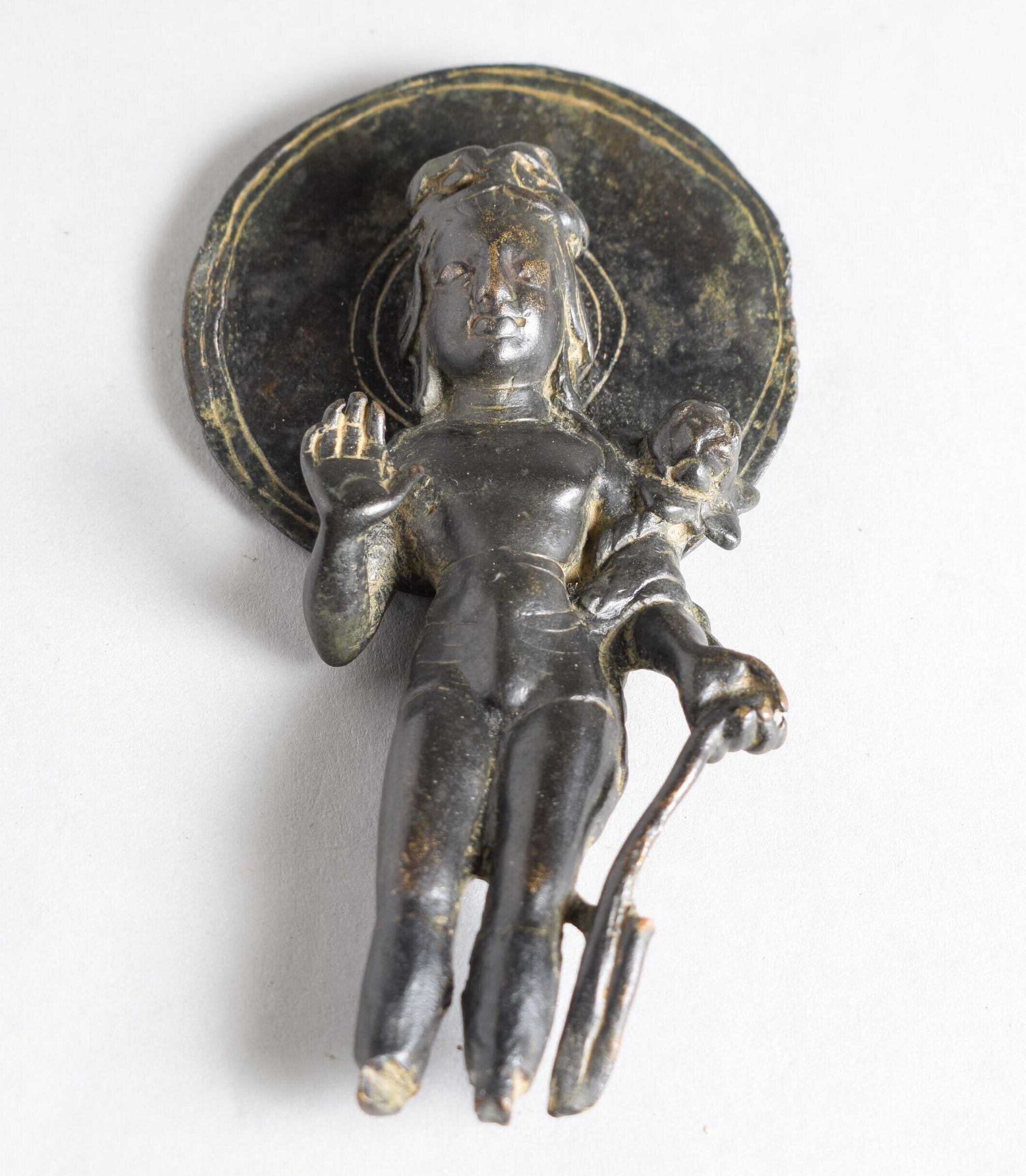 BODHISATTVA PADMAPANI
Copper alloy
Reportedly Helmand river region, Afghanistan
Possibly Swat valley, Pakistan
5th - 6th century
莲花手观音(Padmapani)是观世音菩萨的一种化身,也是大乘佛教中最受欢迎的菩萨。他左手持莲花(padma)——象征纯净与重生;右手举起作施无畏印(abhaya mudra),表明其作为众生保护者与世界秩序守护者的双重角色。此造像与斯瓦特河谷地区后犍陀罗风格的造像相关联。
这件小型金属莲花手观音像为素身无饰,以改良版的三屈式(tribhanga)姿态站立。其身份标识——莲花——握于左手;右手则抬起作施无畏印,消除畏惧,彰显其护佑众生与守护世界秩序的职能。
这尊造像似乎为整体实心铸造,头光单独铸造后用铜铆钉固定于脑后。背部仅部分修整,且有一处铸造瑕疵。像身膝部以下断裂,腿部有附加的固定物,证明曾进行过早期修复,但并非完全成功。
造像面容饱满,双唇厚实,眼睑低垂;头发束成高髻,数缕发丝垂落肩头。衣纹的表现已简化,仅在大腿、腰腹及左臂处刻有数道线纹。
Padmapani, a form of Avalokitesvara, is the most popular bodhisattva in Mahayana Buddhism. In his left hand he holds a lotus (padma), the emblem of purity and regeneration, whilst his right hand is raised in the gesture of protection (abhaya mudra), indicating Padmapani’s role both as protector of living creatures and guardian of world order. This figure relates to those associated with the post-Gandhāran style of the Swat valley.
This small example of Padmapani, a form of Avalokitesvara, is the most popular bodhisattva in Mahayana Buddhism, in metal is shown without ornament, standing in a modified version of the tribhanga (three bends) posture, with his identifying attribute, the lotus, grasped in the left hand, whilst the right hand, allaying fear, is raised in abhaya mudra ( a gesture of protection), indicating Padmapani's role both as protector of living creatures and guardian of world order..
The statue appears to be solid cast in one piece, with the halo cast separately, then attached to the back of the head with a copper rivet. The back is only partially finished, and has one casting flaw. The figure is broken below the knees where appendages pinned to the legs attest to an early, not altogether successful repair.
The face is full with its thick lips and heavy-lidded eyes; the hair gathered into a high chignon with a few locks falling onto the shoulders. The depiction of the garment has been reduced to a few etched lines on the thigh, midriff and the left arm
来源:
Purchased from Spink and Son Limited
著录:
U. von Schroeder, Indo-Tibetan Bronzes 1981, pl.5B.
The Crossroads of Asia : transformation in image and symbol in the art of ancient Afghanistan and Pakistan / edited by Elizabeth Errington and Joe Cribb with Maggie Claringbull. Cambridge: Ancient India and Iran Trust, 1992 Number: 0951839918 p. 233, cat. no. 219

