
侧边栏

11-12世纪西藏或尼泊尔铜鎏金释迦牟尼佛立像(牛津大学阿什莫林博物馆)
尺寸:高14.3cm
年代:11-12世纪
质地:铜鎏金
风格:西藏 尼泊尔
来源:牛津大学阿什莫林博物馆
参阅:外部链接
鉴赏:
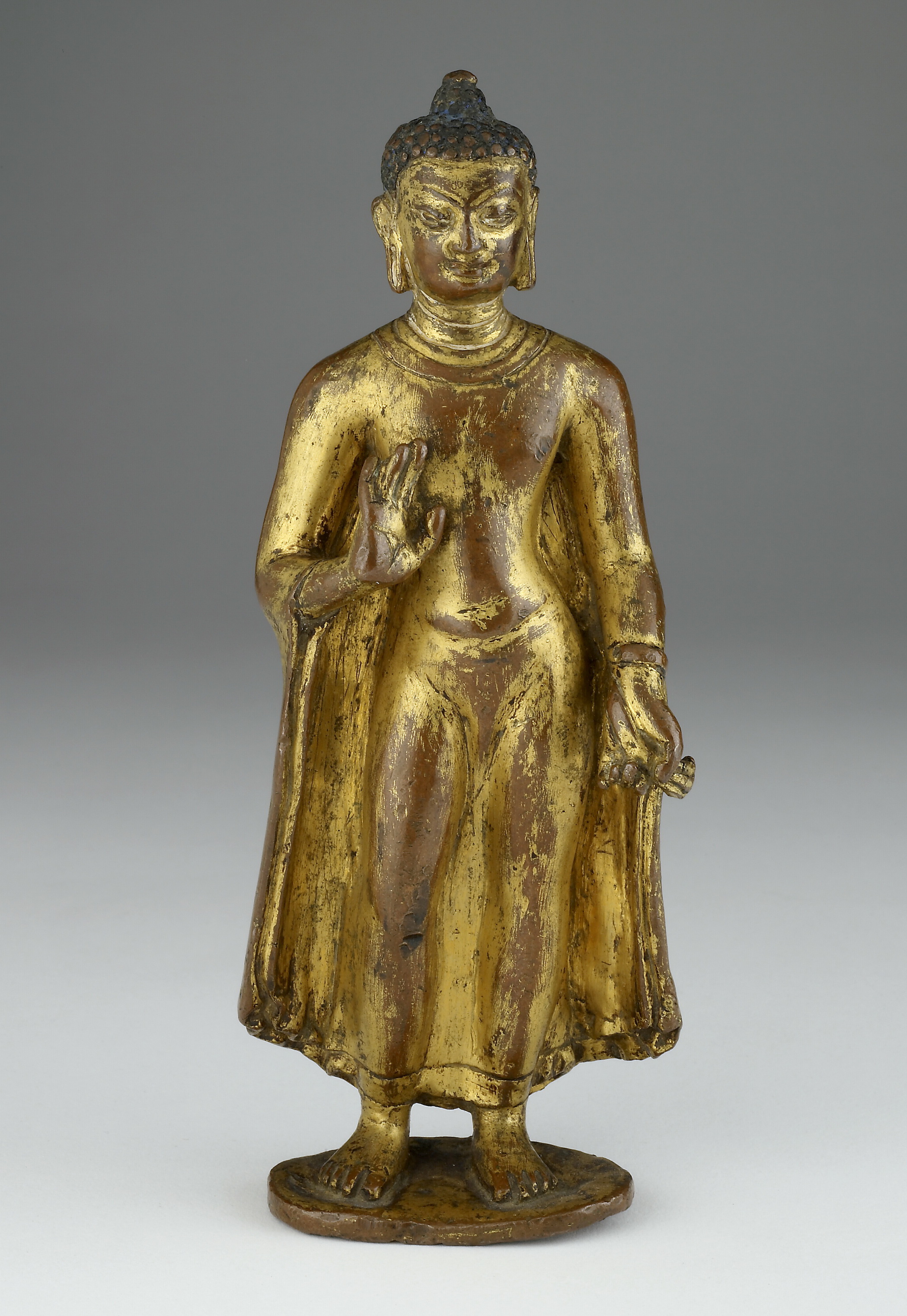
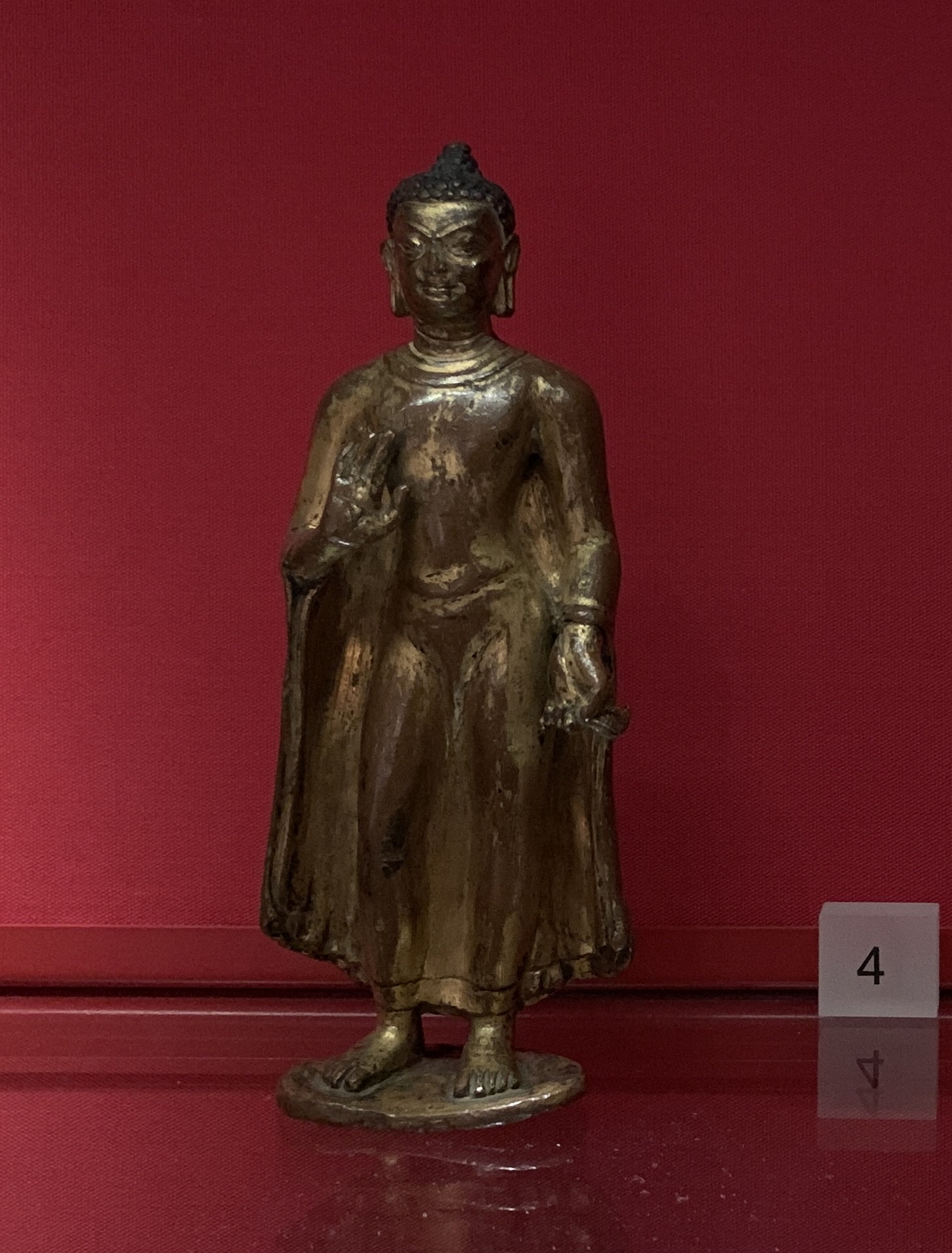
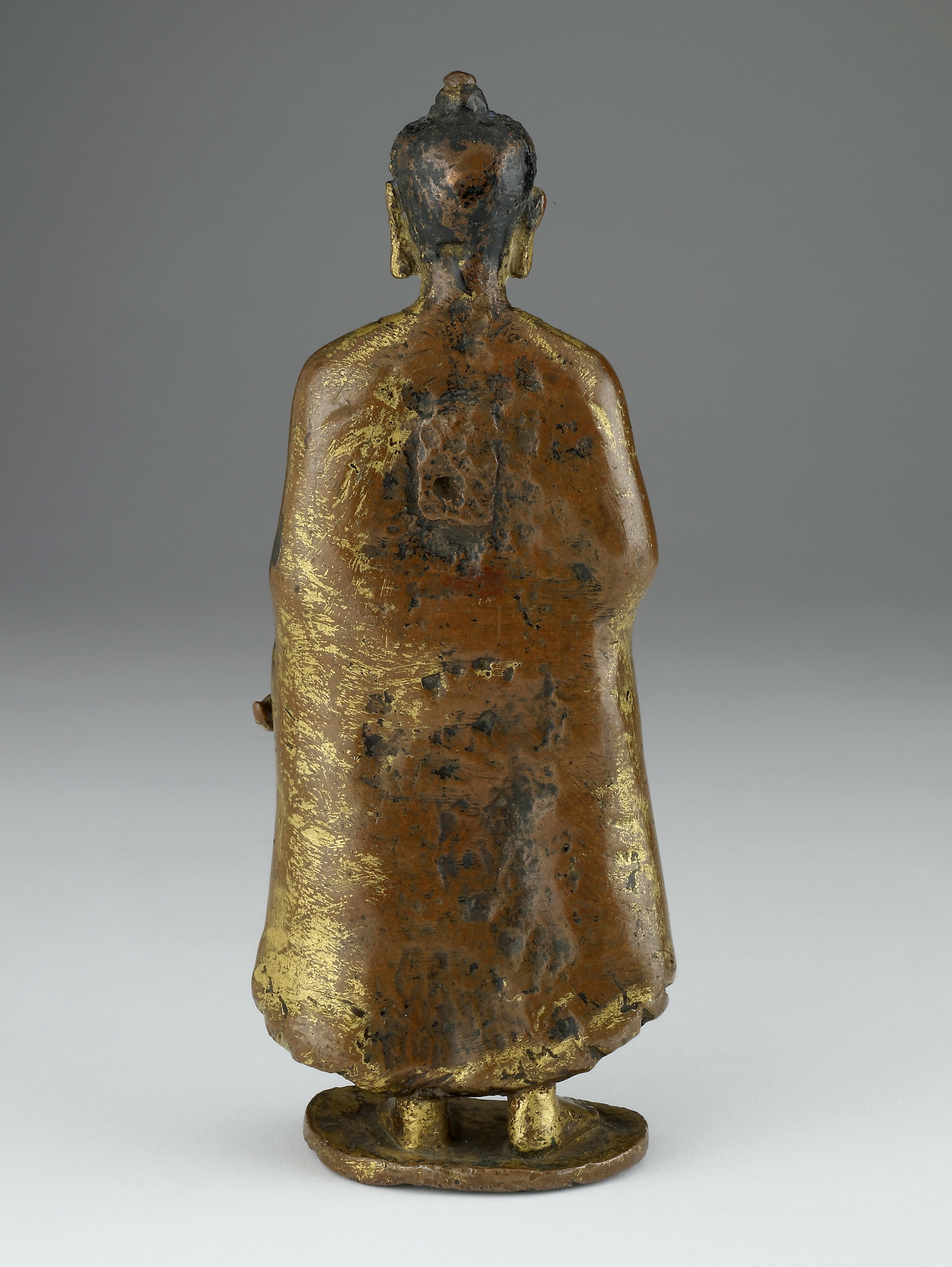 这尊佛像可能是由十一至十二世纪的一位尼泊尔雕塑家为西藏西部或喜马拉雅山西部的一位供养人所制作的,当时它是按照藏传佛教的习俗被供奉的.
这尊佛像以柔和微曲的姿势宁静站立,右手抬起施无畏印,左手握住衣缘。这一经典造型体现了萨尔纳特(Sarnath)美学传统中的优雅比例与轻薄贴体衣袍特征——该传统在李查维时期(Licchavi period)传入尼泊尔,并在此后长期延续。外层袈裟覆盖双肩,于脚踝处形成对称而柔和的程式化衣褶。对袈裟的简洁处理,反衬出佛陀健硕而优美的身躯,凸显了腰腹与髋部的轮廓。衣褶的走势与躯干的平滑塑形,令人联想到加德满都(Kathmandu)地区9至10世纪雕刻的石质立佛像[1]。佛首上隆起的螺旋发髻与饰有扁平宝珠顶严的肉髻(uṣṇīṣa)、宽阔的面相、精致的五官,也与几尊被归为10至11世纪尼泊尔的铜铸造像风格相近[2]。相较于10世纪的实例,此像躯干略显丰腴,因此年代可能推至11至12世纪。
韦尔登(Weldon)与凯西·辛格(Casey Singer)此前曾将此像与加德满都谷地(Kathmandu Valley)11至12世纪的作品关联,指出其铜合金材质与鎏金成色均符合已知范例[3]。但他们同时强调,尼泊尔立佛通常施予愿印,而非无畏印(可参见受尼泊尔启发的第31号藏传佛教造像)。此外,他们还注意到佛像发髻上残留的蓝色颜料,表明此像曾为西藏所藏:在佛像发部及面部施涂颜料,正是藏传佛教装藏仪轨的一部分。这些因素令他们难以断定此像的最初施主究竟是尼泊尔人还是藏人。尼泊尔造像往往前后同样精工细作,而此像背面大部未经细致加工,则成为指向藏人赞助的另一特征——这一点被认为是11世纪西藏西部造像的典型特点[4]。引人注目的是,克利夫兰美术馆(Cleveland Museum)著名的克什米尔风格立佛,恰恰采用与此完全相同的无畏印图像特征;据其藏文题记记载,该像于公元1000年前后为西藏西部王子那伽罗阇(Nāgarāja)所得,并作为其私人供奉像。这一图像范式在西藏至今仍属罕见。因此,以此特定范式创作的外来佛像于1000年左右传入西藏西部并受供奉的事实,引导学者提出如下推测:眼前这尊佛像或许出自11至12世纪尼泊尔工匠之手,为西藏西部或西喜马拉雅(Western Himalaya)地区的施主所造,并在其时依藏传佛教仪轨进行了装藏[5]。
The Buddha stands serenely in a subtly flexed posture, his right hand raised in the abhaya gesture of protection, and left hand holding the edge of his robe. This classic representation reflects the elegant proportions and diaphanous robe type of the Sarnath aesthetic tradition, which was introduced into Nepal in the Licchavi period and persisted there long after. The upper robe covers both shoulders, falling symmetrically in gentle stylized folds at the ankles. The simplicity of the treatment of the robe emphasizes the Buddha’s strong and graceful body, enhancing the contours of his abdomen and hips. The folds of the robes and smooth modelling of the body are reminiscent of stone standing Buddha images carved at Kathmandu in the ninth to tenth century [1]. The head with its raised spherical curls and ushnisha with a flat jewel finial, the broad planes of the face, and fine features also recall several cast Buddha images attributed to tenth- to eleventh-century Nepal [2]. The body is less slim than the tenth-century examples, suggesting a date in the eleventh to twelfth century.
Weldon and Casey Singer have previously associated this sculpture with Kathmandu Valley productions of the eleventh to twelfth century, remarking that the copper alloy and colour of the gilding conform to known models [3]. They emphasize however that standing Buddhas from Nepal always display the varada not the abhaya gesture (see cat. 31 for a Tibetan example inspired by Nepal). Moreover, they remark on the blue pigment of the hair, an indication that the sculpture was formerly in Tibetan possession: the application of pigment to the hair and face of an image is indeed part of Tibetan Buddhist consecration practices. These factors led them to suggest that it is difficult to ascertain whether the original patrons of this work were Nepalese or Tibetan. While Nepalese sculptures are often as elaborately modelled in the front as at the back, an additional element suggestive of Tibetan patronage is the largely unfinished back of this image. This feature has been remarked as characteristic of statues produced in West Tibet during the eleventh century [4]. It is striking that the famous standing Kashmiri Buddha of the Cleveland Museum is represented in precisely this icono-graphy of abhaya mudra; according to its Tibetan inscription, it was acquired by Nagaraja, a prince of West Tibet, c.1000 ad as his personal image. This iconography has remained infrequent in Tibet to the present day. Thus the example of a foreign statue of the Buddha in this specific iconography, imported to West Tibet around 1000 and venerated there, leads to the suggestion that the present Buddha was perhaps created by a Nepalese sculptor of the eleventh to twelfth century for a patron in West Tibet or the Western Himalaya, at which time it was consecrated according to Tibetan Buddhist custom [5].
[Footnotes:]
1 See Slusser, Nepal Mandala, pl. 459, for the tenth-century standing Buddha of Nakabahi, Patan, and Bangdel, Stolen Images of Nepal, pl. 35, for the Buddha of Vinchey-bahal, Patan, attributed to the ninth century.
2 See Pal, Desire and devotion, pl. 104, for a Buddha (H. 21 cm), cast in non-gilt copper alloy, with virtually identical treatment of the hair and ushnisha, but a very high forehead; see also Zwalf, Buddhism: Art and Faith, pl. 161, for a gilt Maitreya, attributed to Nepal, tenth century (British Museum, OA 1967.7-13.1), and Pal, A Collecting Odyssey, pl. 143, for a gilt copper Akshobhya, attributed to the eleventh-century Kathmandu Valley.
3 Weldon and Casey Singer, The Sculptural Heritage of Tibet, fig. 42, pp. 71–2. 4 See Reedy, Himalayan Bronzes, pp. 184–5, discussing two standing Bodhisattvas (W125 and 126) cast in the Kashmiri aesthetic tradition and attributed to West Tibet.
5 Reedy, op. cit., p. 259, pl. U331, for a standing Buddha in abhaya mudra which is attributed as ‘probably Uttar Pradesh’: it has a similar face and head to the Nepalese models, yet it is cast in leaded bronze, h. 39.4 cm (Los Angeles County Museum of Art, M.70.17).
In: Heller, Amy, Early Himalayan Art (Oxford: Ashmolean Museum, 2008)

