
侧边栏

3-4世纪犍陀罗石雕释迦牟尼佛说法坐像(纽约佳士得)
尺寸:高61.6 cm
年代:3-4世纪
质地:片岩石雕
风格:犍陀罗
来源:拍卖会
成交:6,630,000美元(2020.09)
参阅:外部链接
鉴赏:
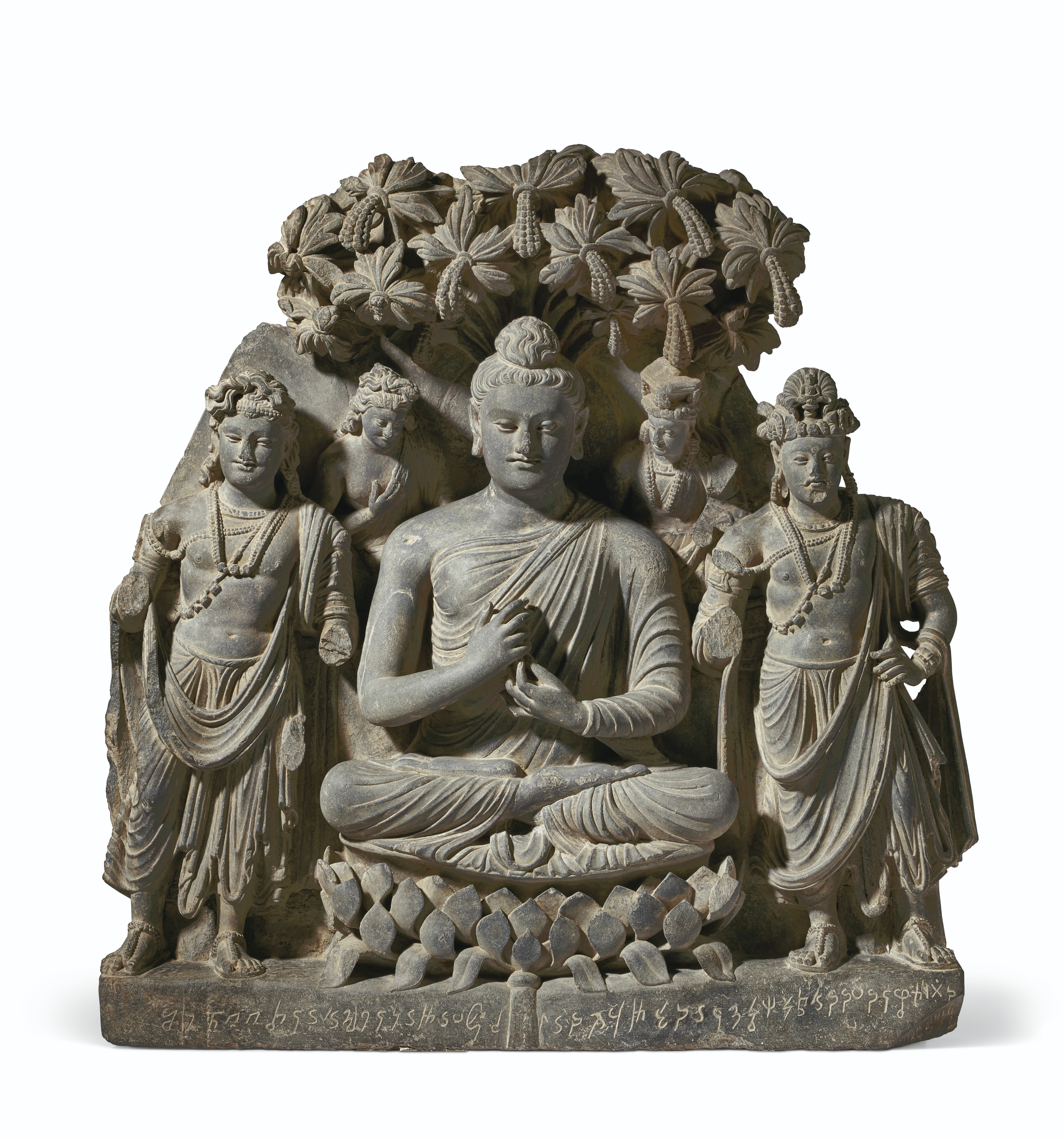
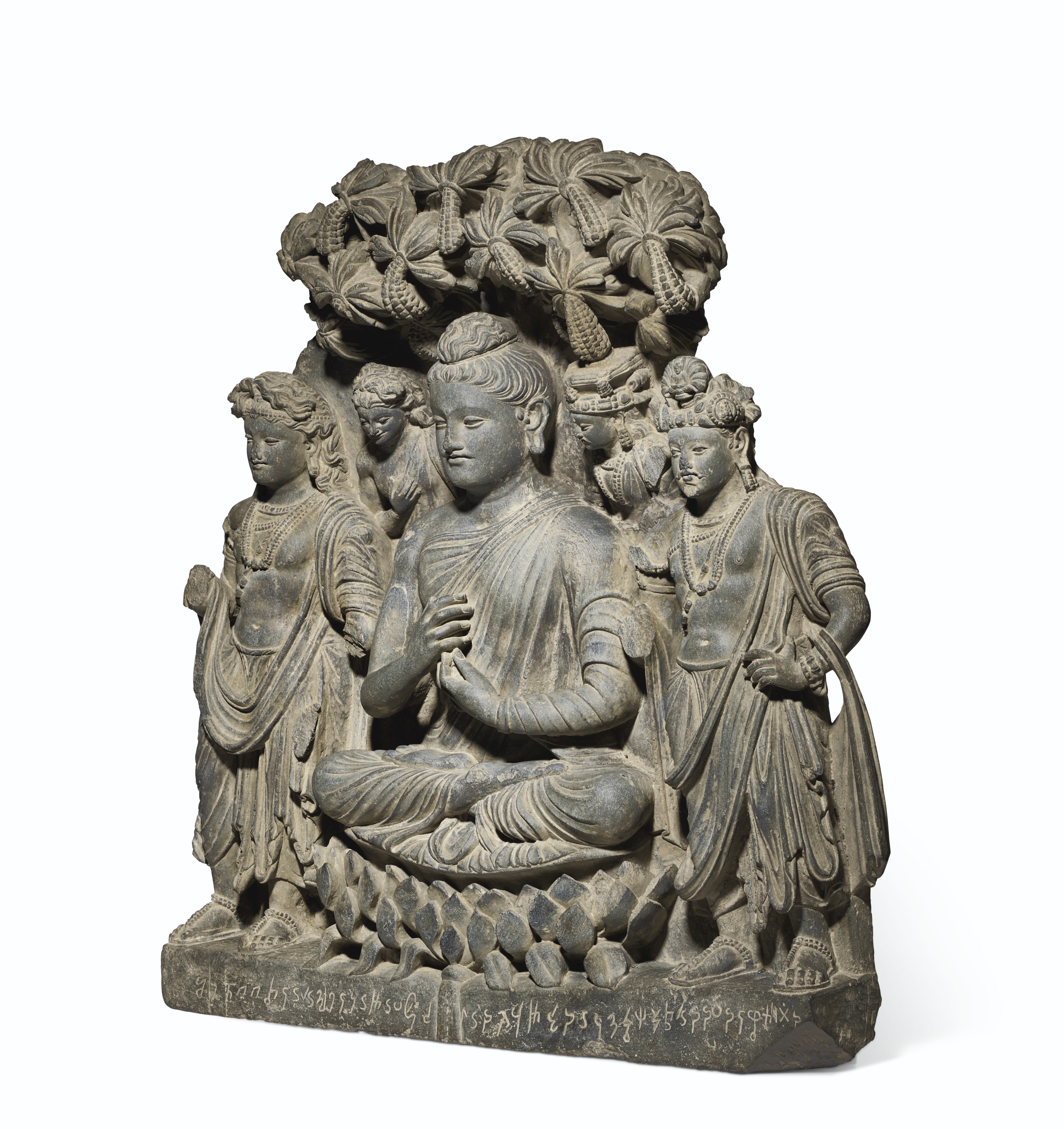
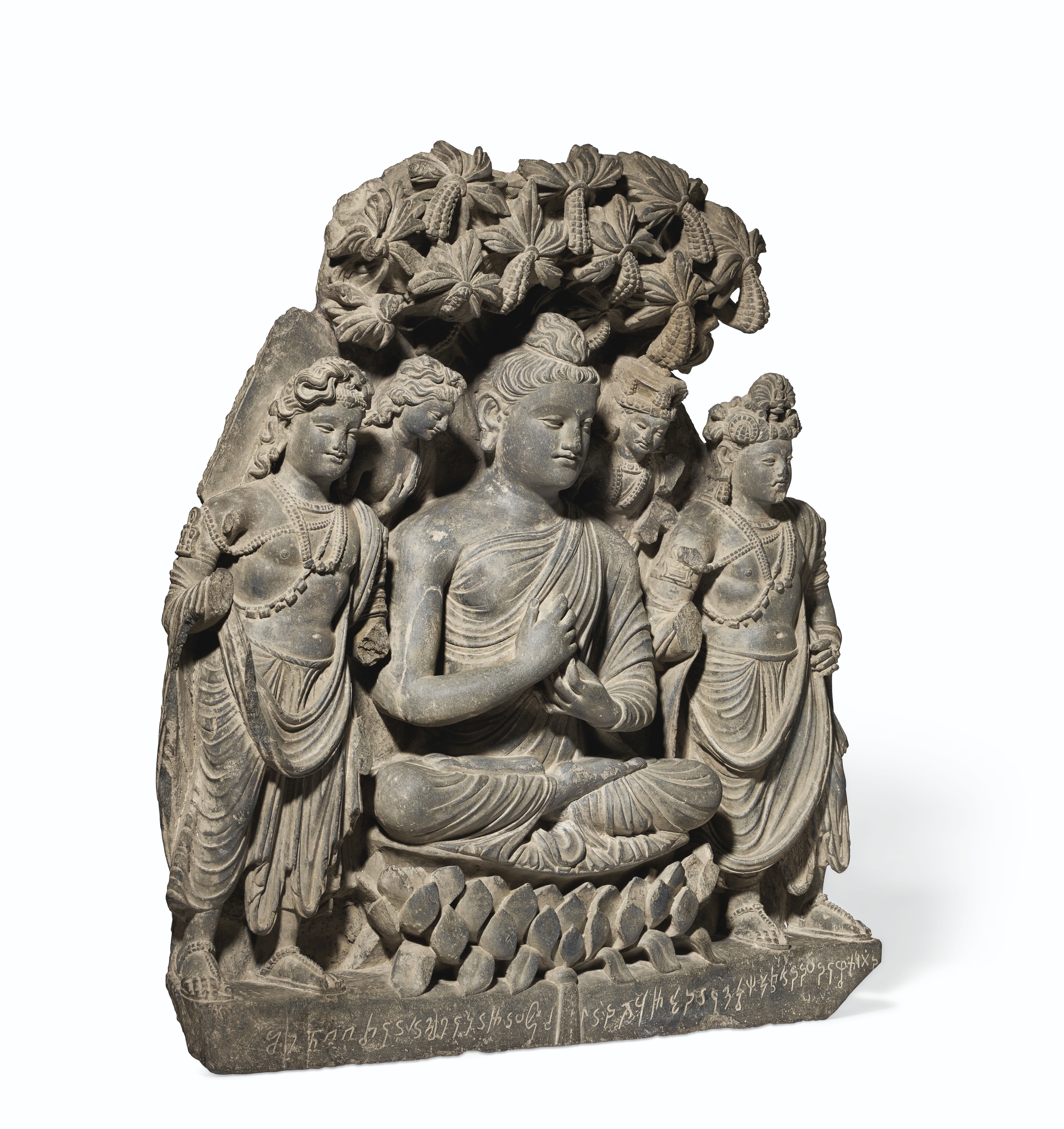 A RARE AND MAGNIFICENT GRAY SCHIST RELIEF TRIAD OF BUDDHA SHAKYAMUNI WITH BODHISATTVAS
ANCIENT REGION OF GANDHARA, DATED BY INSCRIPTION TO YEAR 5, PROBABLY 3RD-4TH CENTURY CE
24 ¼ in. (61.6 cm.) high; 23 ¼ in. (59.1 cm.) wide
Provenance
Collection of Claude de Marteau, Brussels, by 1973.
Important private collection, Japan, by 1990.
Literature
Advertisement, Oriental Art, vol. XIX, no. 1, Surrey, Spring 1973, p. 24.
J. Harle, “A Hitherto Unknown Dated Sculpture from Gandhara: A Preliminary Report,” South Asian Archaeology, Leiden, 1974, pp. 128-135.
G. Fussman, “Documents épigraphiques kouchans”, Bulletin de l’École Française d’Extrême Orient, vol. 61, Paris, 1974, pp. 54-8.
A. Quagliotti, “Ossevazioni sul Buddha di Bruxelles,” Rivista degli studi orientali, vol. 51, fasc. 1/4, Rome, June 1978, pp. 137-140, tav. 1.
P. Pal, ed., Light of Asia: Buddha Sakyamuni in Asian Art, Los Angeles, 1984, p. 191, cat. no. 74.
S. Czuma, Kushan Sculpture: Images from Early India, Cleveland, 1985, p. 199, cat. no. 109.
K. Khandalavala, “The Five Dated Gandhara School Sculptures and Their Stylistic Implications,” Indian Epigraphy: Its Bearing on the History of Art, New Delhi, 1985, plate 112.
J. van Lohuizen-de Leeuw, “The second century of the Kaniṣka era,” South Asian Studies, vol. 2, London, 1986, p. 6, fig. 7.
G. Fussman, “Numismatic and Epigraphic Evidence for the Chronology of Early Gandharan Art,” Investigating Indian Art: Proceedings of a Symposium on the Development of Early Buddhist and Hindu Iconography Held at the Museum of Indian Art Berlin in May 1986, Berlin, 1987, p. 72, fig. 3.
G. Mitterwallner, “The Brussels Buddha from Gandhara of the Year 5,” Investigating Indian Art: Proceedings of a Symposium on the Development of Early Buddhist and Hindu Iconography Held at the Museum of Indian Art Berlin in May 1986, Berlin, 1987, p. 215, fig 1.
I. Kurita, Gandharan Art, vol. I, Tokyo, 1988, p. 143, P3-VIII (illus. cover), second edition 2003 (illus. back cover).
K. Tanabe, “Iconographical and Typological Investigations of the Gandharan Fake Bodhisattva Image Exhibited by the Cleveland Museum of Art and Nara National Museum,” Orient, XXIV, Tokyo, 1988, p. 88, fig. 2.
G. Verardi, “Le sculture del Gandhara nel Civico Museo Archeologico di Milano,” Rassegna di studi del Civico Museo Archeologico e del Civico Gabinetto Numismatico di Milano, Milan, 1991, supplement VII, p. 46, fig. 16 (line drawing).
M. Akira, ed., Iconography of Nirvana and Maitreya - from India to Central Asia, Tokyo, 1992, no. 138.
M. Akira, ed., Gandharan - Wonders of Buddha, Tokyo, 1995, no. IV-12.
M. Bussagli, (trans. B. Arnal), L’Art du Gandhara, Paris, 1996, pp. 188 (part), 189.
S. Wriggins, Xuanzang: A Buddhist Pilgrim on the Silk Road, Boulder, 1996, p. 66, fig. 4.6.
I. Kim, The Future Buddha Maitreya: An Iconological Study, New Delhi, 1997, fig. 83.
F. Tissot, “Remarks and Several Gandhara Pieces,” East and West, vol. 55, no. 4, Rome, 2005, p. 396, fig. 1.
P. Pal, “Reflections on the Gandhara Bodhisattva Images,” Bulletin of the Asia Institute, vol. 20, Detroit, 2006, p. 103, fig. 2.
M. Akira, Gandharan Art and Bamiyan Site, Tokyo, 2006, p. 61, no. 26.
C. Schmidt, Symbols of Royalty and Divinity: Stylistic and Iconographic Characteristics of Turbans Worn by Images of Bodhisattvas from Ancient Greater Gandhara, Lahore, 2007, figs. 29a, 29b (part).
I. Kurita, Introduction to Gandharan Art, Tokyo, 2008, fig. 50.
J. Rhi, “Identifying Several Visual Types in Gandharan Buddha Images,” Archives of Asian Art, vol. 58, New York, 2008, p. 56, fig. 24.
M. Akira, “Iconography of the Two Flanking Bodhisattvas in the Buddhist Triads from Gandhara,” East and West, vol. 58, no. 1, Rome, 2008, p. 146, fig. 21.
C. Luczanits, “Gandhara und seine Kunst,” Gandhara: Das buddhistische Erbe Pakistans / Legenden, Klöster und Paradiese, Bonn, 2008, p. 24, abb. 7.
M. Rhie, Early Buddhist Art of China and Central Asia, v. 3, Leiden/Boston, 2010, fig. 6.18.
C. Luczanits, “Gandhara and its Art,” The Buddhist Heritage of Pakistan: Art of Gandhara, New York, 2011, p. 20, fig. 9.
M. Akira, (trans. M. McClintock), “The Current State of Research on Gandharan Art,” Kokka, no. 1385, Tokyo, 2011, pl. 3.
G. Fussman, A. Quagliotti, The Early Iconography of Avalokiteśvara, Paris, 2012, pl. IX, 15.
J. Hartmann, “Die Modernisier der indischen Gesellschaft,” Schrift und Sprache: Was Forscher über unsere ältesten Kulturgüter wissen. Spektrum der Wissenschaft Spezial: Archäologie · Geschichte · Kultur, no. 3, Berlin, 2014, p. 35.
J. Rhi, “Positioning Gandharan Buddhas in chronology: significant coordinates and anomalies,” Problems of Chronology in Gandharan Art, Oxford, 2018, p. 43, figs. 12-13.
Exhibited
Los Angeles County Museum of Art, The Art Institute of Chicago, The Brooklyn Museum, “Light of Asia: Buddha Sakyamuni in Asian Art,” 4 March 1984-10 February 1985, cat. no. 74.
Cleveland Museum of Art, Asia Society, New York, Seattle Art Museum, “Kushan Sculpture: Images from Early India,” 13 November 1985-13 July 1986, cat. no. 109.
Shizuoka Kenritsu Bijutsukan, Fukuoka Ajia Bijutsukan, Fukui-shi Bijutsukan, “Gandhara Art & Bamiyan Site,” 28 December 2007-6 July 2008, cat. no. 26.
Lot Essay
Carved in deep relief, with exquisite modeling and lifelike attention to detail, the present lot can be considered one of the most important and recognizable Gandharan sculptures to ever appear at auction. Extensively published and widely exhibited, this rare and important Buddhist triad has previously been described by Dr Pratapaditya Pal in Light of Asia: Buddha Sakyamuni in Asian Art, Los Angeles, 1984, p. 191 as “one of the finest extant Gandhara reliefs” ever known to international art historians and the art market. The figures of Buddha and his flanking bodhisattvas, Avalokiteshvara and Maitreya, as well as the boughs of the tree above, are carved with such depth as to appear almost in the round, and the emerging torsos of Brahma and Indra behind contribute to the sense of deep perspective, a masterful feat on the part of the sculpture considering the shallow actual depth of the relief.
One of the numerous aspects which distinguishes this magnificent triad, depicting Buddha Shakyamuni with a divine retinue of bodhisattvas, is its inclusion in a small group of inscribed figural sculpture from the ancient region of Gandhara. As recently as 2017, this group of five inscribed figural works included the present lot; a seated Buddha from Manane Dheri; a standing Buddha from Loriyan Tangai; a standing Buddha from Hashtnagar; and a standing Hariti from Skarah Dheri, the latter four all commonly known by their excavation site and subject matter, i.e. the Loriyan Tangai Buddha, etc. For further discussion, see J. Rhi, “Positioning Gandharan Buddhas in chronology: significant coordinates and anomalies”, Problems of Chronology in Gandharan Art, Oxford, 2018, pp. 35-49 and also C. Luczanits, “Gandhara and its Art”, The Buddhist Heritage of Pakistan: Art of Gandhara, New York, 2011, pp. 20-22. The present triad, however, has been known colloquially and frequently published as the ‘Brussels Buddha’ due to its previous inclusion in the collection of the late Belgian dealer and connoisseur, Claude de Marteau.
Since the initial appearance of the present lot in an advertisement in Oriental Art magazine in the spring of 1973, enthusiastic scholastic and epigraphical debate surrounding the chronology and interpretation of Gandharan inscriptions, and the methodology of translation of dated inscriptions into the Gregorian calendar, has followed.
The primary question for epigraphical debate pertains to the correlation of era (i.e. Kanishka; Kharoshti; Azes; Vikrama, etc.) applied to the numerical inscription, which would give a modern dating anywhere between the first and fifth centuries CE. Although a median date of third-fourth century CE is presently accepted as a working hypothesis by art historians and epigraphical specialists, the question of accuracy still remains a subject of debate. Determining the correlation of the inscribed date to the Gregorian calendar has a significant and far-reaching effect, of course, on the dating of the present lot; the beginning and end of the Kushan era; and the greater understanding of the development and evolution of Gandharan art history.
Writing about the present lot in “Gandhara and its Art”, The Buddhist Heritage of Pakistan: Art of Gandhara, New York, 2011, p. 21, Christian Luczanits suggests a dating of third-fourth century (232 or 332 CE), based upon the premise “… of the Kushan era as beginning with Kanishka I at 127 CE” as well as the “… assumption of the development of iconographic themes based on the slowly increasing importance of concepts and ideas associated with Mahayana Buddhism.” The specifically Mahayanist iconographic themes to which he refers includes the worship of bodhisattvas, including Avalokiteshvara and Maitreya, both of whom flank the Buddha in the present lot. Luczanits further summarizes: “ .. the interpretations of art history and Buddhist studies on the one hand and those of archaeology, history and epigraphy on the other hand have been drifting apart, without the possibility of reconciliation.”
The inscription on the present lot has been presented by Juhyung Rhi in “Positioning Gandharan Buddhas in chronology: significant coordinates and anomalies”, in Problems of Chronology in Gandharan Art, Oxford, 2018, p. 43. and translated as:
sa[m] 41 Phagunasa masasa di pamcami Budhanadasa trepidakasa damamukhe madapidarana adhvadidana puyaya bhavatu (In the year 5, on the fifth day of the month of Phalguna: the pious gift of Buddhananda, learned in the three baskets (pitakas), may it be for honoring the deceased [?] father and mother)
Based on an interpretation of the year 5 in the inscription as correlating to the Kanishka era, it is dated by Pratapaditya Pal in the “Light of Asia” exhibition catalogue to the year 83 CE. Since the time of publication, however, the first century attribution has been widely debated as too early a date for a stele of this sophistication and subject matter vis-à-vis the current understanding of the trajectory of Gandharan sculpture.
Further distinguishing characteristics of this extraordinary sculpture include the unusual and divine assembly of deities and bodhisattvas surrounding Buddha Shakyamuni, seated at the center of the relief. In the present lot, Buddha is flanked on the proper left by the bodhisattva Avalokiteshvara, as evidenced by the diminutive Buddha figure at the crown of his head; and flanked on the proper right by another bodhisattva, likely Maitreya, although losses to the forearms preclude positive identification by attribute. Behind Buddha float two smaller figures with hands raised in adoration: crowned Indra on the proper left and an ascetic figure depicting Brahma on the proper right. Surmounting Buddha and retinue is a heavy bough of luxuriant leaves, alternately described as the famous bodhi tree, or a celestial tree laden with flowers.
Compare this triad with a very similar relief in the Peshawar Museum depicting the same scene (published as the “Miracle of Shravashti” in H. Hargreaves, Handbook to the Sculptures of the Peshawar Museum, Calcutta, 1930, pl. 2, fig. a.). In the Peshawar example, the bodhisattva Maitreya flanks Buddha on the proper left. Beyond this difference, there is remarkable resemblance between the two triads, including the treatments of the leaves and flowers; the elegant hairstyles and cascading style of the robes; the particular crown style of Indra; and the unusual treatment of the lotus throne petals, which resemble an artichoke and are more frequently seen in bronze sculpture from the Swat Valley.
本拍品雕工深峻,造型精美,细节栩栩如生,堪称有史以来出现在拍卖市场上最重要、最具辨识度的犍陀罗(Gandharan)雕塑之一。这尊稀有而重要的佛教三尊像曾广泛出版并多次参展,此前被普拉塔帕迪亚·帕尔(Pratapaditya Pal)博士在《亚洲之光:佛陀释迦牟尼在亚洲艺术中的呈现》(Light of Asia: Buddha Sakyamuni in Asian Art,洛杉矶,1984年,第191页)中描述为国际艺术史学家与艺术品市场所公认的“现存最精美的犍陀罗浮雕之一”。佛陀及其两侧的胁侍菩萨——观音(Avalokiteshvara)与弥勒(Maitreya)——以及上方的树枝,均被雕凿得如此深邃,几近圆雕;后方浮现的梵天(Brahma)与帝释天(Indra)的半身像更增添了深远的透视感,考虑到浮雕的实际厚度甚浅,这是雕刻师的一项高超技艺。
这尊宏伟的三尊像表现的是佛陀释迦牟尼(Buddha Shakyamuni)与菩萨圣众。其众多卓越之处之一,在于它被纳入犍陀罗古地区一小批带有铭文的人像雕塑之中。截至2017年,这一批共五件带铭文人像作品包括:本拍品;一件出自马纳内德里的坐佛(Manane Dheri seated Buddha);一件出自洛里扬坦盖的立佛(Loriyan Tangai standing Buddha);一件出自哈什特纳加尔的立佛(Hashtnagar standing Buddha);以及一件出自斯卡赫德里的诃利帝立像(Skarah Dheri standing Hariti)。后四件通常以其发掘地点及主题命名,如“洛里扬坦盖佛陀”等。进一步讨论见J. Rhi著《犍陀罗佛陀的年代定位:重要坐标与异常》(Positioning Gandharan Buddhas in chronology: significant coordinates and anomalies),载于《犍陀罗艺术的年代学问题》(Problems of Chronology in Gandharan Art,牛津,2018年,第35-49页);以及C. Luczanits著《犍陀罗及其艺术》(Gandhara and its Art),载于《巴基斯坦的佛教遗产:犍陀罗艺术》(The Buddhist Heritage of Pakistan: Art of Gandhara,纽约,2011年,第20-22页)。然而,本拍品因曾为已故比利时古董商兼鉴赏家克劳德·德·马尔托(Claude de Marteau)收藏,常被俗称为“布鲁塞尔佛陀”(Brussels Buddha),并在诸多出版物中以此名出现。
自本拍品于1973年春季首次以广告形式出现在《东方艺术》(Oriental Art)杂志上以来,围绕犍陀罗铭文的年代学与解读方法,以及将纪年铭文转换为公历的方法,引发了热烈的学术与碑铭学讨论。
碑铭学争论的核心问题在于:铭文中的数字究竟对应何种纪年体系(如迦腻色伽纪年(Kanishka)、佉卢文(Kharoshti)、阿泽斯纪年(Azes)、超日王纪年(Vikrama)等),这将使其公历年代落在公元1世纪至5世纪之间。尽管目前艺术史家与碑铭学专家暂以公元3-4世纪作为中间值的工作假说,但准确性仍然是一个有争议的问题。确定铭文纪年与公历的对应关系,对本拍品的断代、贵霜时代的起止以及更广泛地理解犍陀罗艺术史的发展与演变,都有着深远而重大的影响。
克里斯蒂安·卢赞尼茨(Christian Luczanits)在《犍陀罗及其艺术》一文(载于《巴基斯坦的佛教遗产:犍陀罗艺术》,纽约,2011年,第21页)中讨论本拍品时,基于两个前提提出了公元3-4世纪(即公元232年或332年)的断代:“……以迦腻色伽一世(Kanishka I)于公元127年即位作为贵霜纪年之始”,以及“……基于与大乘佛教(Mahayana Buddhism)相关的观念与思想逐渐增强的重要性,对图像学主题发展所作的假设”。他所指的大乘佛教图像学主题尤其包括对菩萨的崇拜,其中即有观音与弥勒——二者正胁侍于本拍品中佛陀两侧。卢赞尼茨进一步总结道:“……一方面艺术史与佛学研究的解读,与另一方面考古学、历史学与碑铭学的解读,已渐行渐远,且尚无弥合之可能。”
本拍品上的铭文由Juhyung Rhi在《犍陀罗佛陀的年代定位:重要坐标与异常》(载于《犍陀罗艺术的年代学问题》,牛津,2018年,第43页)中加以呈现,并翻译如下:
  sa[m] 41 Phagunasa masasa di pamcami Budhanadasa trepidakasa damamukhe madapidarana adhvadidana puyaya bhavatu
  (第5年,Phalguna月第5日:通达三藏(pitakas)的佛欢喜(Buddhananda)之虔敬供养,以此回向,愿用于[?]敬奉过世的父母。)
基于铭文中“第5年”对应迦腻色伽纪年的解读,普拉塔帕迪亚·帕尔在《亚洲之光》展览图录中将其断代为公元83年。然而,自该图录出版以来,这一公元1世纪的断代因与本件作品在犍陀罗雕塑发展轨迹认知下的成熟程度及主题内容不符,而受到广泛质疑。
这尊非凡雕塑的另一个突出特征,是其围绕中央坐于浮雕中心的佛陀释迦牟尼,汇聚了非同寻常的神圣诸天与菩萨众。在本拍品中,佛陀的正右侧(proper right)为观音菩萨——其冠顶有化佛小像为证;正左侧(proper left)为另一位菩萨,很可能是弥勒,但因前臂残缺无法依持物确切辨识。佛陀身后浮现两个较小的形象,双手合举作礼敬状:正左侧为戴冠的帝释天,正右侧为一苦修者形象的梵天。佛陀及圣众上方是繁茂的枝叶,被描述为著名的菩提树(bodhi tree),或一棵挂满花朵的天界宝树。
将此三尊像与白沙瓦博物馆(Peshawar Museum)藏一件表现相同场景的非常相似的浮雕进行比较(发表为“舍卫城大神变”,见H. Hargreaves著《白沙瓦博物馆雕塑手册》(Handbook to the Sculptures of the Peshawar Museum),加尔各答,1930年,图版2,图a)。在白沙瓦的例子中,弥勒菩萨位于佛陀的正左侧。除此之外,两件三尊像之间有着显著的一致性,包括枝叶与花朵的处理、优雅的发型与流畅的衣袍样式、帝释天特定的冠式,以及莲座莲瓣非同寻常的处理方式——其形似洋蓟,更常见于斯瓦特河谷(Swat Valley)的铜造像中。

