
侧边栏

9-10世纪西藏(吐蕃)合金铜杨柳观音菩萨立像(牛津大学阿什莫林博物馆)
尺寸:9.4 x 4.2 x 2.9cm
年代:9-10世纪
质地:合金铜
风格:西藏(吐蕃) 南诏国
来源:牛津大学阿什莫林博物馆
参阅:外部链接
鉴赏:
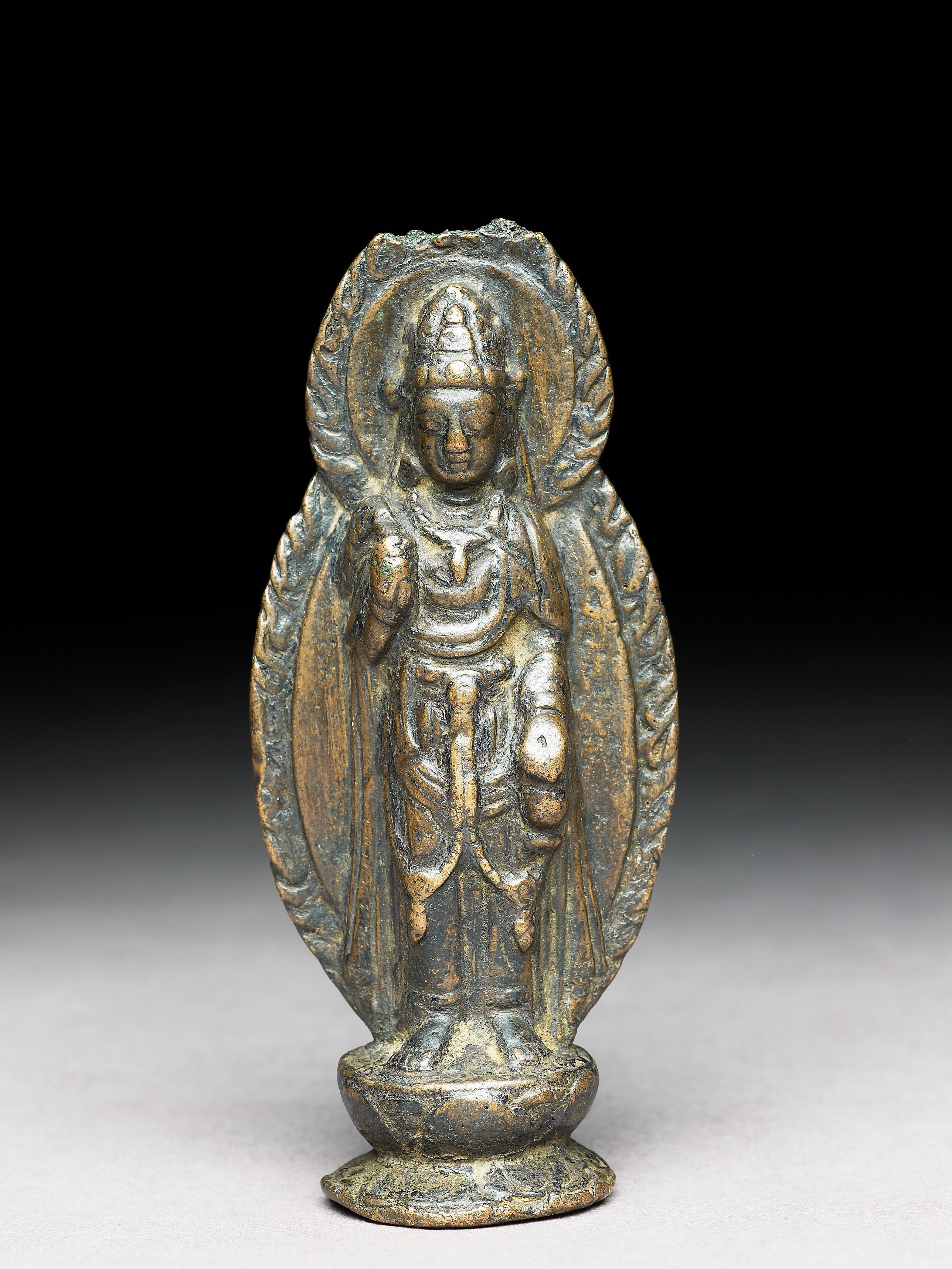
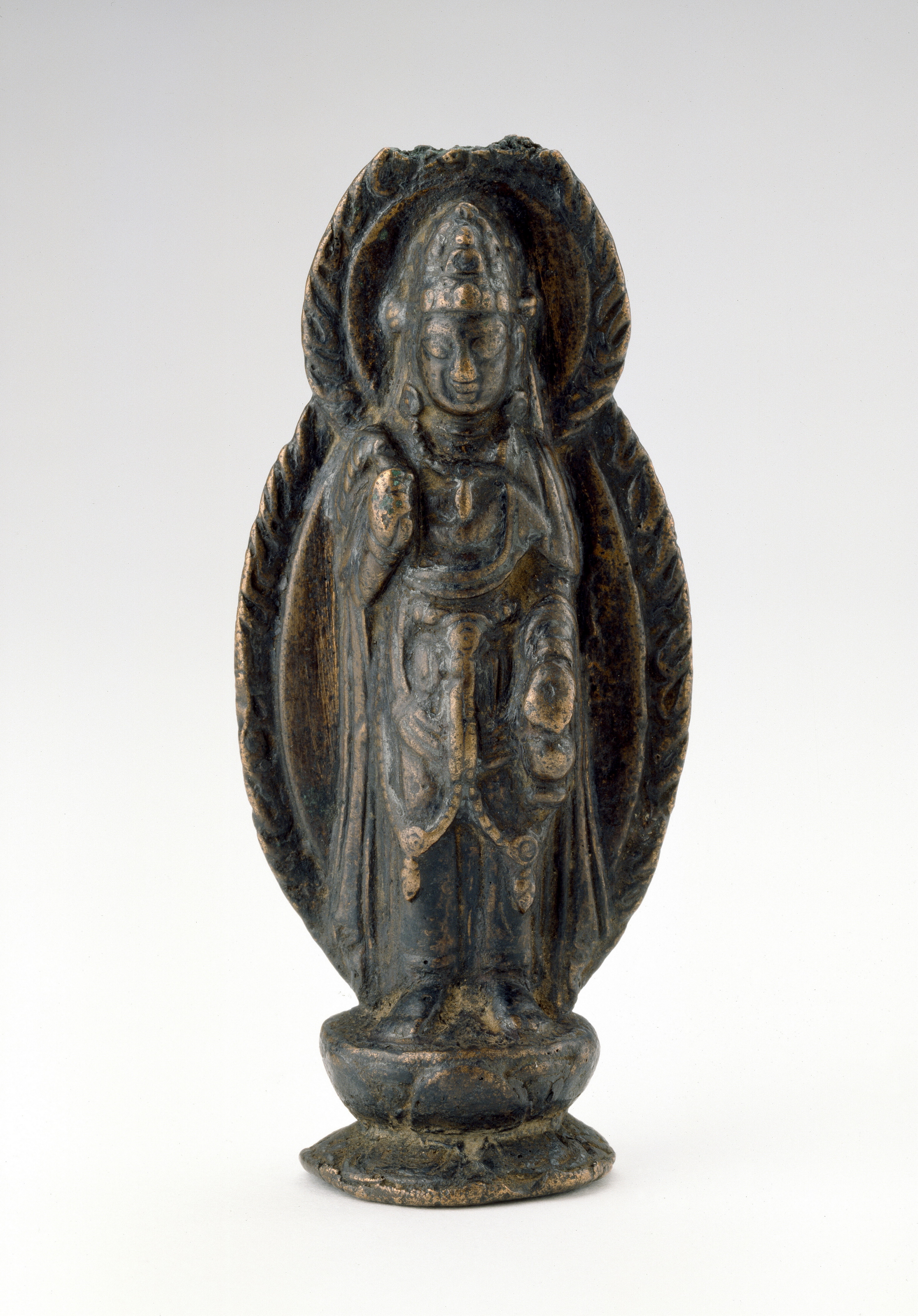
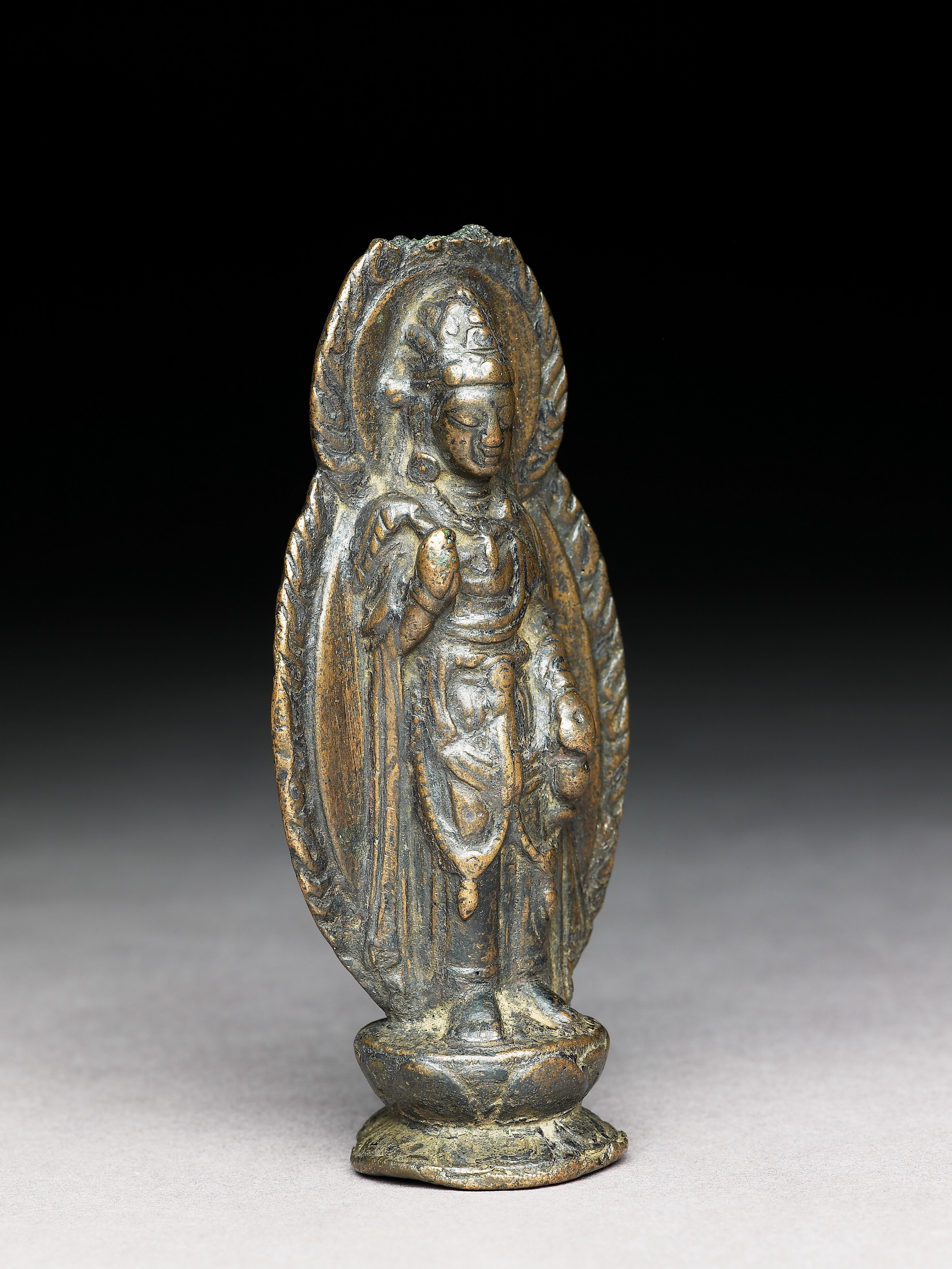
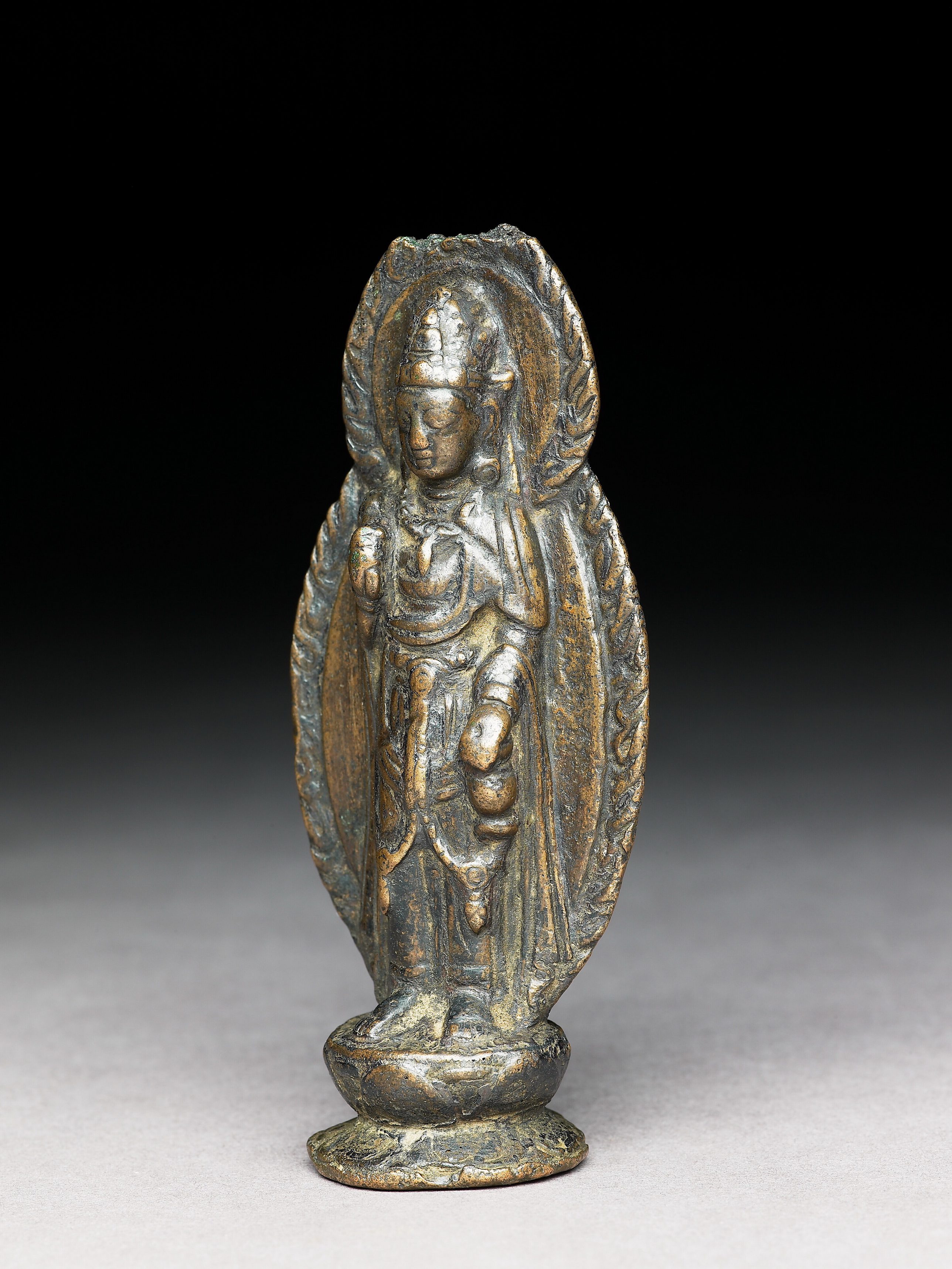
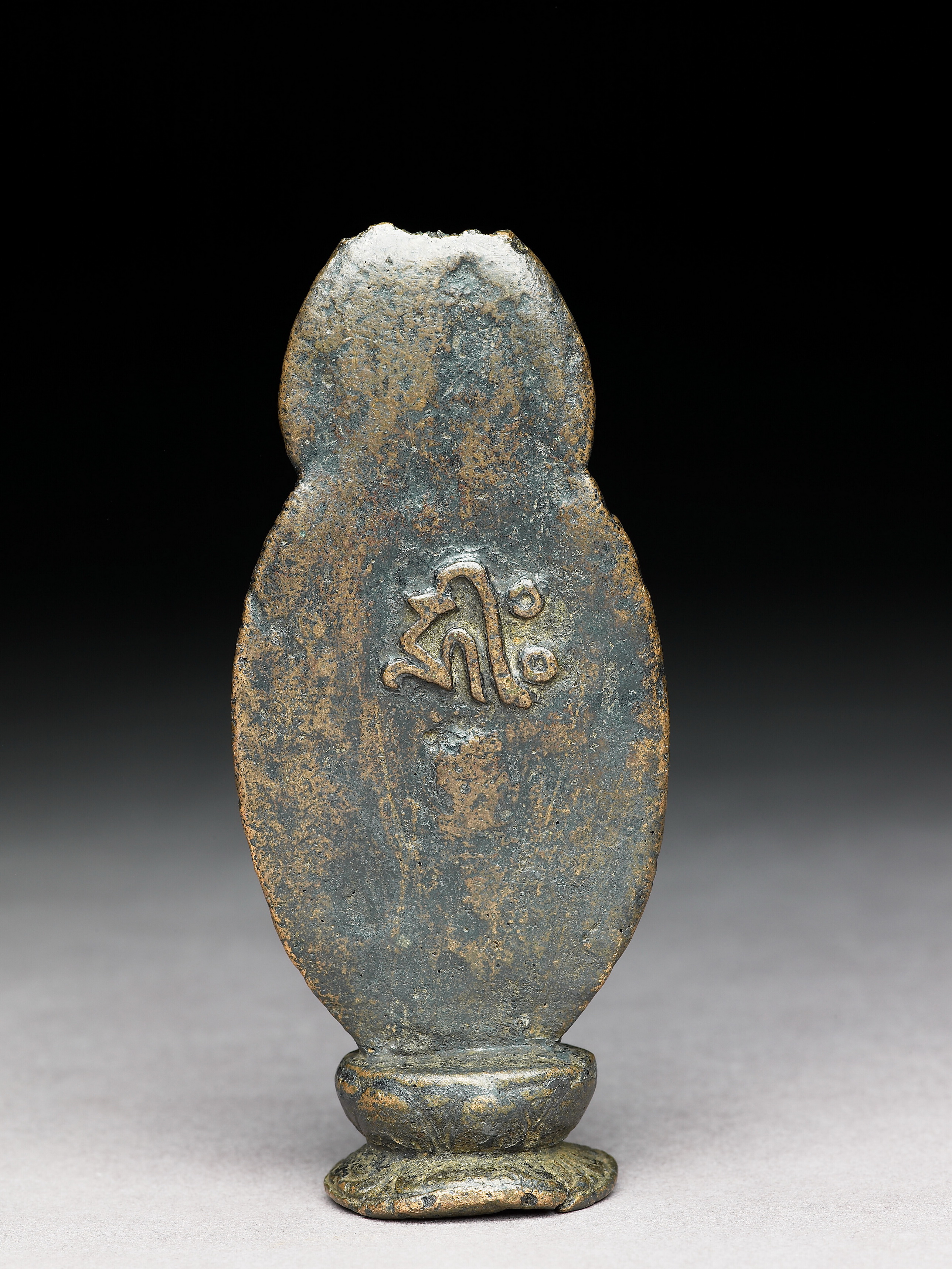 发现于云南, 风格混杂, 1995年购买
This small Bodhisattva may be identified as an aspect of Avalokitesvara, holding a branch of willow over his right shoulder and a flask in his left hand. In the central triangular panel of his crown, a small seated Buddha may just be discerned. The Bodhisattva is wearing a necklace and an elaborate chain belt with jewel pendants at knee level above his thin dhoti. The long sashes of the scarves which pass from his shoulders fall in very small naturalistic pleats at his ankles. His body is perfectly straight. This pure frontality, the narrow scarves, and the elongated chains draped to the knees recall early tenth-century paintings of Avalokitesvara from Dunhuang [1]. The crown with fan-shaped extensions at the temples does not exhibit the typical ribbons or florets of the crowns at Dunhuang, but instead recalls Kashmiri models, as does the very simple form of the flames on the lotus surround [2]. Although the upper portion of the halo is broken, it appears that it came to a small point, in contrast with the circular halo around his head. The figure appears within an oval prabha, as narrow at the shoulder level as at the ankle, differentiating it from the Kashmiri ovoid prabha models which are wider at the shoulder level.
On the reverse, a word written in Tibetan alphabet non-cursive letters is modelled in relief. It was thus modelled at the same time as the casting of the image, which is very thin and solid cast. This syllable may be read as Hri, a syllable for sacred incantation, although the artist has slightly misaligned the vowel. There are two vertically aligned circles as punctuation, which is typical of Tibetan inscriptions on stone steles and on silver during the eighth to ninth century [3].
This Tibetan inscription and the use of certain conventions from the Western Himalaya point to the period of the Tibetan occupation of Dunhuang, or shortly after. The image is said to have been acquired in Yunnan, where the Nanzhao kingdom was in close alliance with the Tibetans in the second half of the eighth century. As troops and monks were then travelling from Qinghai to Yunnan via the Mekong river, it is possible that the image was made in Dunhuang and then carried to Yunnan.
In its metal alloy and its iconography, stylistic conventions of the draperies and ornate prabha, it is formally quite distinct from the local Nanzhao sculptures of the ninth to tenth century [4].
[Footnotes:]
1 Whitfield and Farrer, Caves of the Thousand Buddhas, pl. 12, dated 910 ad.
2 Reedy, Himalayan Bronzes (k 51): Tathagata Amoghasiddhi, Kashmir, 8th–9th century.
3 Compare this punctuation on the 779 ad inscribed stone stele from Samye (bsam yas): Richardson, A Corpus of Early Tibetan Inscriptions, pl. 4.
4 Lutz, Der Tempel der Drei Pagoden von Dali, Abb. 100.
In: Heller, Amy, Early Himalayan Art (Oxford: Ashmolean Museum, 2008)
这尊小型的菩萨造像可被辨识为观音的一种化身,其右肩上擎一枝柳条,左手持一瓶。在其头冠中央的三角形饰板中,可以依稀辨认出一尊小型的坐佛。菩萨佩戴项链,在轻薄的下衣之上,于膝部高度饰有精致的腰带,其上缀有珠宝垂饰。从双肩垂下的长帔帛飘带在脚踝处形成非常自然的细小褶皱纹。其身体笔直挺立。这种纯粹的正面性、窄幅的帔帛以及垂至膝部的细长璎珞,让人联想起10世纪初敦煌的观音绘画[1]。其头冠在太阳穴处呈扇形展开,没有表现出敦煌头冠上典型的饰带或小花,反而让人联想到克什米尔的样式,莲花周围的火焰纹亦是如此,其形式非常简单[2]。尽管身光的上半部分已破损,但与头后的圆形顶光相比,身光似乎是呈一个小尖顶形状。造像出现在一个椭圆形的举身光(prabha)内,该举身光在肩部与脚踝处的宽度相同,这与克什米尔那种在肩部更宽的卵形举身光样式有所不同。
在背面,有用藏文字母(非草书)浮雕出的一个字。它是在铸造这尊非常薄的实心造像时一同制作的。这个音节可被读作“赫利”(Hri),是一个用于神圣咒语的音节,尽管工匠对元音符号的刻划略有偏差。其旁边有两个垂直排列的圆圈作为标点符号,这是8至9世纪西藏石碑和银器上铭文的典型特征[3]。
这处藏文铭文以及对某些西喜马拉雅地区传统程式的运用,都指向了吐蕃占领敦煌的时期,或在此之后不久。据说这尊造像购自云南,而南诏王国在8世纪下半叶与吐蕃结成了紧密的联盟。由于当时军队和僧人经由湄公河从青海前往云南,因此这尊造像有可能是在敦煌制作,随后被带到云南的。
从其金属合金成分、图像学特征、衣饰的风格化处理以及华丽的举身光来看,它在形式上与9至10世纪的当地南诏雕塑有着显著区别[4]。
[注脚:]
1 Whitfield与Farrer,《Caves of the Thousand Buddhas》,图版12,年代为公元910年。
2 Reedy,《Himalayan Bronzes》(k 51):如来·不空成就佛(Tathagata Amoghasiddhi),克什米尔,8至9世纪。
3 可将此标点与公元779年桑耶寺(bsam yas)石碑上的铭文进行对比:Richardson,《A Corpus of Early Tibetan Inscriptions》,图版4。
4 Lutz,《Der Tempel der Drei Pagoden von Dali》,图100。
著录:
Heller, Amy, Early Himalayan Art (Oxford: Ashmolean Museum, 2008), page mentioned: p. 92, page illustrated: p. 73, Cat. No.: no. 14 on p. 72
争议1:
Inscribed with hri syllable on reverse, the script closer to Late Gupta or later Indian scripts than to Tibetan (acc. to Peter Roberts).
背面刻有hri音节,字体更接近后笈多或之后的印度文字,而非藏文(据Peter Roberts)
争议2:
有人认为是云南南诏国时期作品

