
侧边栏

14世纪尼泊尔铜鎏金莲花手观音立像(纽约邦瀚斯)(纽约佳士得)
尺寸:高32.5 cm
年代:14世纪
质地:铜鎏金
风格:尼泊尔 帕拉
来源:拍卖会
成交:未成交(2023.03); 578,500美元(2012.09)
参阅:纽约邦瀚 纽约佳士得
鉴赏:
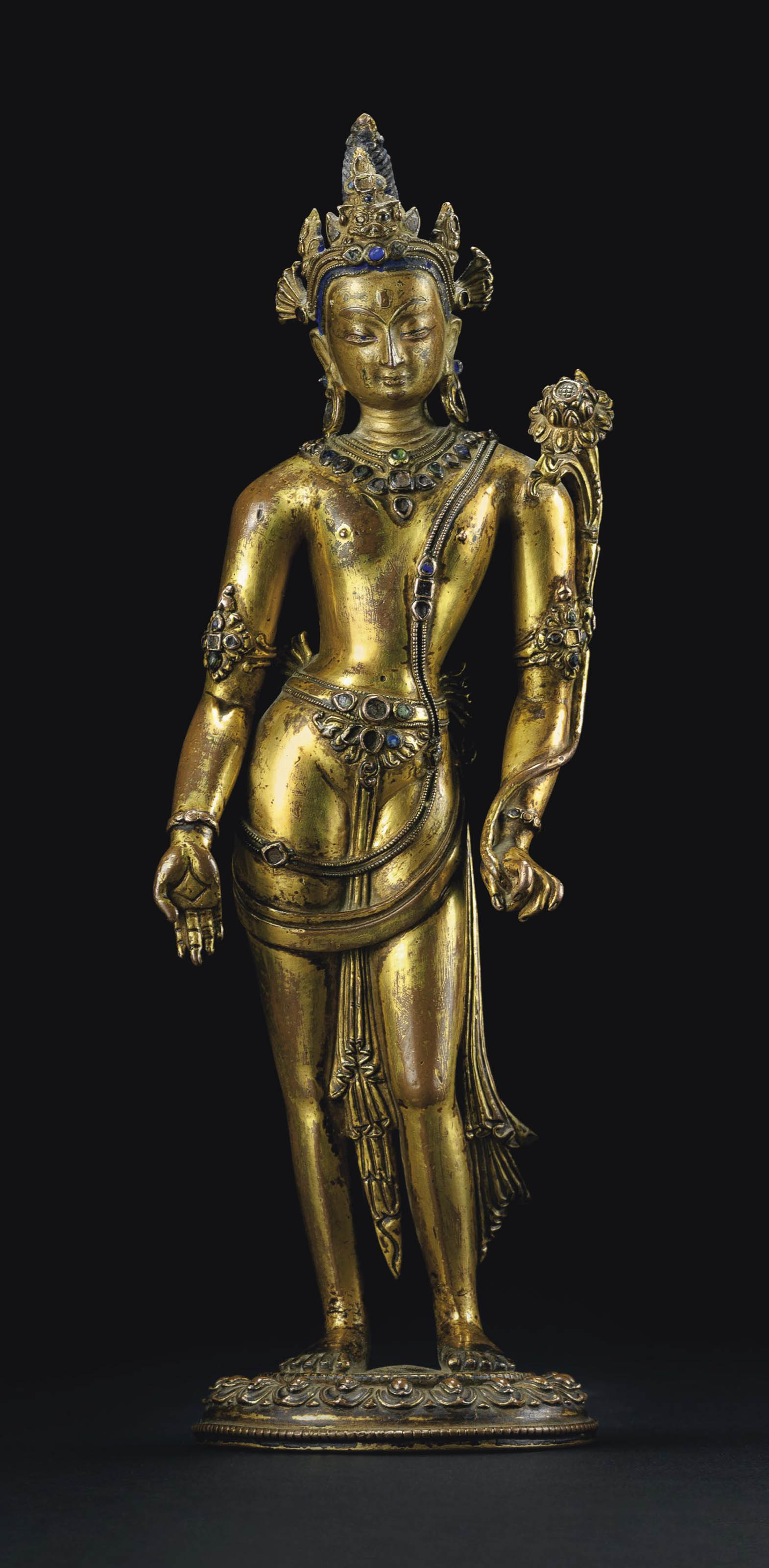
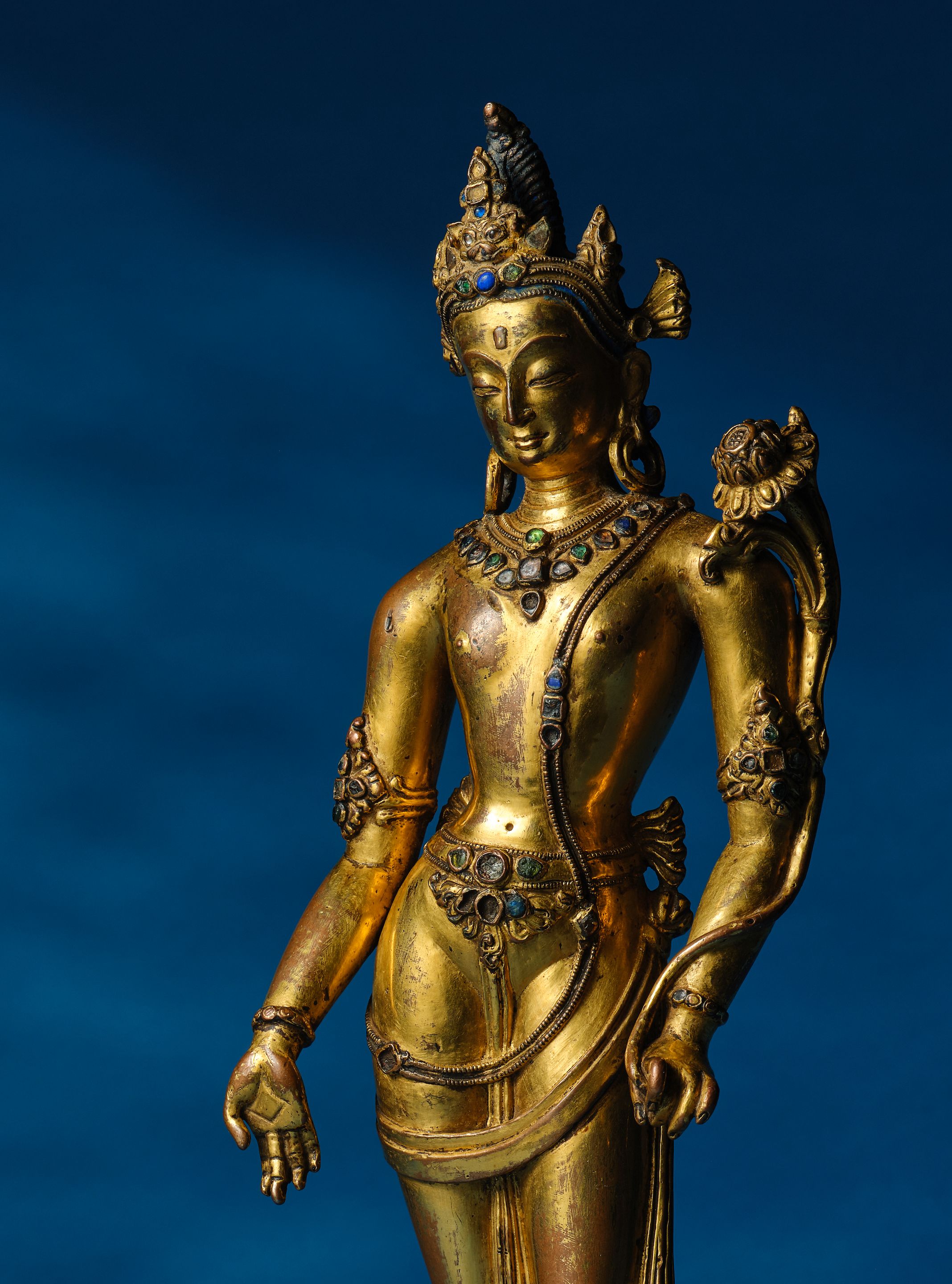
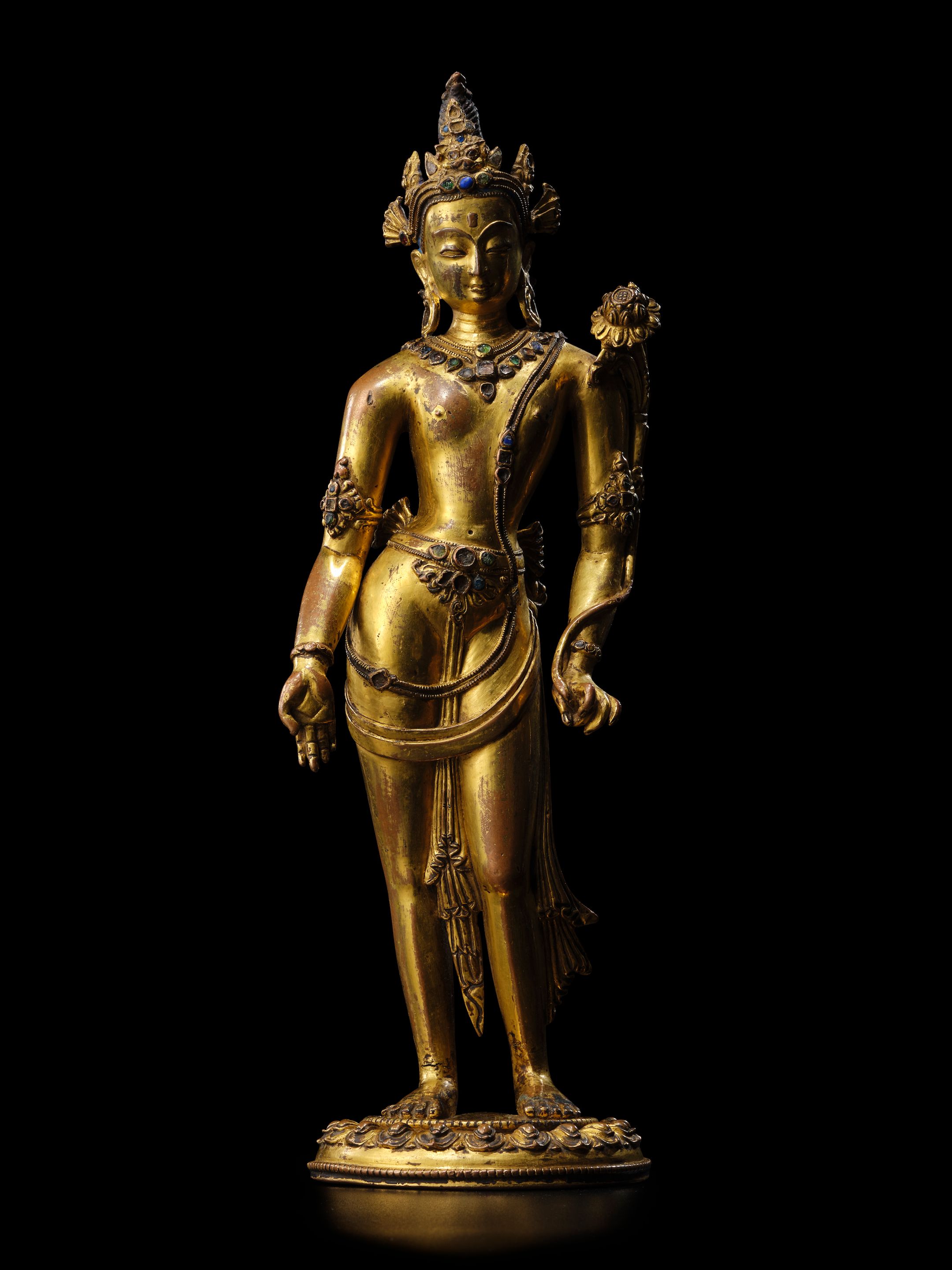
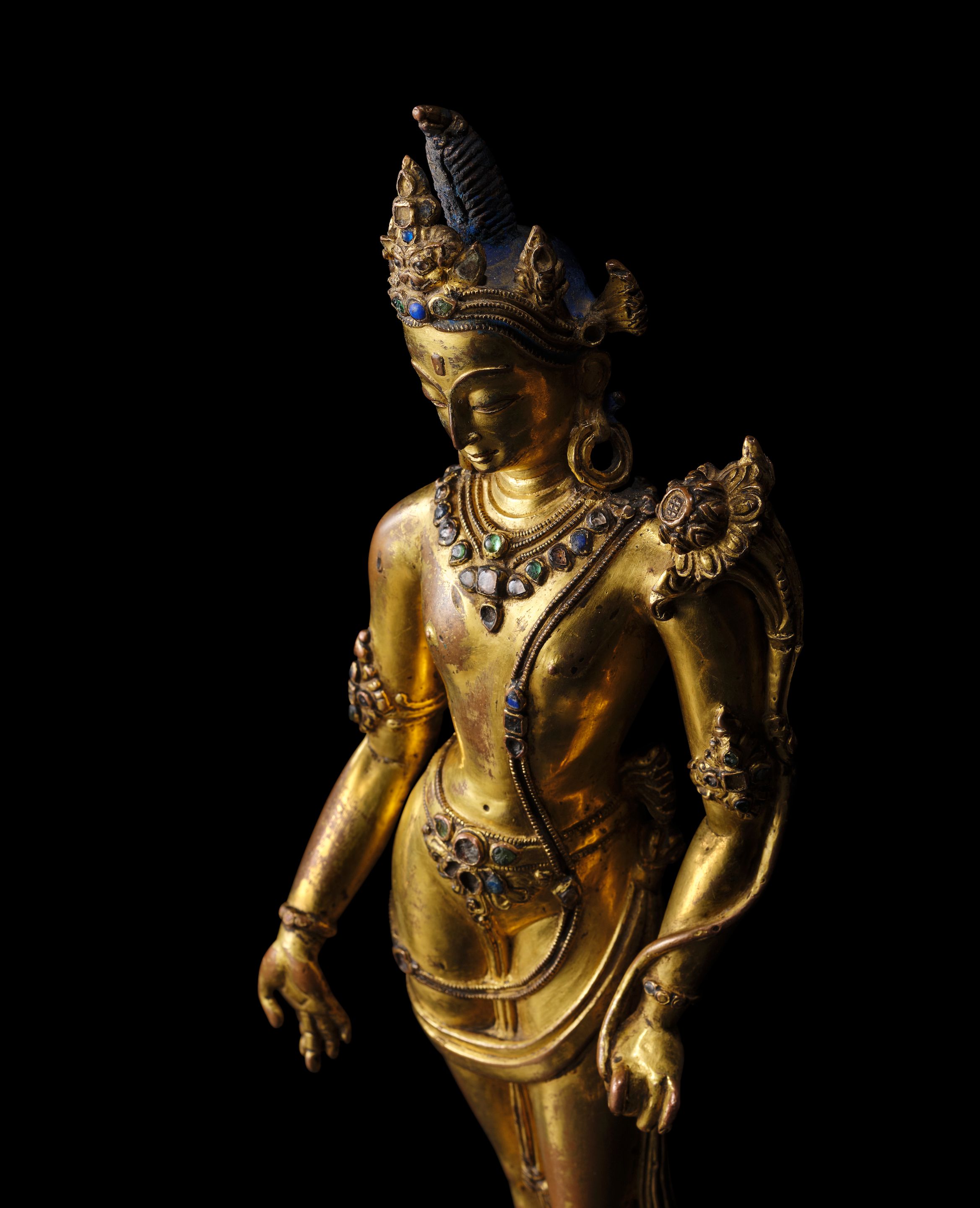 铜鎏金莲花手观音菩萨像
尼泊尔,马拉王朝早期,十四世纪
喜马拉雅艺术资源网编号:1411
高12 3/4英寸(32.5厘米)
观世音菩萨——“观照世间者”——以立姿莲花手(Padmapani Lokeshvara,字面意为“持莲者”)之化身呈现,左肩上方绽放一朵莲花。作为大乘佛教中纯净圆满的大悲菩萨,观音甘愿推迟自身的无上觉悟,以先救度一切众生脱离苦难。他以右手垂下结施愿印(varada mudra)来传达这一无私誓愿,赋予信众往生佛国净土的能力,并助其从轮回中解脱。
这尊铸造精美的造像具足永恒青春王子般的俊美容貌,代表了十三至十四世纪活跃的尼瓦尔(Newari)工匠在鎏金铜像制作上登峰造极的技艺水准。其宽阔的肩膀与精瘦的上身展现出健美的体魄。一条圣线(sacred thread)从左肩轻轻垂挂至右髋,将观者目光引向观音收窄的腰身及重心偏向一侧的有力双腿,这些部位的处理极为精妙。柔和温婉的微笑与内省垂视的目光,传达出其宁静祥和的亲近之感。
数百年来的供奉持握,为这尊造像的包浆赋予了温暖灿烂的光泽。鎏金表面的几处磨损露出下方迷人的红褐色铜体。凸起边缘上清晰细节的完好保存,证明了这尊铜像在其历史中一直受到精心敬奉。相对轻微的磨痕亦表明:尽管此像很可能最初在尼泊尔供奉(当地有抚触造像的修行传统),但根据发髻中群青颜料的痕迹判断(在西藏,造像通常被着衣装饰并从远处礼敬),它很可能不久便被请至西藏。
就精致程度而言,此像在马拉王朝早期(十三至十四世纪)最著名的立姿观音像中名列前茅,其耳饰、缯带及感性造型的风格与鲁宾艺术博物馆(Rubin Museum of Art,C2005.16.8;HAR 65430)的一尊同尊菩萨像、桑多尔·P·富斯收藏(Sandor P. Fuss Collection,HAR 88413)的另一例,以及邦瀚斯(Bonhams)纽约2021年3月16日拍卖的一尊略小之像(拍品309号)如出一辙。此外,此类与莲花台座原铸一体的造像极为罕见,因为几乎所有其他同时代的实例均在脚跟处直接伸出插榫或带有简单的圆碟,以插入分体的台座。在尺寸与品质上最为接近的可比实例包括吉美博物馆(Musée Guimet,MA 5031)的一尊带连珠纹边圆碟的莲花手观音像,以及范·阿尔芬等人所著《Cast for Eternity》(2005年,第186-187页,第60号)中出版的一尊立姿文殊菩萨像(其单层莲花台座与本尊造型相近)。
尼瓦尔人是来自尼泊尔加德满都谷地的一个族群,他们是技艺精湛的工匠。其无与伦比的铜像铸造技艺在西藏、蒙古和中国备受追捧。尼瓦尔人铸造佛教造像的优雅与细腻,莫过于他们对年轻矫健的立姿菩萨像的经典呈现——这尊典雅的鎏金铜观音像即为明证。
来源
女士旧藏,1961年入藏
苏富比,伦敦,1986年3月10日及11日,拍品98号
1980年代末购自苏黎世贝尔蒂·阿施曼(Berti Aschmann)收藏
佳士得,纽约,2012年9月12日,拍品537号
A gilt bronze figure of Padmapani
Nepal, 14th century
Standing on a low lotus base with beaded rims, his right hand extended in varadamudra and his left delicately grasping the stem of a lotus blossoming at the shoulder, wearing a sheer dhoti with voluminous folds falling between the legs, secured at the waist with a sash draped across the thighs and hanging at his side, adorned in ornate jewelry with a beaded sacred thread, the face with full lips, aquiline nose, and elongated eyes centered by a raised urna and surmounted by a foliate tiara with flared ribbons, the hair in a tall chignon and topped with a knop
站立于低矮的莲座之上,莲座边缘饰有连珠纹。右手伸出结施与印(varadamudra),左手轻柔地持一莲花茎,莲花绽放于肩侧。身着轻薄透明的裙袍(dhoti),丰厚的衣褶垂落于两腿之间,腰系圣带(sash),横过大腿并垂于身侧。佩戴华丽的珠宝,并以串珠圣线(sacred thread)为饰。面容双唇饱满,鼻梁高挺呈鹰钩状,细长双目之间嵌有凸起的白毫(urna),头顶花叶宝冠(tiara),冠侧缯带飘展。头发结成高髻,顶饰宝珠。
来源:
Acquired from the Collection of Berti Aschmann, Zurich, in the late 1980s
Avalokiteshvara, the “Lord who looks upon the World,” is the bodhisattva of compassion, and one of the principle deities in Mahayana Buddhism. Although he has attained enlightenment like the Buddha, the bodhisattva forgoes his escape from the suffering of rebirth to act as a guide to all living beings until they themselves have achieved nirvana. Worshipped in many guises, here he is depicted as Padmapani, the “holder of the lotus.” Like the lotus, which rises from its murky bed below the water to blossom in the pristine air, Padmapani has detached himself from the grounding pain and impurities of the material world and is enlightened in body, speech, and mind.
Worshipped in Nepal from at least the mid-6th century, Avalokiteshvara was one of the most popular Buddhist deities in the Kathmandu Valley, his worship rivaling that of the Buddha himself. Demand for images of this auspicious bodhisattva was therefore staggering and from an early period, craftsmen throughout the valley were executing works in wood, stone, paint, and bronze. A distinct Newari style of representation emerged from this locus of fervent worship, influenced initially by the Gupta dynasty and later, as seen in this work, the Pala dynasty of Northeastern India. The deity is nearly always depicted standing, in contrast to the Indian tradition of showing him seated. The style is further characterized by the lithe form of the body and the swaying hips, with the head titled to the side, resulting in a graceful curvilinear form. The dhoti billows in voluminous folds between the legs and is secured at the waist with a pendant sash, while the sacred thread is elegantly beaded. For a similar bronze representation of Padmapani in the Museum of Fine Arts, Boston, see P. Pal, The Arts of Nepal, vol. I, 1974, fig. 195.
观音菩萨(Avalokiteshvara),即“观照世间之主”,是大乘佛教中的慈悲菩萨,亦是其主要尊神之一。尽管如同佛陀一般已证悟正觉,此菩萨却甘愿暂离脱离轮回之苦,而作为一切众生的向导,直至他们自身证得涅槃。观音以多种化相受世人礼拜,于此被描绘为“莲华手”(Padmapani,即持莲花者)。正如莲花自水下浊泥中升起,于清净空气中绽放,莲华手已然超脱物质世界根本的痛苦与染污,于身、语、意皆得觉悟。
尼泊尔对观音的崇拜至少始于公元6世纪中叶,在加德满都谷地,观音是最受欢迎的佛教神祇之一,其信仰之盛堪与佛陀本人匹敌。因此,对这尊吉祥菩萨造像的需求极为惊人,且自早期起,谷地各地的工匠便以木、石、彩绘及青铜等材质制作作品。在这一炽烈信仰的中心,形成了一种独特的尼瓦尔(Newari)造像风格,初期受笈多王朝(Gupta dynasty)影响,后期——正如本件作品所示——受印度东北部波罗王朝(Pala dynasty)的影响。与印度传统中呈现为坐姿不同,尼泊尔的这尊神祇几乎总被描绘为站立姿态。该风格的进一步特征在于身体的纤巧柔韧与髋部的摆姿,头部微倾,形成优美的曲线形态。裙袍(dhoti)在两腿之间呈饱满的衣褶翻卷飘扬,腰系垂坠飘带,圣线(sacred thread)则以优雅的串珠形式表现。关于一尊类似风格的莲华手青铜像,现藏于波士顿美术博物馆(Museum of Fine Arts, Boston),参见P. Pal所著《The Arts of Nepal》第一卷(1974年),图195

