
侧边栏

14世纪尼泊尔迦舍末罗风格铜鎏金四臂观音立像(香港佳士得)(纽约邦瀚斯)
尺寸:高23.8 cm
年代:13-14世纪
质地:铜鎏金
风格:尼泊尔 迦舍末罗
来源:拍卖会
成交:3,175,000港元(2025.11); 377,000美元(2015.03)
参阅:香港佳士得 纽约邦瀚斯
鉴赏:
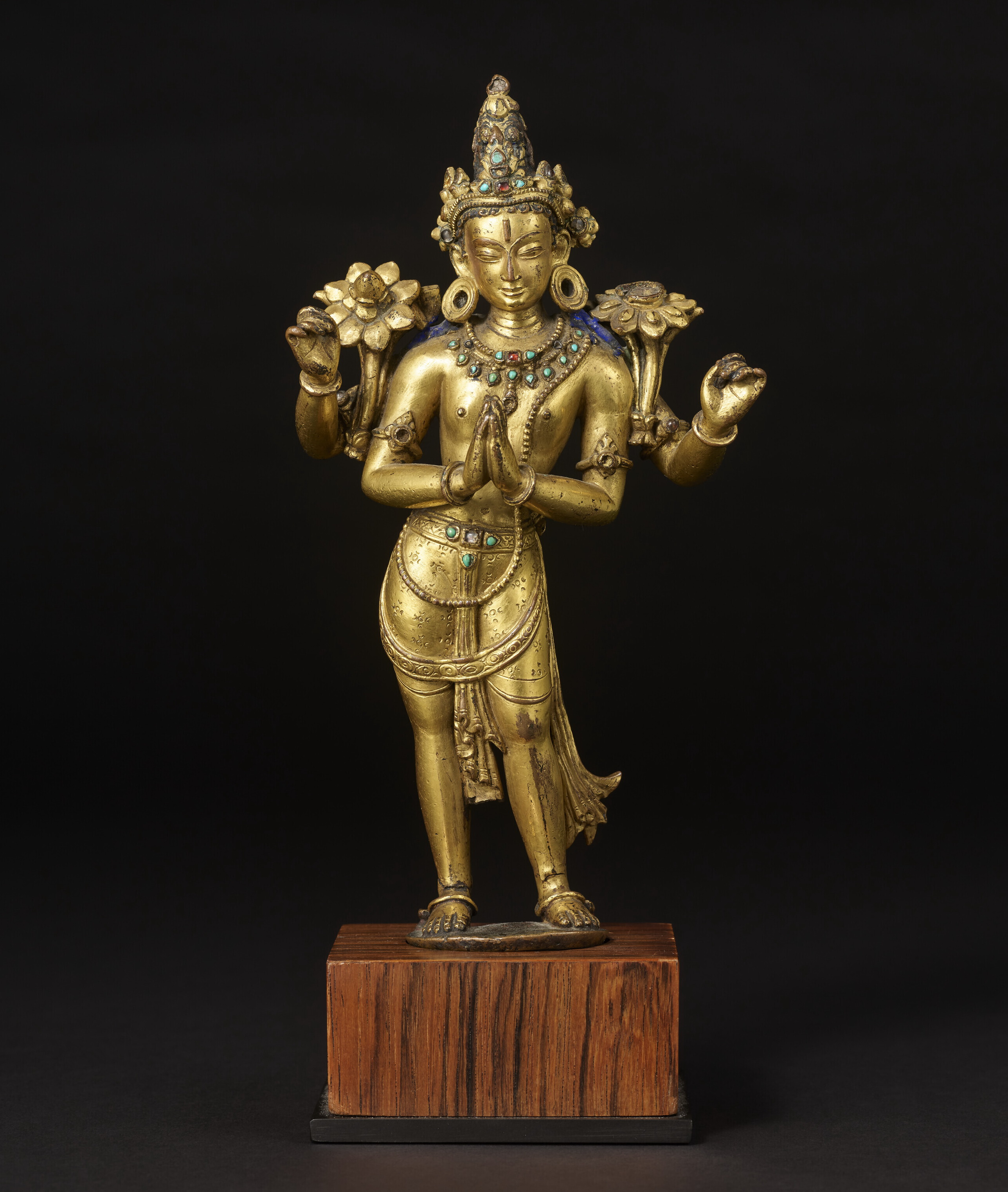
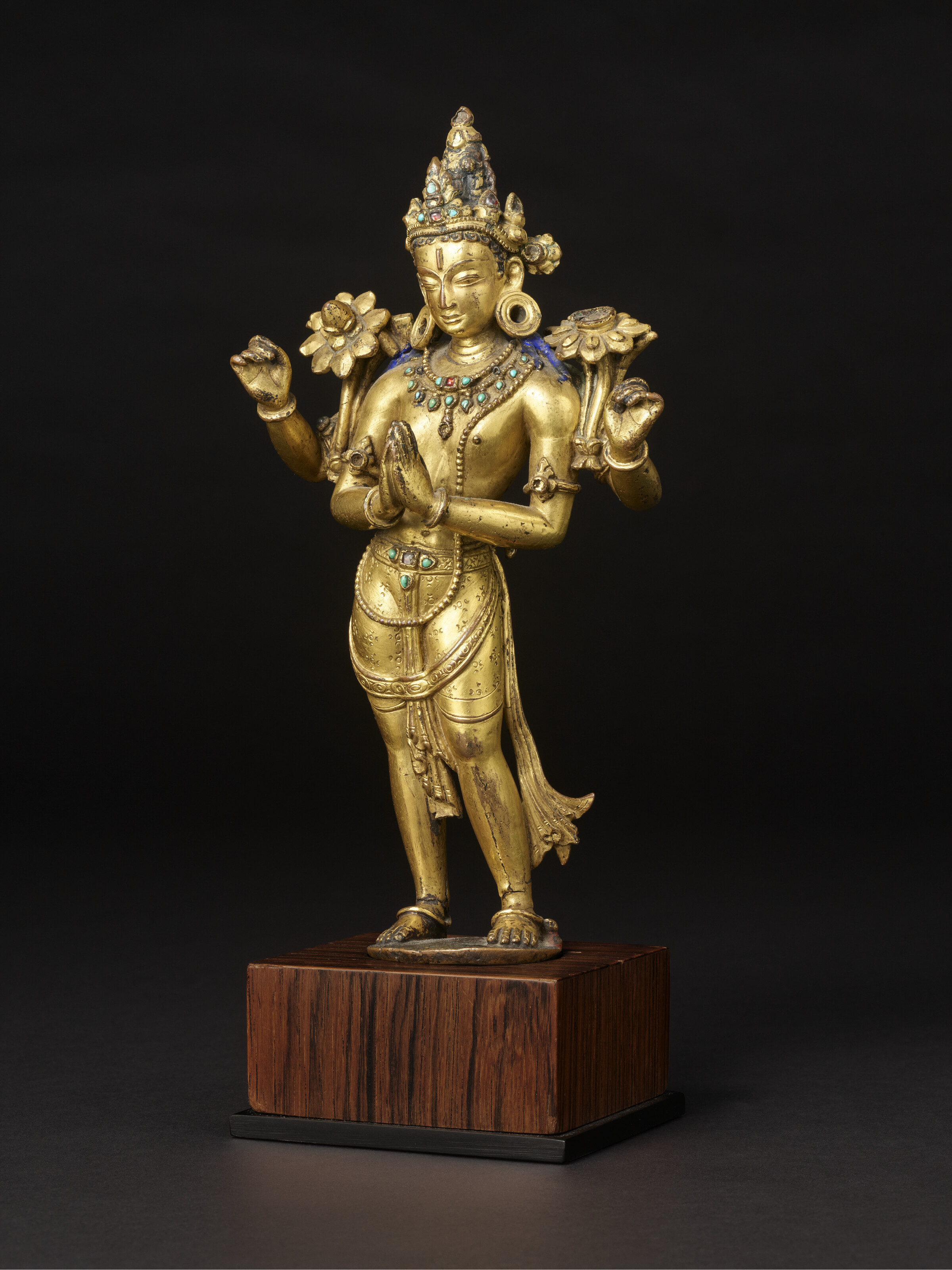
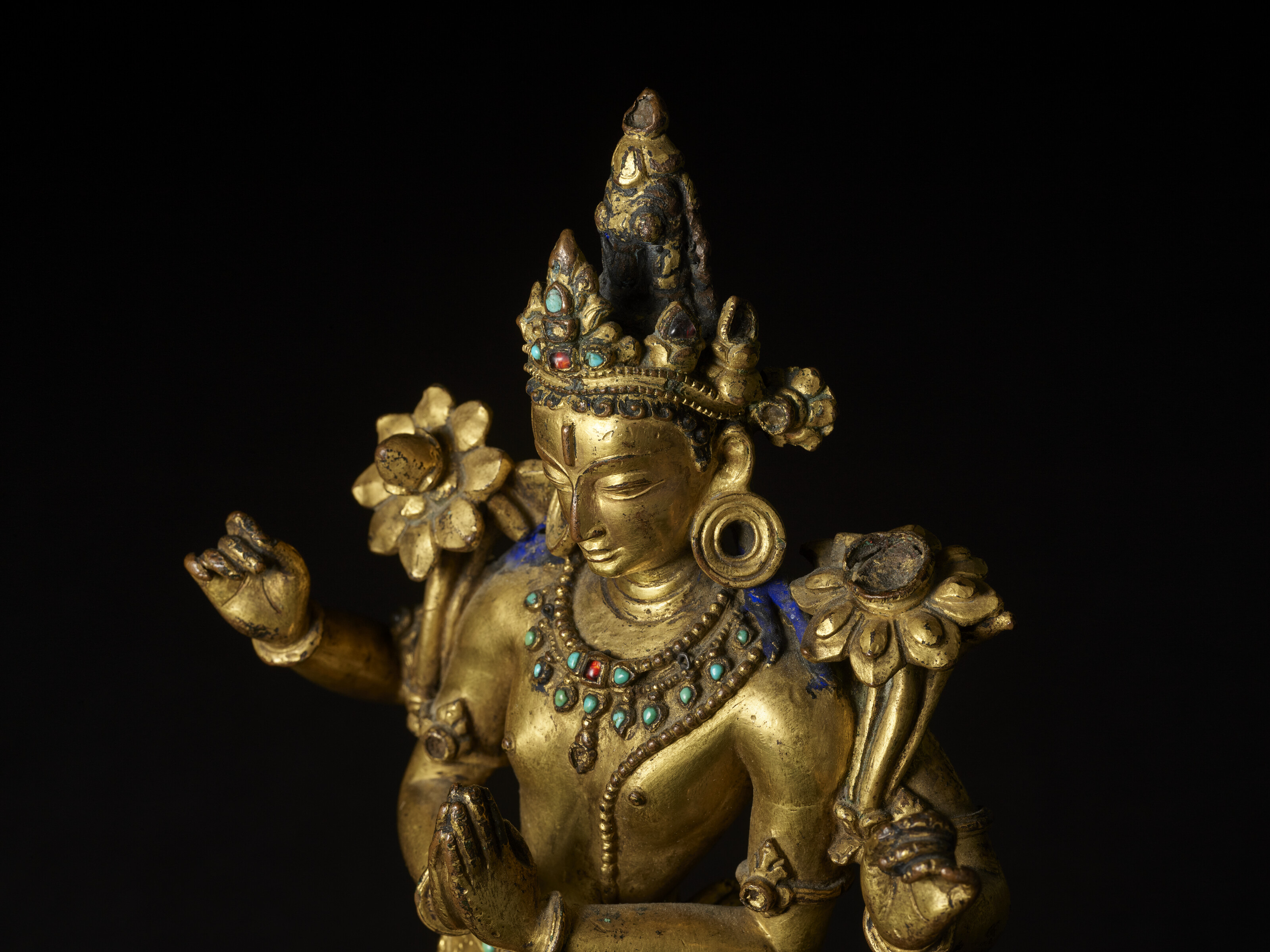
A GILT COPPER ALLOY FIGURE AVALOKITESHVARA
NEPAL, KHASA MALLA KINGDOM, 13TH/14TH CENTURY
来源:
William H. Wolff, New York before 1965
Robert and Bernice Dickes Collection New York
Carlton Rochell Ltd, 2010
Private Californian Collection
Bonhams, New York, 16 March 2015, lot 5
Private Collection New York
著录:
Stella Kramrisch, The Art of Nepal, Asia House Gallery, New York, 1965, no. 51.
Carlton Rochell Ltd., Indian and Southeast Asian Art: Selections from Robert and Bernice Dickes Collection, New York, 2010
This rare and striking image of Avalokiteshvara represents a unique standing form of Shadakshari Lokeshvara, a variant of the Bodhisattva of Compassion typically portrayed in seated posture. First published by Stella Kramrisch in her seminal 1964 exhibition catalogue The Art of Nepal, the sculpture was originally dated to the 16th century. However, subsequent decades of scholarship in Himalayan art have established a more accurate attribution to the early 14th century, during the flourishing of the Khasa Malla kingdom in West Nepal and West Tibet.
Cast in copper alloy using the lost-wax technique and richly gilded, this figure exudes a refined elegance characteristic of high Himalayan craftsmanship. Its delicate proportions, supple form, and poised serenity reflect the influence of Newar sculptural idioms from the Kathmandu Valley. The four-armed deity clasps the principal hands in the gesture of devotion (anjali mudra), while the now-lost upper hands likely held lotus stems.
What sets this figure apart is not only its upright posture but its nuanced interpretation of the Shadakshari iconography, adapted here perhaps in response to specific patronage or regional devotional practice. However, while the standing posture of this Shadakshari is rare, it is part of a broader, often locally determined, iconographic fluidity within Himalayan Buddhist art.
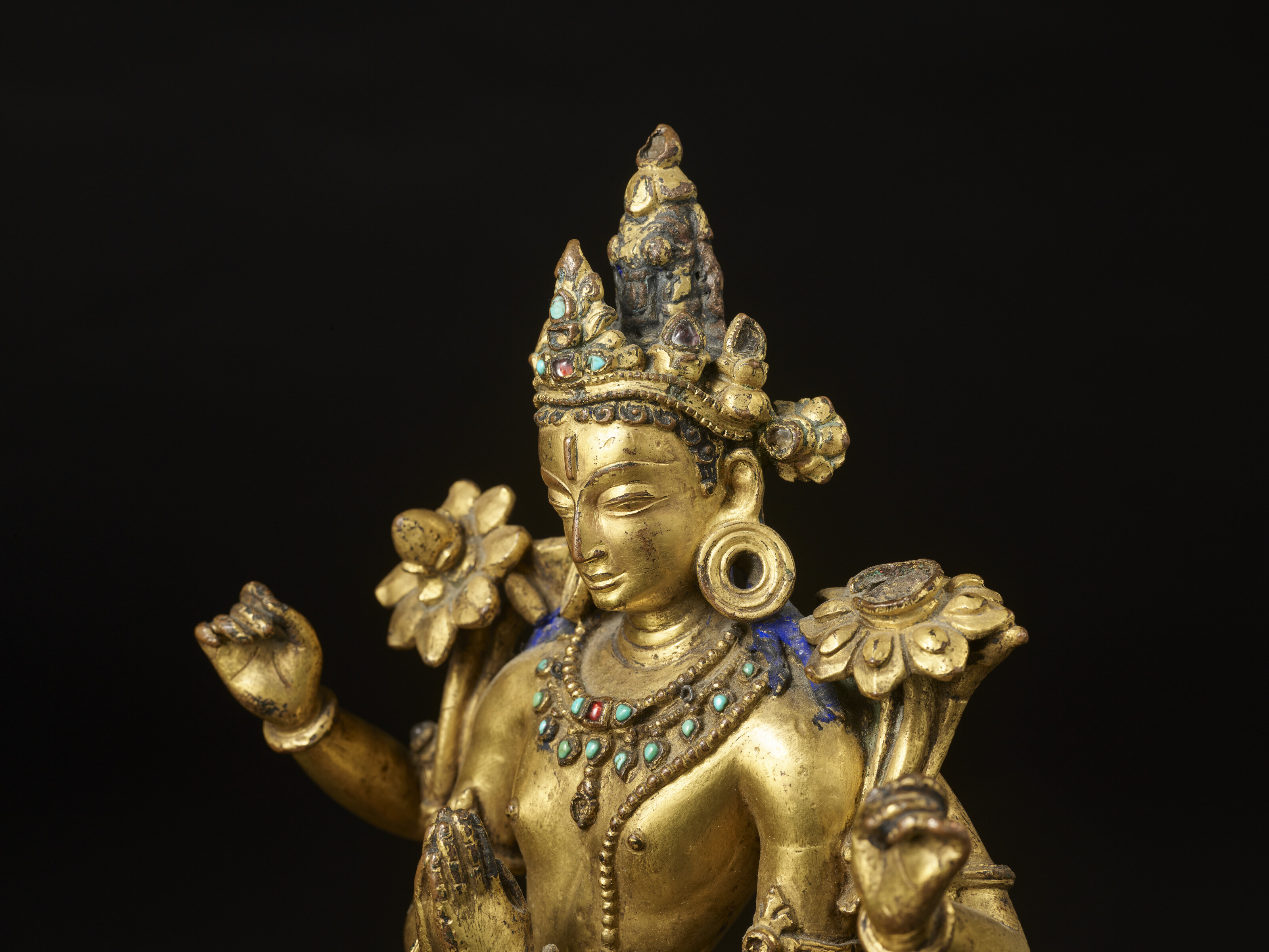
While the sculpture’s stylistic features, such as the sensuous modelling, tiered crowns, lotus jewellery, and gem-set inlays, reflect close ties to Kathmandu Valley production, several critical details mark it as a product of the Khasa Malla kingdom. Most distinctive is the fine articulation of the finger joints on the reverse of the hands, a feature that, as Ian Alsop has shown ('Metal Sculpture of the Khasa Mallas' in Casey and Denwood, eds. Tibetan Art: Towards a Definition of Style, London, 1997, pp. 68-79), appears uniquely in Khasa Malla bronzes. The restrained coiffure, lotus-bud crown elements (possibly referencing Pala motifs), and slightly schematic treatment of the back, relatively unfinished yet structurally sound, support this attribution.
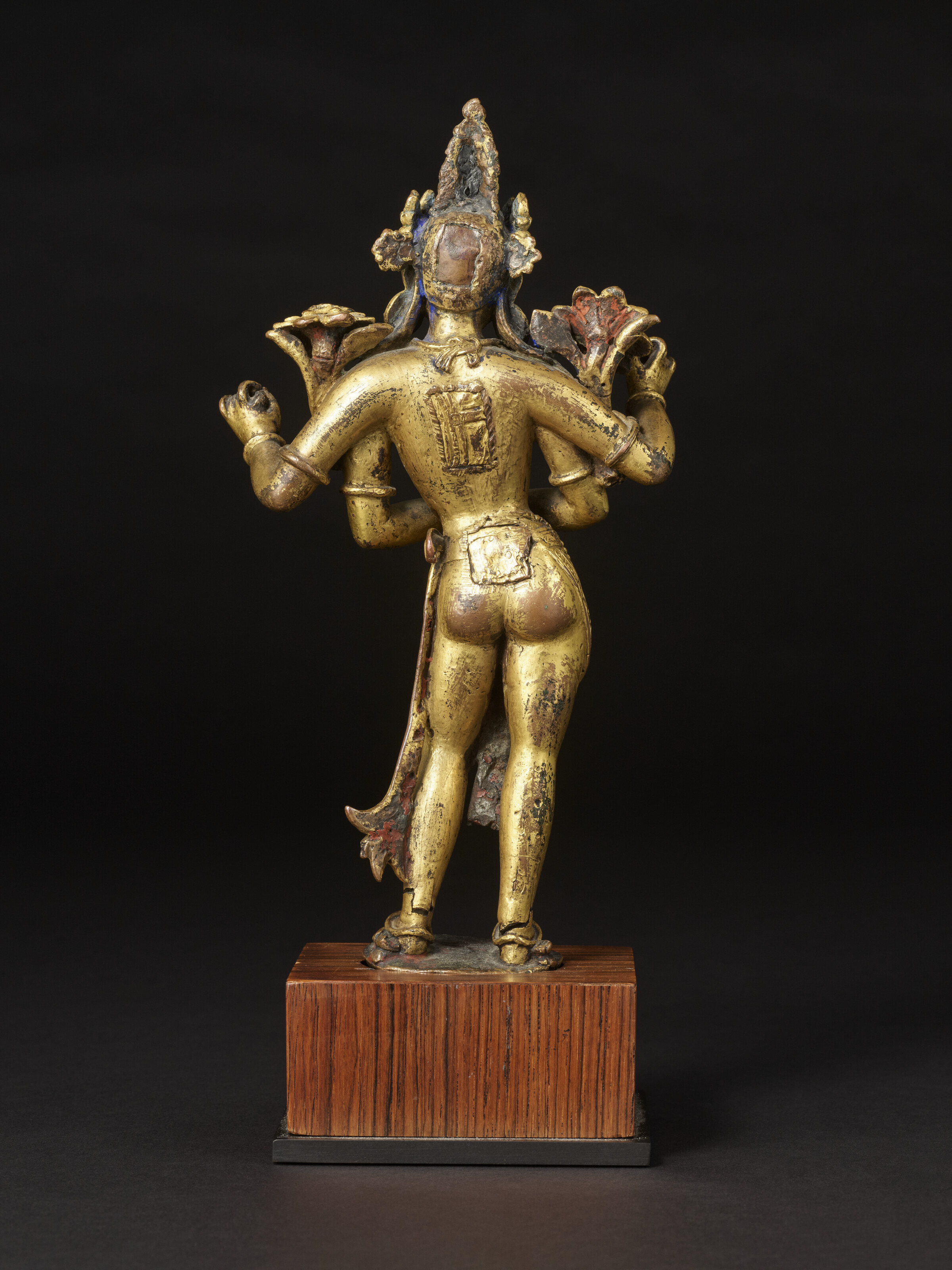
Additional regional markers include the insertion plates on the back of the hollow-cast sculpture, used for consecratory materials, a Tibetan ritual practice not found in Valley sculpture but typical of Khasa Malla bronzes intended for West Tibetan contexts. Traces of blue pigment in the hair and the use of turquoise in the jewellery further point toward this western Himalayan provenance. Similar pigment and material use is documented in other Khasa Malla works, such as the Avalokiteshvara in the Claire Ritter Collection and a related sculpture in the Ford Collection (ibid, Alsop, “Metal Sculpture of the Khasa Mallas of West Nepal/West Tibet” asianart.com, figs. 7, 8.)
Stylistic parallels may be drawn to a Vasudhara in the Rietberg Museum (Uhlig, On the Path to Enlightenment, no. 97, p. 152) and the Goddess in the National Museum of Asian Art, Washington D.C. (F1986.23) particularly in the facial type and the distinct lotus-bud crown finials.
The present sculpture is one of only a handful of known representations of Shadakshari Lokeshvara from the Khasa Malla kingdom. It stands as a rare and refined testament to the confluence of Newar aesthetic mastery and western Himalayan devotional vision during a period of vibrant artistic production.
这尊稀有而引人注目的观音像代表了六字大明观音的一种独特立姿形式,是通常呈坐姿的观音菩萨的一个变体。此像最早发表于Stella Kramrisch 1964年具有开创性的展览图录《The Art of Nepal》中,最初断代为16世纪。然而,随后数十年的喜马拉雅艺术研究将其更准确地定为14世纪早期,即尼泊尔西部与西藏西部的卡萨马拉王国鼎盛时期。
此像采用失蜡法铸造,铜合金胎,通体鎏金,散发出喜马拉雅地区顶级工艺的精妙优雅。其精致的比例、柔和的体态以及沉静的安详气质,反映了加德满都谷地纽瓦尔雕塑语汇的影响。四臂中的主臂双手合掌作礼敬印,现已遗失的上方双手原应持莲花茎。
此像的独特之处不仅在于其立姿,更在于其对六字大明观音图像学的一种精妙而细腻的诠释——这种改编或许是针对特定的赞助需求或地区修法实践。然而,尽管此尊六字大明观音的立姿罕见,但这种图像学的灵活性在喜马拉雅佛教艺术中较为普遍,往往由地域决定。
虽然此像的风格特征——如性感的造型、层叠的宝冠、莲华珠宝及嵌宝石工艺——反映了与加德满都谷地制作的紧密联系,但若干关键细节表明其为卡萨马拉王国的作品。最显著的特征是手背部指关节的精细刻画,正如Ian Alsop所指出的,这一特征仅出现在卡萨马拉王国的铜像上(见Casey与Denwood编,《Tibetan Art: Towards a Definition of Style》,伦敦,1997年,第68-79页)。克制的发式、莲蕾状宝冠构件(可能参考了帕拉母题),以及背部略显程式化但结构稳固的处理方式,均支持这一归属。
其他地域性标志包括空心铸造像背部的封藏插板,用于装藏圣物——这是加德满都谷地造像中未见、而西藏西部语境下卡萨马拉铜像典型的藏传佛教仪轨。发间残留的蓝色颜料以及珠宝中使用的绿松石,进一步指向其西喜马拉雅地区的来源。其他卡萨马拉作品中也记载了类似的颜料与材料使用,如Claire Ritter收藏的一尊观音像以及Ford收藏的一尊相关造像(同上,Alsop,《尼泊尔西部/西藏西部的卡萨马拉王国金属造像》,asianart.com,图7、8)。 Nancy Tingley, Celestial Realms: The Art of Nepal, Sacramento, 2012, no. 16.
这尊优雅的造像首次发表于1964年斯特拉·克拉姆里施(Stella Kramrisch)的开创性展览图录《尼泊尔艺术》(The Art of Nepal)。¹ 尽管克拉姆里施将这尊铜像定为十六世纪,但经过其后五十年的喜马拉雅艺术学术研究,将其定为约十三/十四世纪更为合理。此像展现了尼泊尔造像的诸多典型特征:采用铜合金铸造并施以厚重的鎏金,精工制作的璎珞镶嵌宝石,身姿纤细、比例小巧,呈现出尼泊尔造像所著称的优雅而感性的仪态。这尊四臂菩萨中间双手合十结礼拜印(anjali mudra),上方双手可能原持两枝莲茎。莲花枝梗很可能是分体制作的,正如里特贝尔格博物馆(Rietberg Museum)一尊约十四世纪文殊菩萨像所见。²
其图像学特征最接近六字大明咒观音(Shadakshari Lokeshvara)——一种在尼泊尔、尤其是西藏广为流行的观音化身,尽管其典型呈现方式是结跏趺坐于莲花座上。³ 艺术家在此可能是将传统的六字大明咒观音图像学特征,调整为供奉者所需的立姿表现。1924年,贝诺伊托什·巴塔查里亚(Benoytosh Bhatttacharyya)曾指出加德满都的Machhandar Vahal中呈现了108种观音化身,其中许多在经典文献中并无相应描述。⁴ S·K·萨拉斯瓦蒂(S. K. Saraswati)同样指出,在两件十一世纪尼泊尔彩绘写本中出现的某些观音化身,并不见于重要的佛教图像学汇编《成就法鬘》(Sadhanamala)。⁵ 西雅图艺术博物馆(Seattle Art Museum)所藏一尊约十一世纪的观音菩萨像,同样偏离了该尊神的常规图像学规范。⁶ 因此,尽管罕见,六字大明咒观音的立姿表现并非没有先例。
此件作品中的重要风格元素可见于约十三至十四世纪的尼泊尔造像,例如里特贝尔格博物馆所藏的一尊财源天母(Vasudhara)像,其发卷、宝冠及腰带的设计与本品如出一辙。⁷ 与之密切相关的莲花手(Padmapani)和金刚手(Vajrapani)像,亦可与本尊进行比照,尤其是其腰带、宝冠、项链及莲花的样式。⁸ 在Bonhams的这尊观音像上,尼泊尔工艺可见于诸多细节,例如两条项链之间现已空置的凹槽两端各有一个小金属环。这些金属环曾用于固定一串小珠(很可能是珍珠),同样的珠串也可能曾装饰宝冠上现已空置的凹槽。金箔(用于增强光泽)至今仍可见于宝冠右侧一处空置的宝石嵌槽中。
⁹ 尽管与十三至十四世纪加德满都谷地的造像存在诸多相似之处,但此像的一些重要特征指向了更为特定的来源地。根据卡萨马拉王国(Khasa Malla kingdom)金属造像研究的开创者伊恩·阿尔索普(Ian Alsop)的说法,手背上的指关节清晰分明——这种处理方式只见于卡萨马拉王国的金属造像。⁹ 卡萨马拉(Khasa Mallas)——阿尔索普称之为“最不为人知却又最引人入胜的喜马拉雅王族之一”——在十二世纪至十四世纪中叶期间繁盛于尼泊尔西部和西藏西部。在这一时期,他们所控制的王国面积往往超过了加德满都谷地的马拉(Malla)统治者。他们定期劫掠加德满都谷地,并在1255年至1278年间为控制菩提伽耶(Bodh Gaya,印度东部伟大的佛教朝圣中心)地区的领土而征战。¹⁰ 作为虔诚的佛教徒和伟大的艺术赞助者,卡萨马拉人委托制作了极为精美的造像,这些造像与加德满都谷地的作品密切相关,但又有可资区别之处。在Bonhams的这尊观音像上,区别于加德满都谷地造像的异特征(除手背上清晰分明的关节外)包括:莲蕾状宝冠饰(可能源自东印度中世纪造像)、相对未经打磨的背部、相对狭窄的发髻,以及精致清晰的面部特征。Bonhams观音像的某些方面也见于已发表的卡萨马拉造像实例中,例如华盛顿弗利尔美术馆(Freer Gallery of Art)所藏一尊卡萨马拉女神像的耳饰、面部特征及莲蕾状宝冠饰与本尊相似。¹¹
造像的背部同样反映了其历史的关键层面。其背部铸造精美但相对未经打磨,上有三块金属片覆盖着开口——这些开口原本用于向这件空心铸造的失蜡法造像内部填充装藏材料。这一做法在加德满都谷地并不知晓,但在西藏普遍流行,也见于被带入其王国西藏西部地区的卡萨马拉作品。同样,发髻中的蓝色颜料是西藏文化的常见特征,但不见于加德满都谷地作品。这种蓝色颜料也出现在其他卡萨马拉铜像上,包括纽约克莱尔·里特收藏(Claire Ritter Collection)的一尊观音像,以及巴尔的摩约翰·吉尔摩·福特夫妇收藏(Mr. and Mrs. John Gilmore Ford Collection)的一尊六字大明咒观音像。¹² 至少有其他三尊卡萨马拉造像表现的是六字大明咒观音。¹³ 绿松石(此像中主要使用的宝石)的使用在卡萨马拉造像中虽不常见,但并非没有先例。¹⁴
简·凯西(Jane Casey),2015年1月
1. Stella Kramrisch, The Art of Nepal, New York, 1964, fig. 51.
2. Published in Helmut Uhlig, On The Path to Enlightenment, Zurich, 1995, no. 64, pp. 112-13. It is possible that in the Bonhams Avalokiteshvara, both (now missing) lotus stems were held in the upper hands.
3. See B. Bhattacharyya, The Indian Buddhist Iconography (New Delhi, 2008), p. 178. He states in his seminal publication, first published in 1924, that images of Shadaksari Lokeshvara abound in Nepal, “both in groups and singly…and almost every monastery at Kathmandu and Patan has got one in it.” Op. cit., p. 35. If the artist of this sculpture indeed intended to represent Shadakshari Lokeshvara, the upper right hand would also have held a rosary (mala), fashioned in another material and now missing.
4. The Indian Buddhist Iconography (New Delhi, 2008), Appendix B.
5. S.K. Saraswati, Tantrayana Art: An Album (Calcutta, 1977), p. XXVI.
6. Pratapaditya Pal, Nepal Where the Gods are Young (New York, 1975), fig. 16, pp. 74-75.
7. Published in Uhlig, On the Path to Enlightenment, no. 97, p. 152.
8. Published in Amy Heller, Early Himalayan Art (Oxford, 2008), pl. 9, pp. 62-63; and fig. 22, p. 36.
9. Personal communication, Ian Alsop. See also Ian Alsop, “The Metal Sculpture of the Khasa Mallas of West Nepal/West Tibet” asianart.com. Alsop discusses this feature on Khasa Malla sculpture in op. cit., figures 4, 5. See also Ian Alsop, “The Metal Sculpture of the Khasa Malla Kingdom”, Orientations Magazine (June 1994): 61-68; and “Metal Sculpture of the Khasa Mallas” in Jane Casey Singer and Philip Denwood, eds. Tibetan Art: Towards a Definition of Style (London, 1997), pp. 68-79.
10. Amy Heller, Hidden Treasures of the Himalayas (Chicago, 2009), p. 23.
11. Alsop, “The Metal Sculpture of the Khasa Mallas of West Nepal/West Tibet” asianart.com, fig. 1.
12. Ian Alsop, “Metal Sculpture of the Khasa Mallas of West Nepal/West Tibet” asianart.com, figs. 7, 8.
13. See figures 8, 9 in Alsop, “The Metal Sculpture of the Khasa Mallas of West Nepal/West Tibet” asianart.com, and in an unpublished example in the Crocker Museum.
14. Ian Alsop, personal communication.
Referenced:
HAR – himalayanart.org/image.cfm/41223.html
Published:
Stella Kramrisch, The Art of Nepal, Asia House Gallery, New York, 1965, no. 51.
Carlton Rochell, Ltd., Indian and Southeast Asian Art: Selections from Robert and Bernice Dickes Collection, New York, 2010
Nancy Tingley, Celestial Realms: The Art of Nepal, Sacramento, 2012, no. 16.
Provenance:
William H. Wolff, New York before 1965
Robert and Bernice Dickes Collection New York
Carlton Rochell, Ltd, 2010
Private Californian Collection

