
侧边栏

7-8世纪尼泊尔石雕莲花手观音立像(牛津大学阿什莫林博物馆)
尺寸:59 x 28.5 x 9cm
年代:7-8世纪 Licchavi时期
质地:石雕
风格:尼泊尔
来源:牛津大学阿什莫林博物馆
参阅:外部链接
鉴赏:
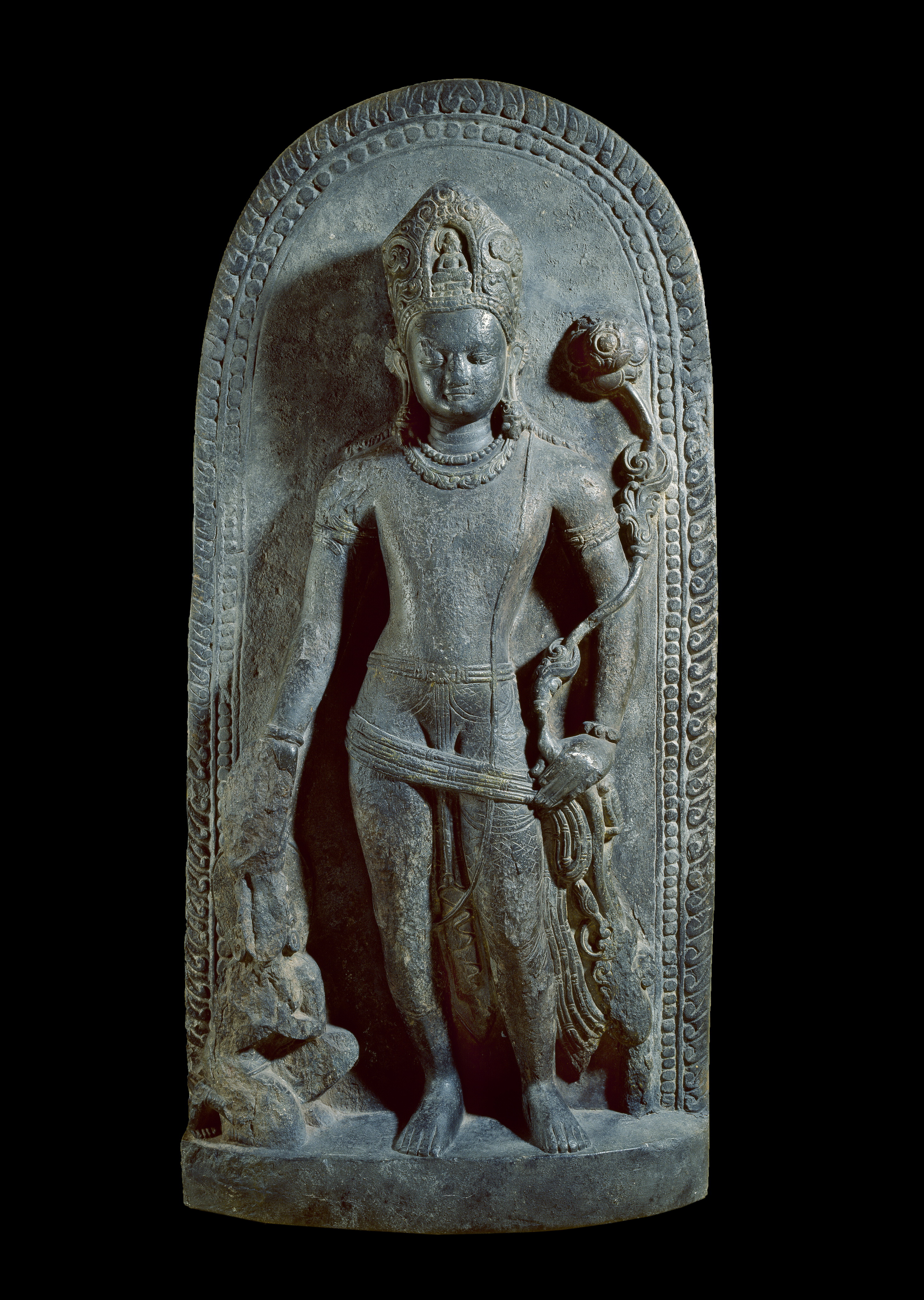
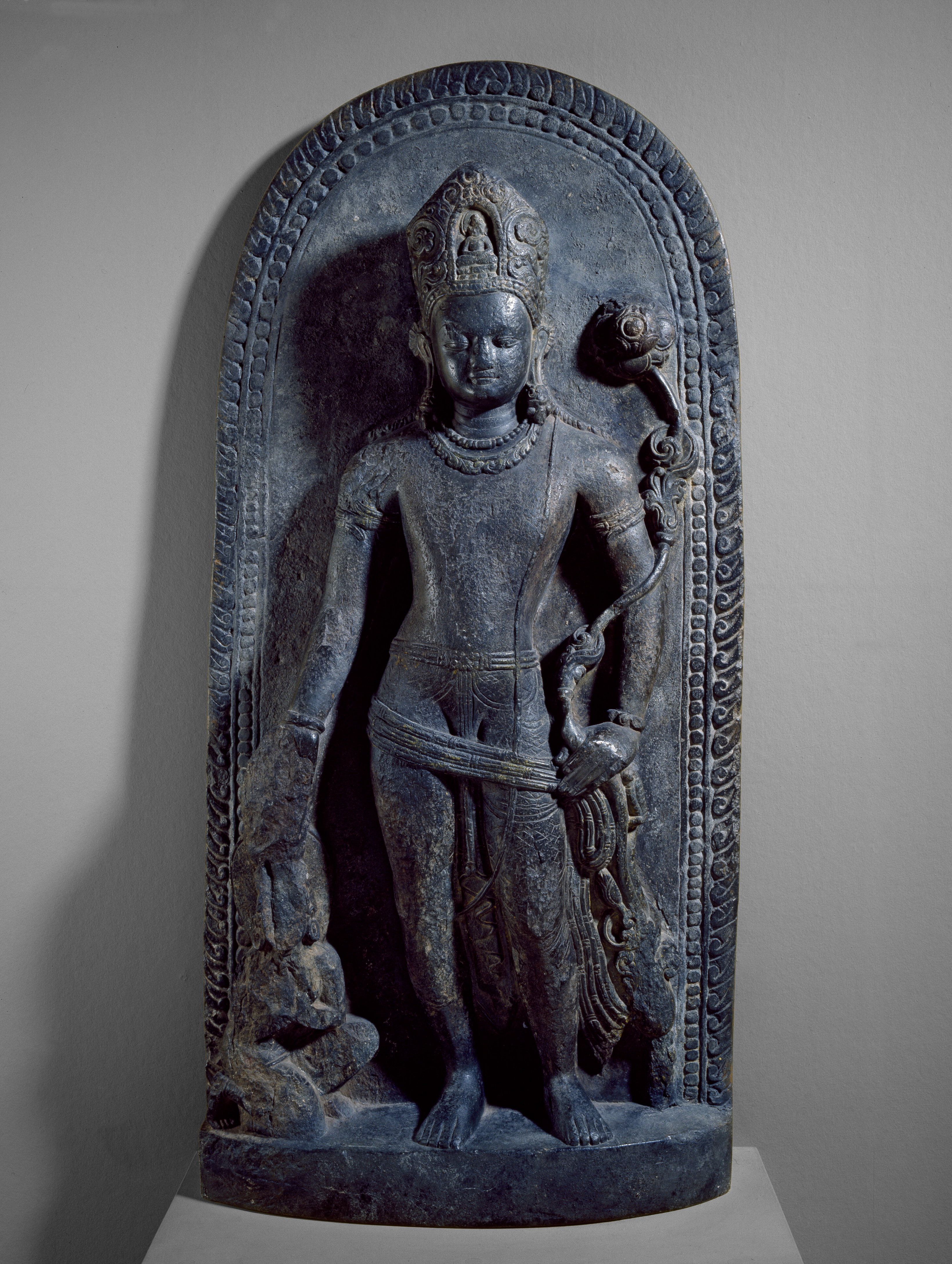 Stele with Avalokiteshvara holding a lotus
购买于1997年
This stone stele depicting a strong and elegant standing figure of Avalokitesvara, the Bodhisattva of Compassion, again reflects the persistence of the Gupta aesthetic in Licchavi Nepal. Here the Bodhisattva blesses a female devotee with his boon-bestowing gesture (varada mudra) as she kneels in prayer at his feet. Stylized flames and pearl medallions border the curved arch surround [1].
The Bodhisattva wears a distinctive crested crown with scrollwork above a single band of pearl beads. Except for the small Amitabha image in its central panel, this crown is similar to that worn by excavated royal figures in terracotta dated around the seventh century. His déhanchement and stalwart posture, massive shoulders, robust chest with only slightly attenuated waist, and serpentine arm-bands all reflect the aesthetic impact of the famous seventh-century Kathmandu caitya of hvaka-Bahal, in which Nepalese artists formulated their own type of Bodhisattva image by adopting the crown in place of the carved chignon, and by adding patterns to the plain fabric of Indian dhoti models (such as the striped and geometric motif seen in this image), as well as the serpent motif of the armlets and the treatment of the sash [2].
Ultimately derived from Sarnath models, Avalokitesvara’s sash is here draped at mid-hip, knotted in a loose swag, then delicately modelled into pleats which fall naturalistically into a point beside his ankles. In the Dhvaka-Bahal sashes, the pleats are stiffly splayed against the doorjamb, while the more naturalistic draping of the sash is found in the eighth-century stone sculpture of Maitreya (h. 45 cm) in Nag-Bahal, Patan [3].
A similar sash is also seen in the eighth- to early ninth-century stone sculptures of Avalokitesvara at Chabahil and Kathesimbhu, both of which have far more slender body proportions for the Bodhisattva [4]. Therefore a seventh- to eighth-century date can be suggested for this sculpture.
[Footnotes:]
1 The uppermost portion of this arched surround and also part of the plain base below the Bodhisattva’s feet are modern restorations.
2 The scale is also similar to the Bodhisattva statues of Dhvaka-Bahal, which measure 70 cm according to Gutschow, The Nepalese Caitya, pls. 352–53. For a detailed discussion of the Dhvaka-Bahal sculptures, see Pal, The Arts of Nepal, vol. 1, pp. 27–33.
3 See Slusser, Nepal Mandala, pl. 472, for the Maitreya of Nag-Bahal.
4 See Pal, op. cit., pls. 187–88, for the Avalokitesvaras of Chabahil and Kathesimbhu.
In: Heller, Amy, Early Himalayan Art (Oxford: Ashmolean Museum, 2008)
这是一尊雕刻于石板上的观音立像(Avalokitesvara,即观世音菩萨,慈悲之菩萨),形象雄健而优雅,再次体现了笈多美学风格在尼泊尔李查维王朝时期的延续。菩萨结施与愿印(varada mudra),为一跪于其足下祈祷的女性信众赐福。拱形背光边缘饰有图案化的火焰纹与珠圈纹 [1]。
菩萨头戴一顶别致的冠饰,冠上有卷草纹样,下方为单排连珠纹带。除了中央饰板内有一尊小的阿弥陀佛像外,此冠与出土的约七世纪皇家人物陶像所戴的冠饰相似。菩萨身体呈三折姿(déhanchement),身姿挺拔,肩部宽厚,胸部结实,腰部仅稍稍收紧,臂上的蛇形臂钏——所有这些特征都反映了著名的七世纪加德满都Dhvaka-Bahal佛塔(caitya)造像的美学影响。在那些造像中,尼泊尔艺术家们通过以冠饰取代雕刻的发髻,在印度式裙袍素净的衣料上添加纹饰(例如本像中见到的条纹和几何图案),以及采用蛇形臂钏和特定的帛带处理方式,形成了自己独特的菩萨造像类型 [2]。
观音的帛带样式最终源于萨尔纳特(Sarnath)的造像模式,在此像中,帛带搭于髋部中间,松松地打成一个花结,然后被细腻地刻画出褶皱,自然而然地垂落在脚踝旁,形成尖角。在Dhvaka-Bahal的造像中,帛带的褶皱是僵硬地展开在门柱上的;而更为自然的帛带垂褶方式,则见于帕坦(Patan)Nag-Bahal出土的八世纪弥勒菩萨石像(高45厘米)[3]。
在查巴希尔(Chabahil)和卡泰辛布(Kathesimbhu)的八至九世纪初观音石像上也能看到类似的帛带,不过这两处造像的菩萨身体比例要纤细得多 [4]。因此,这尊造像的年代可推测为七至八世纪。
(附注原文的脚注信息,供参考)
[1] 此拱形背光的最顶部以及菩萨足下素面台座的一部分,为现代修复。
[2] 其体量也与Dhvaka-Bahal的菩萨像相似,据Gutschow所著《The Nepalese Caitya》,图版352-353,那些造像高70厘米。关于Dhvaka-Bahal造像的详细讨论,见Pal所著《The Arts of Nepal》,第1卷,第27-33页。
[3] Nag-Bahal的弥勒菩萨像,见Slusser所著《Nepal Mandala》,图版472。
[4] Chabahil和Kathesimbhu的观音像,见Pal,前引书,图版187-188。
—— 引自:Heller, Amy 所著《Early Himalayan Art》(牛津:阿什莫林博物馆,2008年)
著录:
Heller, Amy, Early Himalayan Art (Oxford: Ashmolean Museum, 2008), page mentioned: pp. 20 & 56, page illustrated: p. 45, Cat. No.: no. 2 on p. 44

