
侧边栏

16世纪西藏局部鎏金银质四臂观音坐像(纽约佳士得)
尺寸:高34.6 cm
年代:16世纪
质地:局部鎏金 银质
风格:西藏
来源:拍卖会
成交:725,000美元(2015.09)
参阅:外部链接
鉴赏:
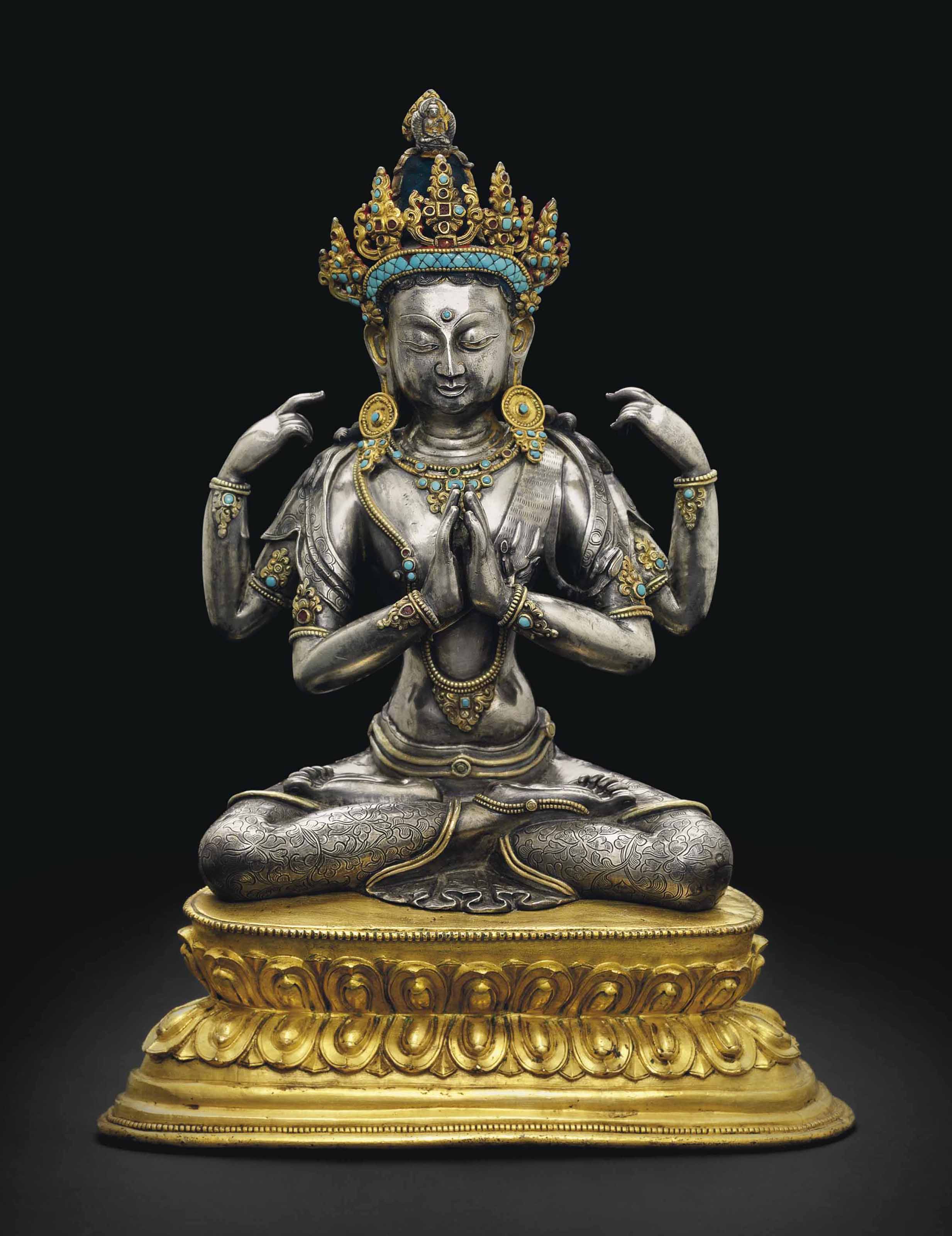 A PARCEL-GILT SILVER FIGURE OF SHADAKSHARI AVALOKITESHVARA
TIBET, 16TH CENTURY
The four-armed bodhisattva seated in dhyanasana on a double-lotus base, his primary hands folded in anjalimudra in front of his heart, clad in a dhoti incised with a foliate pattern and a shawl incised with a cloud pattern, an antelope skin hanging over his left shoulder, adorned with multiple beaded necklaces, bracelets, earrings and tiara inlaid with hardstones, the hair piled into a high chignon centered with Amitabha, the base sealed and incised with a double-vajra
四臂菩萨以金刚跏趺坐(dhyanasana)坐于双层莲座之上,其主手于胸前合掌结祈祷印(anjalimudra)。身着阴刻花叶纹的长裙(dhoti),披搭阴刻云纹的披肩,左肩垂挂羚羊皮。佩戴多层串珠项链、手镯、耳珰及嵌饰宝石的宝冠(tiara),头发高盘成髻,髻中央安奉阿弥陀佛(Amitabha)。底座已封藏,并阴刻金刚交杵纹(double-vajra)。
来源:
The Sporer Collection, New Jersey, acquired in London, 20 June 1972
著录:
E. Olson, “Tantric Buddhist Art,” Orientations, May 1974, p.50, fig.3
E. Olson, Tantric Buddhist Art, 1974, pp.25, 53, cat. no.12
Himalayan Art Resource (himalayanart.org), item no. 24028
展览:
Tantric Buddhist Art, China House Gallery, China Institute of America, New York, 14 March 1974 – 24 May 1974
Shadakshari Avalokiteshvara, the four-armed form of the bodhisattva of supreme compassion, is believed to be the embodiment of the Buddhist mantra om mani padme hum, (“hail to the jewel in the lotus”). These six syllables represent the six realms of existence: Om is white and stands for the god realm, ma is green and stands for the demigod or Asura realm, ni is yellow and stands for the human realm, pad is blue and stands for the animal realms, me is red and stands for hungry ghost realm, hum is black and stands for the hell realm. Shadakshari ushers all beings from the six realms into enlightenment.
Of particular note is the smooth contours of the body overall, including the broad shoulders and chest, which appears as if filled with prana, or sacred breath, as the deity sits in meditation. This is a superb example of the opulent silver metal tradition practiced in Central Tibet during the 16th century. Their inspiration came from northeastern India, where Newar craftsmen practiced and propagated the use of various metals and materials in Buddhist images drawn from Pala prototypes; for further discussion, see “Tibet: ‘Non-Gilt Schools’” in U. von Schroeder, Indo-Tibetan Bronzes, 1981, pp.461-467. For an example of Indian Pala confluence with Newar craftsmanship on early Chinese sculpture during Mongol rule, see a late 13th/early 14th century example in J. Huntington and D. Bangdel, Circle of Bliss, 2003, p.182, cat. no.45.
The present example relates closely to that of a 17th century White Tara from the John D. Rockefeller 3rd Collection (now at Asia Society, New York); see M. Rhie and R. Thurman, Wisdom and Compassion: The Sacred Art of Tibet, 1991, p.134, fig.26. Both faces are characterized by sharp noses with rounded and incised nostrils, and proud eyebrow ridges. The bodies are similarly modeled, with elongated limbs and simple, fleshy necks and waists. The hair on each figure is rendered with the thick strands and curls at the hairline clearly delineated, in addition to the thick locks flowing over the shoulders. The jewelry is similarly beaded and placed low on the upper arms, wrists and ankles, and the pendants on the long necklaces are nestled into the flesh around the belly button. The scarves and dhotis are both thickly cast and embossed. Aside from iconography, the other major difference is size: the silver figure of the present example is nearly 10 cm. larger than the Tara and also retains its gilt base, making for an extremely impressive figure and suggesting an important commission.
六字观音(Shadakshari Avalokiteshvara)是至尊慈悲菩萨之四臂化身,被认为是大乘佛教咒语“唵嘛呢叭咪吽”(om mani padme hum,意为“礼赞莲花中的珍宝”)的具象化身。这六个音节代表六道轮回:唵(om)为白色,代表天道;嘛(ma)为绿色,代表阿修罗道;呢(ni)为黄色,代表人道;叭(pad)为蓝色,代表旁生道;咪(me)为红色,代表饿鬼道;吽(hum)为黑色,代表地狱道。六字观音接引六道一切众生趣入觉悟。
尤为值得称道的是其整体躯体的流畅轮廓,包括宽阔的肩膀与胸膛,当此尊以禅定姿态安坐时,仿佛充盈着prana(生命气)或神圣的呼吸。此像是16世纪西藏中部地区盛行的华丽银质工艺传统的卓越典范。其灵感源自印度东北部,尼瓦尔工匠在那里实践并推广了以波罗时期造像为蓝本、使用多种金属和材料制作佛教造像的传统;相关讨论见U. von Schroeder所著《Indo-Tibetan Bronzes》(1981年,第461-467页)中的“西藏:‘非鎏金流派’”章节。关于蒙古统治时期印度波罗风格与尼瓦尔工艺在中国早期雕塑上的融合实例,可参见J. Huntington与D. Bangdel合著的《Circle of Bliss》(2003年,第182页,图录第45号)中一件13世纪末/14世纪初的实例。
本件作品与约翰·D·洛克菲勒三世旧藏(现藏于纽约亚洲协会)的一件17世纪白度母(White Tara)像密切相关(参见M. Rhie与R. Thurman合著的《Wisdom and Compassion: The Sacred Art of Tibet》,1991年,第134页,图26)。两尊造像的面部特征均为锐利的鼻子,带有圆形且阴刻的鼻孔,以及高挑的眉脊。身躯塑形方式相似,四肢修长,颈部和腰部简洁而丰润。每尊像的发丝均以厚实的发股表现,发际线处清晰刻画出卷曲的纹理,并有浓密的发缕垂落于双肩。珠宝同样以串珠形式呈现,佩戴于上臂、手腕及脚踝的较低位置,长项链上的坠饰则垂落在肚脐周围的肌肤之上。披肩与长裙均采用厚实铸造并加以浮雕装饰。除图像学差异外,另一主要区别在于尺寸:本件银质造像比那尊白度母高出近10厘米,且保留了鎏金的底座,使其成为一尊极为震撼的造像,暗示着其应是一份重要的委托制作。

