
侧边栏

14世纪西藏唐卡四臂观音坐像(纽约佳士得)
尺寸:46.7 x 40 cm
年代:14世纪
质地:唐卡
风格:西藏
来源:拍卖会
成交:44,100美元(2023.09)
参阅:外部链接
鉴赏:
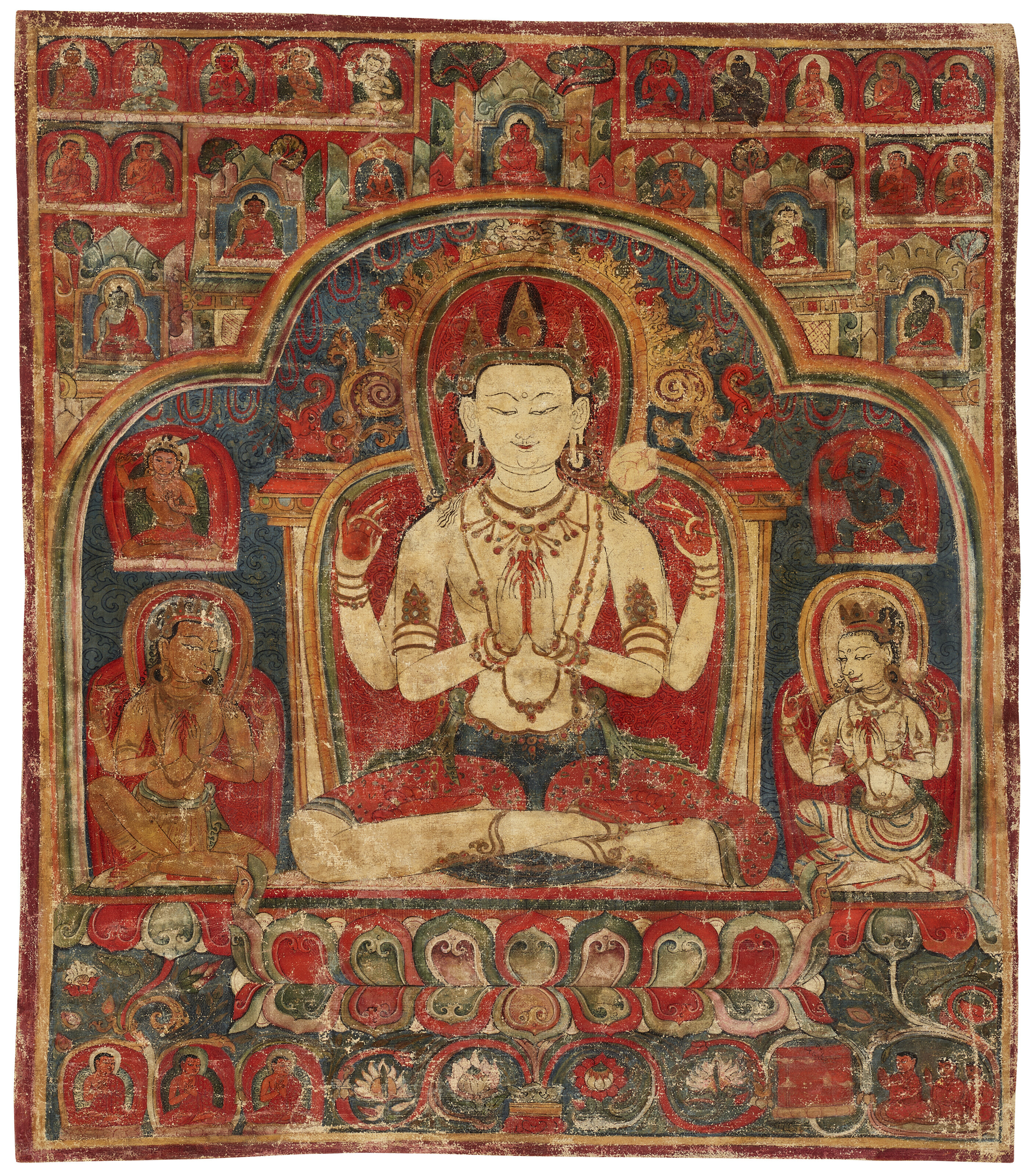
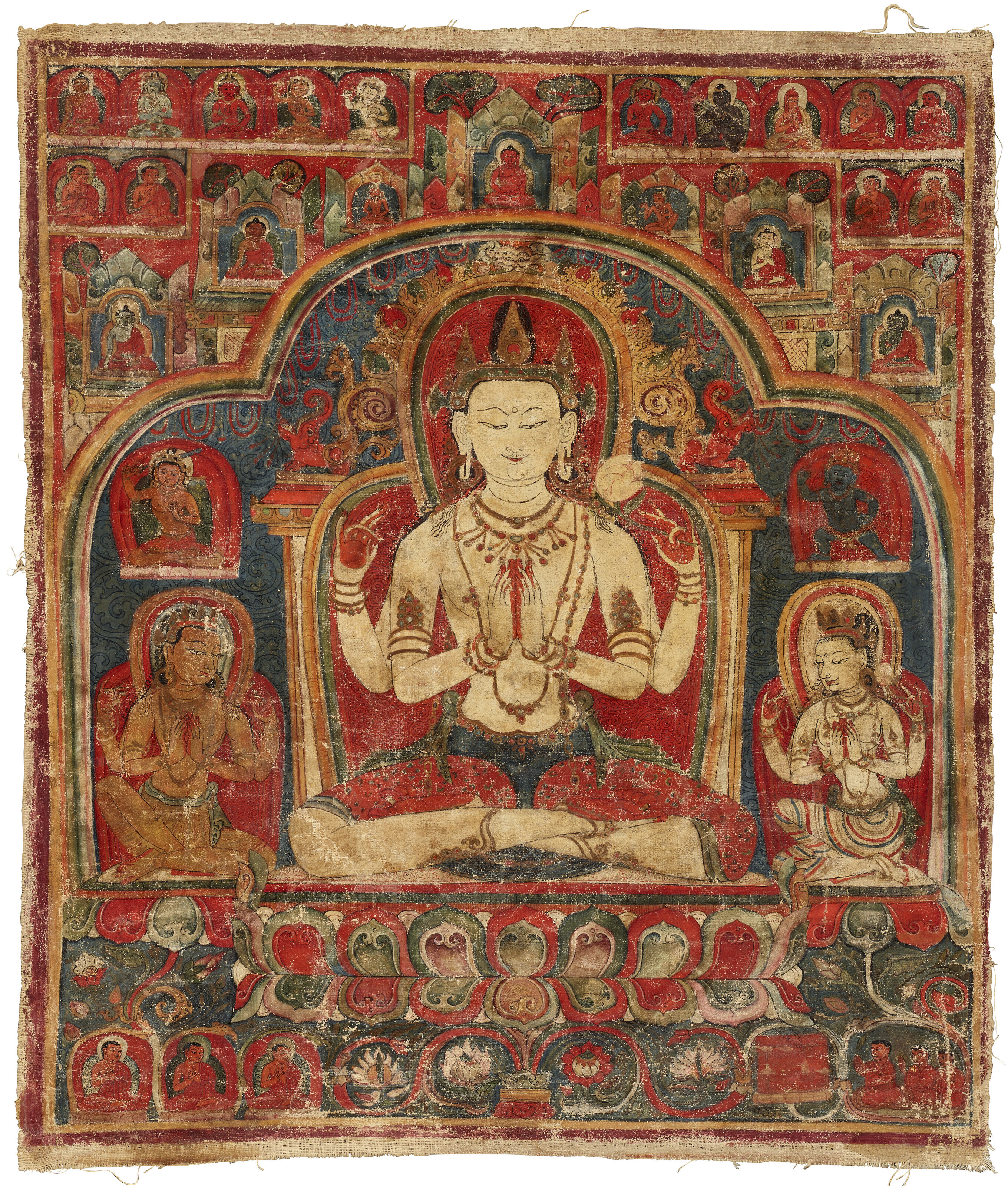
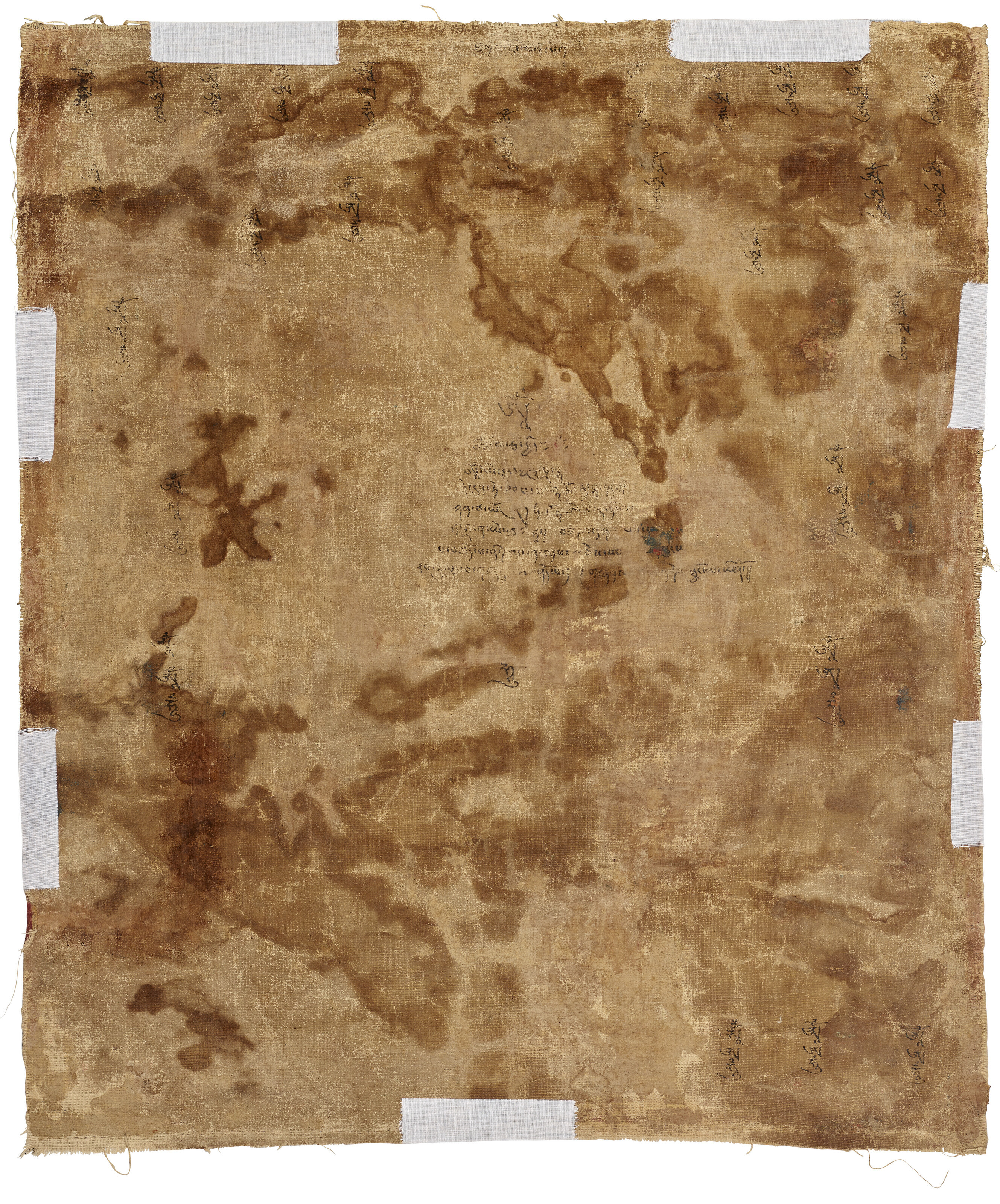 A RARE PAINTING OF SHADAKSHARI LOKESHVARA
TIBET, 14TH CENTURY
著录:
D. Jackson, The Nepalese Legacy in Tibetan Painting, New York, 2010, p. 112, fig. 6.20.
Himalayan Art Resources, item no. 41209.
这件重要的十四世纪中叶绘画描绘的是六字大明观音——四臂化现的观音菩萨,体现大悲之本怀,与其六字真言“嗡嘛呢叭咪吽”相应。画面中央,六字大明观音四臂中的主臂双手于胸前合十作礼敬印。第二左手持白莲花茎,第二右手持念珠。
画面左侧(主尊右手侧)为黄色四臂男相眷属宝手菩萨,其双手持物与主尊相同,第一双手之间捧一隐秘宝珠。画面右侧为持物相同的女相六字大明尊,有时被视为六字大明观音之佛母。二胁侍均转身微微朝向观音,以示礼敬。本画的风格、图像配置及胁侍菩萨的姿态,与夏鲁寺“见热息拉康”中的六字大明观音壁画高度相似,见喜马拉雅艺术资源网(Himalayan Art Resources)编号57021-57023。
本画的图像谱系源自印度佛教大师阿底峡·吉祥燃灯智——此师为十一世纪佛教从印度次大陆传入西藏之关键人物,亦是藏传佛教噶当派的重要祖师。六字大明观音的成就法收录于阿底峡所集的三十三部密续法门中,即世所称“那塘百法”。本画中,六字大明观音的传承谱系以横栏形式从左至右呈现:始自释迦牟尼佛与金刚持,向右延展,包括帝洛巴和阿底峡等。其下一层起首为堆敦·贡噶坚赞(十四世纪早期至中期重要人物),其后为噶当派其余传承上师。左下角绘有三位上师坐于蔓草纹中。右下角绘三位在家供养人,可能为一父二子,呈跪姿,双手合掌作祈请状,面向观音。其前供奉食物、净水与香,置于一红色供台之上,台下为橙色莲座。
在六字大明观音双肩两侧为文殊菩萨与金刚手菩萨。其左侧(画面中主尊的右手侧)为阿罗波迦那文殊——智慧菩萨,坐于莲台之上,右手高举智慧剑,左肩侧持莲花茎,上托经函。主尊右侧(画面中主尊的左手侧)为金刚手菩萨,呈弓箭步站立,右手持金刚杵,左手持铃。观音、文殊、金刚手分别代表悲、智、力,是为佛道上进趣之根本功德,三者合称“三怙主”(世界三尊)。
此画是标志着西藏绘画转型期的重要作品——此时期旧的帕拉-犀那(Pala-Sena)风格正被新的“贝利”(Beri)或尼瓦尔(Newari)风格所取代。“贝利”风格是一种经典的印度风格,盛行于尼泊尔,与东印度帕拉风格有近缘关系。据David Jackson研究,在帕拉风格消亡后,从1360年代至1450年代约一个世纪的时间里,这种风格成为西藏的普遍绘画风格。与早期帕拉风格相比,“贝利”风格采用更多的蔓草纹作为装饰元素,填充于背光或背景色块之中。这些蔓草纹往往极其精细,乍看之下近乎平涂。
虽然此画采用尼瓦尔风格,但早期帕拉风格的影响依然存在。具体而言,五方佛与诸仙人坐于其中的崎岖山岩元素,以及风格化的树木,均显露出鲜明的帕拉影响。此外,画面下方区域使用的靛蓝色背景,以及由莲花茎蔓形成的旋绕蔓草纹,皆为帕拉风格的特征。与本画可作对比的是一件图像极为相近的六字大明观音绘画,见David Jackson著《The Nepalese Legacy in Tibetan Painting》,纽约,2010年,第110页,图6.19。
This important painting from the mid-fourteenth century depicts Shadakshari Lokeshvara, the four-armed manifestation of the bodhisattva of supreme compassion embodying his famed six-syllable mantra “Om mani padme hum.” In the center of the composition, Shadakshari Lokeshvara joins two of his four hands together before him in a gesture of reverence. With his second left hand, he grasps the stem of a white lotus, and with his second right hand, he holds up a rosary.
At the main figure’s proper right at the left of the composition is the male accompanying figure Manidhara, who also has four arms and is yellow in color. He holds his hands in the same position as Shadakshari Lokeshvara and holds a hidden jewel between his first pair of hands. To the right of the composition, the goddess Shadakshari is depicted with the same attributes as the central figure. Occasionally, she is recognized as the consort of Shadakshari Lokeshvara. The two accompanying figures turn partially towards Lokeshvara in a gesture of reverence and respect. The style, iconography and the figural position of the accompanying deities in the present painting are closely related to a mural of Shadakshari Lokeshvara in “Chenrezig Lhakhang” of Shalu Monastery, illustrated on Himalayan Art Resources, item nos. 57021-57023.
The iconographic program of the present painting originates from the Indian Buddhist master Atisha Dipamkara Shrijnana, an instrumental figure in the spread of Buddhism from the Indian subcontinent to Tibet during the eleventh century and a key figure in the Kadam lineage of Tibetan Buddhism. The sadhana or practice manual for Shadakshari Lokeshvara is found within Atisha’s collection of thirty-three tantric lineages, more commonly known as the “Hundred Sadhanas of Narthang.” In the present painting, the transmission lineage of Shadakshari Lokeshvara is depicted in horizontal registers from left to right – beginning with Shakyamuni and Vajradhara, and extending towards the right, including Tilopa and Atisha. The subsequent tier starts with Droton Kunga Gyaltshen, a prominent figure in the early to mid-fourteenth century, followed by additional lineage masters of the Kadam school. The lower left corner depicts three additional gurus seated within vegetal scrolls. The lower right corner depicts three lay patrons, potentially a father and his two sons. They are rendered in a kneeling position, their hands clasped in a gesture of supplication, directed towards Lokeshvara. Before them, offerings of food, water, and incense are placed, framed by a red shrine resting on an orange lotus.
On the two sides of Shadakshari Lokeshvara's shoulders are Manjushri and Vajrapani. To his proper left, Arapacana Manjushri, the bodhisattva of wisdom is seated atop a lotus. He brandishes the sword of wisdom in his right hand and holds the stem of a lotus on which a book rests above his left shoulder. On Lokeshvara's proper left, Vajrapani stands in the archer’s stride, holding a vajra in his right hand and a bell in his left. Avalokiteshvara, Manjushri, and Vajrapani epitomize compassion, wisdom, and power respectively, fundamental qualities for advancing along the Buddhist spiritual path. Together, they are known as “The Three Lords of the World.”
The present work is a cornerstone that marks a transitional period in Tibetan painting, a time when the older Pala-Sena style is being replaced by the more modern Beri or Newari style. The Beri was a classic Indic style that flourished in Nepal and was adjacently related to the Eastern-Indian Pala style. According to David Jackson, it became the universal painting style of Tibet for about a century, from the 1360s to 1450s, following the demise of the Pala style. Compared to the earlier Pala style, the Beri style employed more vegetal scrollwork as decorative elements to fill nimbuses or color fields in the background of paintings. The scrollwork is often so fine that it seems at first glance to be painted with a solid coat of color.
While the artwork is executed in the Newari style, echoes of earlier Pala influences persist. Specifically, the rugged mountainous elements within which the five primordial Buddhas and rishis are seated, along with the stylized trees, exhibit a distinct Pala influence. Additionally, the utilization of an indigo blue background in the lower section of the painting and the swirling scrollwork created by the lotus stem all bear the hallmark of the Pala style. Compare the present painting with a closely related and iconographically similar painting of Shadakshari Avalokiteshvara illustrated by David Jackson in The Nepalese Legacy in Tibetan Painting, New York, 2010, fig 6.19, p. 110.

